Clear Sky Science · en
Socioeconomic, demographic and geographic disparities in accessibility to food pantries in the united States
Why Getting to a Food Pantry Matters
For millions of Americans who struggle to put food on the table, a nearby food pantry can mean the difference between going hungry and getting a meal. This study looks across the entire United States to ask a simple but crucial question: where are food pantries located, and which communities can actually reach them? By combining national maps, census data, and travel times, the researchers uncover who benefits from this charitable safety net—and who is still left out.
Mapping a Hidden Safety Net
Food pantries are often tucked into church basements, community centers, or small nonprofits. Because there is no single master list, the team first had to build one. They pulled together 34,475 food pantry locations from online directories and Google Maps, then rigorously checked each entry using automated searches and human review. After validation, more than 31,000 locations were confirmed as active food pantries, forming one of the most complete national pictures of this system to date. They then matched each pantry to nearby neighborhoods, defined by small census areas called block groups, to see how far people would have to travel.
How the Study Measured Access
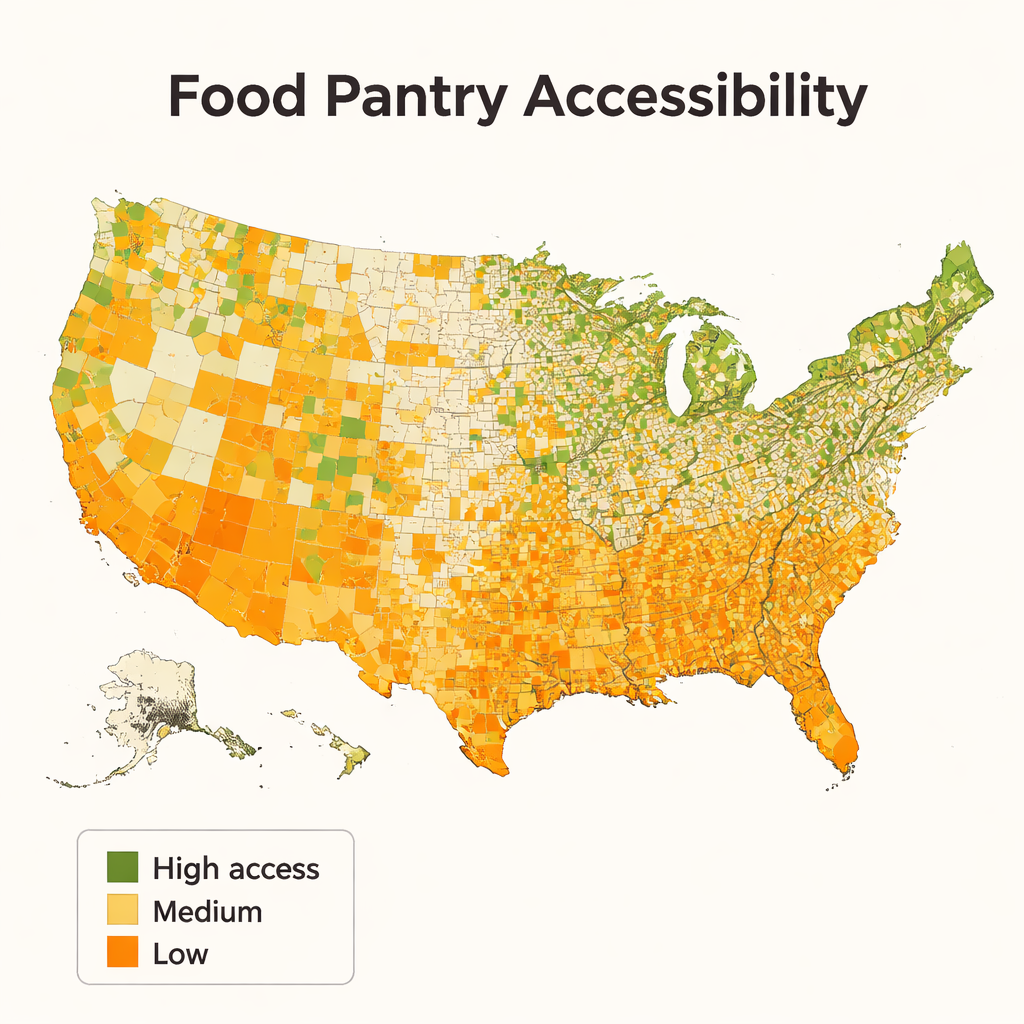
Access was defined in terms that match real life: how long it takes to get to the closest pantry. In cities and suburbs, the researchers focused on travel time by walking or public transit, reflecting how many low-income households actually move around. A neighborhood was labeled high access if residents could reach a pantry within 15 minutes on foot or 30 minutes by bus or train; medium and low access meant progressively longer trips or no realistic route at all. In rural areas, where public transit is scarce and driving is the norm, access was measured by miles on the road. There, high access meant a pantry within 10 miles, medium fell between 10 and 20 miles, and low access meant driving more than 20 miles or having no pantry within 25 miles.
Who Has a Pantry Nearby—and Who Doesn’t
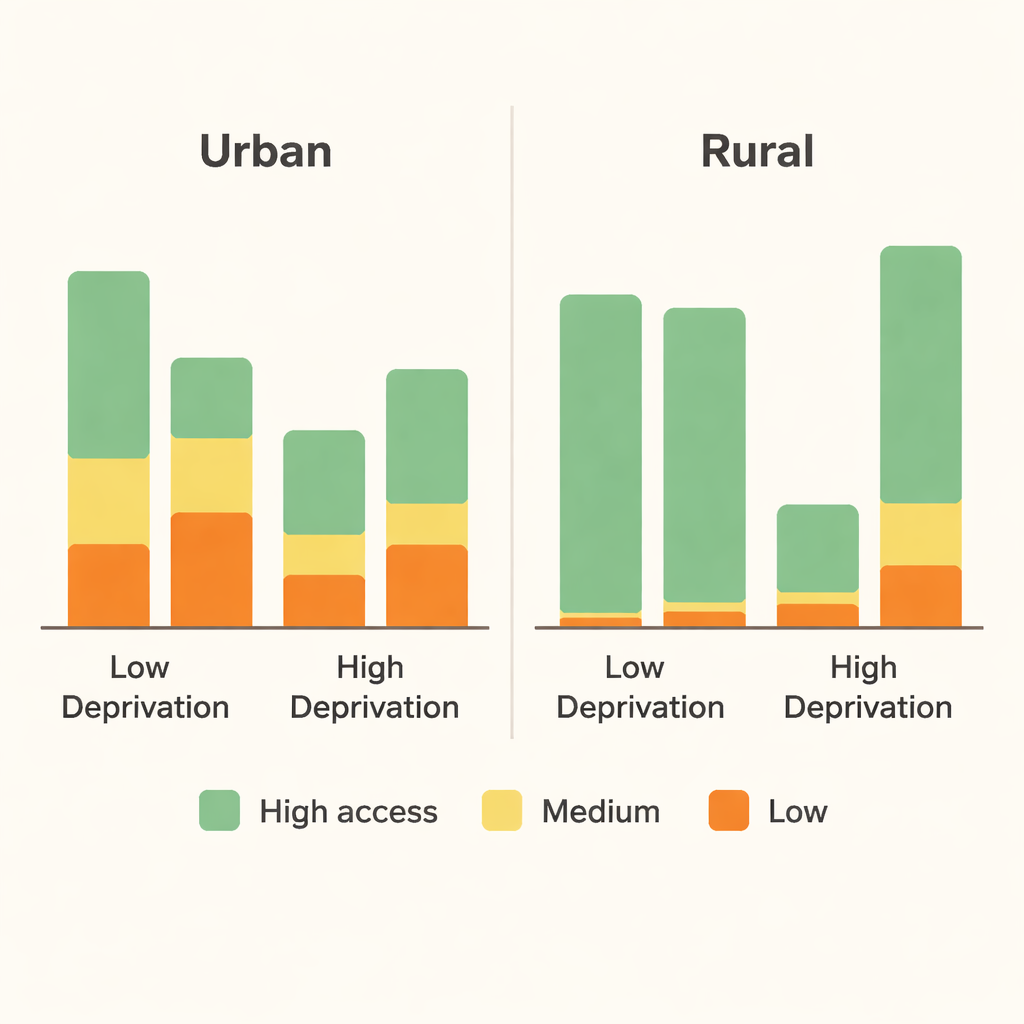
Across nearly 240,000 neighborhoods, about one in four had low access to a food pantry. The map of the country revealed strong regional patterns. States in the Northeast generally fared well, while many in the South and parts of the West had more communities with poor access. The picture also differed between city and countryside. Paradoxically, rural neighborhoods were, on average, more economically disadvantaged than urban ones—but they were more likely to have a pantry within a reasonable driving distance. Still, some rural areas with very high hardship scores had especially poor access, meaning some of the neediest communities face the longest trips.
How Need and Location Line Up
To see whether pantries tend to sit where they are most needed, the team linked access to local demographics and economic conditions. In cities, the alignment was fairly strong. Neighborhoods with better pantry access tended to have lower incomes, higher poverty, more residents using public assistance, and larger shares of Black and Hispanic residents—groups known to face higher food insecurity. In other words, urban pantries are often located in places where hunger risk is high. Rural America told a murkier story. While high-access rural neighborhoods were still generally poor, access was not as tightly tied to education, employment, or poverty levels. Some of the least educated rural areas and those with many people out of work actually had worse access, suggesting that where a pantry ends up may depend as much on geography, volunteers, and buildings as on local need.
What This Means for Fighting Hunger
The study concludes that charitable food systems are doing a better job of reaching vulnerable communities in urban areas than in many rural ones, and that big regional gaps persist. Simply counting the number of pantries is not enough; what matters is how long it takes people to get there. For policymakers and local leaders, the findings point toward targeted solutions: adding or moving pantries in high-need, low-access regions such as parts of the South and remote Western states; using mobile pantries or transportation support in far-flung rural areas; and ensuring that nearby pantries are reliably open and stocked. Ultimately, while food pantries play a vital role in easing hunger, the authors argue that lasting progress will also require broader policies that tackle poverty and food insecurity at their roots.
Citation: Zhang, Y., Lee, M., Gibbons, J.B. et al. Socioeconomic, demographic and geographic disparities in accessibility to food pantries in the united States. Sci Rep 16, 6248 (2026). https://doi.org/10.1038/s41598-026-35784-z
Keywords: food insecurity, food pantries, rural communities, urban poverty, access to food