Clear Sky Science · en
Unveiling InTe for flexible thermoelectric applications with enhanced performance via Bi/Se co-doping and MnO₂ integration
Turning Body Heat into Usable Power
Every day, vast amounts of energy are lost as waste heat—from factory machinery, car engines, and even our own bodies. This study explores a new way to reclaim a tiny slice of that heat and turn it into electricity using thin, flexible strips that can be printed like newspaper ink. The researchers focus on a little-known material called indium telluride (InTe) and show how it can be engineered and printed to power future wearable gadgets and small wireless sensors without batteries.
A New Material for Flexible Power Strips
Most high‑performance heat‑to‑electricity materials work well only as hard, brittle blocks that are expensive to make and difficult to bend. That makes them poor candidates for smart clothing, skin‑mounted health patches, or flexible Internet‑of‑Things devices. InTe is different: it naturally blocks heat flow very well, which is good for thermoelectric performance, but on its own it conducts electricity poorly. The team’s central idea is to transform InTe into a printable "ink" and then carefully adjust its composition so it can be deposited onto thin plastic films, creating flexible thermoelectric generators that sit comfortably on curved surfaces.
From Powder to Printed Power Generator
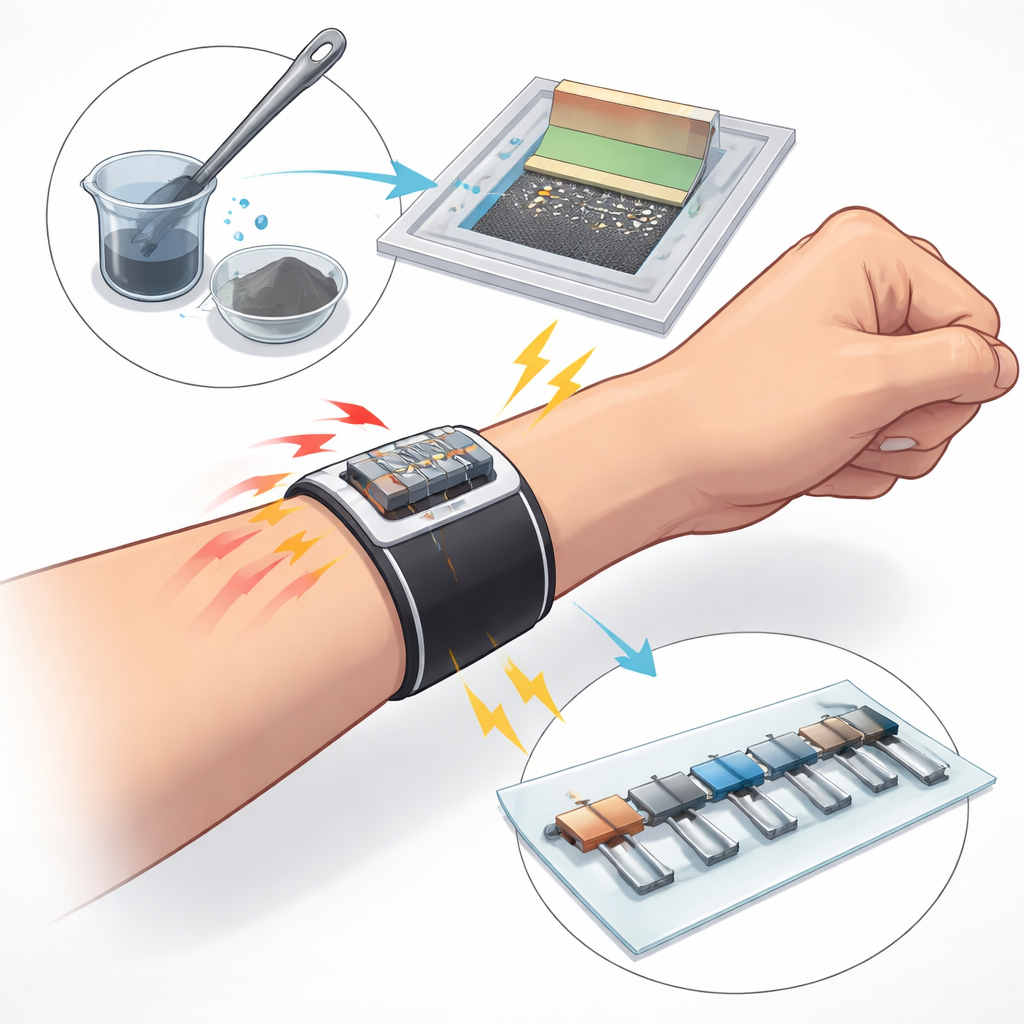
The researchers started with high‑purity powders of indium, tellurium, bismuth, and selenium. They first reacted these powders in sealed tubes at high temperature to form solid chunks of InTe and its doped variants. These chunks were then ground into fine particles and mixed with a liquid and polymer binder to make a thick ink. Using a standard screen‑printing process—similar to how graphics are printed on T‑shirts—they pushed this ink through patterned meshes onto clear plastic sheets. Repeating the print pass twelve times built up uniform films that formed the active "legs" of the thermoelectric generator, which were then connected with printed silver electrodes. The resulting devices were thin, lightweight strips, each containing eight tiny legs arranged in series to build up useful voltage from a temperature difference.
Fine-Tuning the Material from the Inside Out
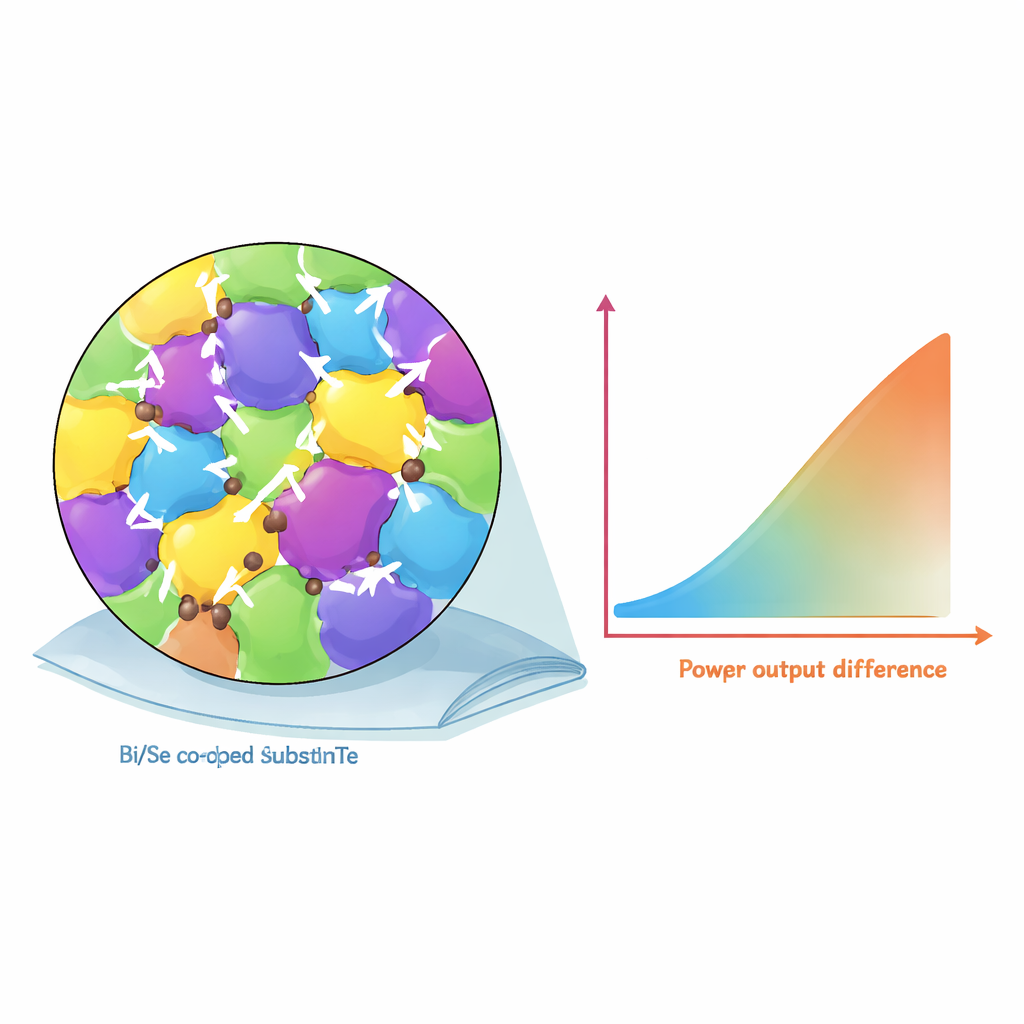
To get more power out of InTe, the team subtly changed its internal recipe by "co‑doping" it with bismuth (Bi) and selenium (Se). By replacing some of the indium atoms with larger bismuth atoms and a small part of tellurium with selenium, they altered the way charge carriers move through the material. X‑ray measurements showed that this treatment enlarged the crystal grains and reduced structural defects, while electron microscopy revealed that the printed films became denser and more continuous. Electrical tests confirmed the payoff: the best composition, labeled In₀.₉₄Bi₀.₀₆Te₀.₉₇Se₀.₀₃, showed both more mobile charge carriers and a much higher voltage generated per degree of temperature difference, a quantity known as the Seebeck coefficient. At a 100‑degree temperature difference, this optimized film produced about 195 millivolts and roughly 29.45 nanowatts of power—almost 30 times more than undoped InTe.
Boosting Performance with a Smart Junction
Even with improved InTe, the team saw another opportunity: adding a second material to create tiny internal junctions that guide current more efficiently. They blended in manganese dioxide (MnO₂), which behaves as an n‑type conductor, opposite in polarity to the p‑type InTe. Where these two materials meet, p–n junctions form, which act like built‑in ramps for separating and directing charge carriers. This composite version of the device had a lower voltage than the best co‑doped sample but a much smaller internal resistance, meaning current could flow more easily. As a result, the mixed In₀.₉₄Bi₀.₀₆Te₀.₉₇Se₀.₀₃/MnO₂ device delivered about 48.41 nanowatts at the same 100‑degree temperature difference—around 1.6 times higher power, thanks to better conduction pathways across the film.
Ready to Bend, Flex, and Keep Working
For real‑world wearables, softness and durability can be as important as electrical performance. The printed devices were therefore bent repeatedly to see whether they would crack or lose function. When flexed to angles up to 120 degrees and cycled 500 times, their electrical resistance changed by only about 2 percent, indicating that the films remained well attached to the plastic and that their internal structure stayed intact. Although the absolute power levels are still in the nanowatt range and not yet ready to power power‑hungry gadgets, they compare well with other early flexible thermoelectric devices in the scientific literature.
What This Means for Everyday Technology
In simple terms, this work shows that a relatively obscure material, InTe, can be turned into a low‑cost printable ink for flexible heat‑harvesting strips. By carefully adjusting its atomic makeup with bismuth and selenium, and then adding MnO₂ to create smart internal junctions, the researchers dramatically improved how efficiently these strips convert temperature differences into electricity—without sacrificing bendability. As the inks and device designs are further refined, similar printed thermoelectric films could one day be woven into clothing, wrapped around pipes, or attached to machinery and the human body to scavenge small but continuous amounts of power from wasted heat.
Citation: Shankar, M., Prabhu, A. & Nayak, R. Unveiling InTe for flexible thermoelectric applications with enhanced performance via Bi/Se co-doping and MnO₂ integration. Sci Rep 16, 5597 (2026). https://doi.org/10.1038/s41598-026-35782-1
Keywords: flexible thermoelectrics, waste heat harvesting, printable electronics, wearable energy, indium telluride