Clear Sky Science · en
Association between fetal eye movement density and developmental problems at age 3 years
Before Birth, the Brain Is Already Practicing
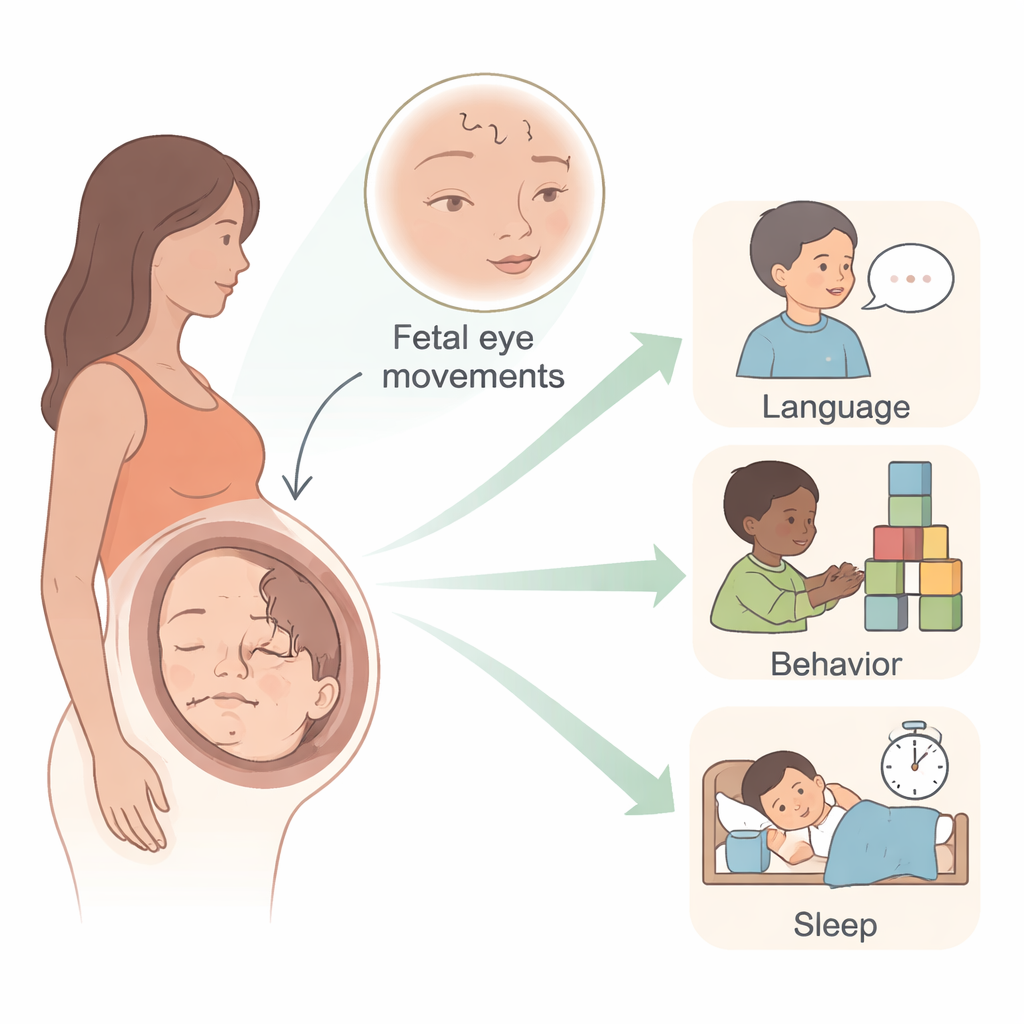
Expectant parents often wonder what their baby is doing inside the womb. Beyond kicking and stretching, a fetus is also moving its eyes during sleep-like states. This study suggests that how often those tiny eyes move before birth may offer an early clue about a child’s later language skills, behavior, and sleep patterns at age three.
Tiny Eye Movements as an Early Signal
Using ultrasound, researchers in Japan recorded fetuses’ eye movements for an hour when mothers were 34 to 36 weeks pregnant. They calculated “eye movement density,” meaning how many eye movements occurred per minute during active periods. These active periods are thought to be an early form of the rapid eye movement, or REM, sleep that becomes familiar later in life. REM sleep is known to be important for brain plasticity and learning in infants, and earlier studies have linked reduced REM activity in newborns to later developmental difficulties.
Following Children into the Preschool Years
Out of 77 pregnant women originally recruited, 41 children had complete data by age three and formed the main group for analysis. When these children turned three, caregivers completed two standardized questionnaires. One, the Kinder Infant Development Scale, covered everyday abilities such as movement, play, understanding and using words, and getting along with others. The other, the Social Responsiveness Scale-2, measured traits related to autism, including social communication and repetitive or rigid behaviors. Parents also provided information about their child’s sleep at 6 months, 1 year, and 3 years, including bedtime, how long the child slept at night, and how often they woke up.
Links to Language, Behavior, and Sleep
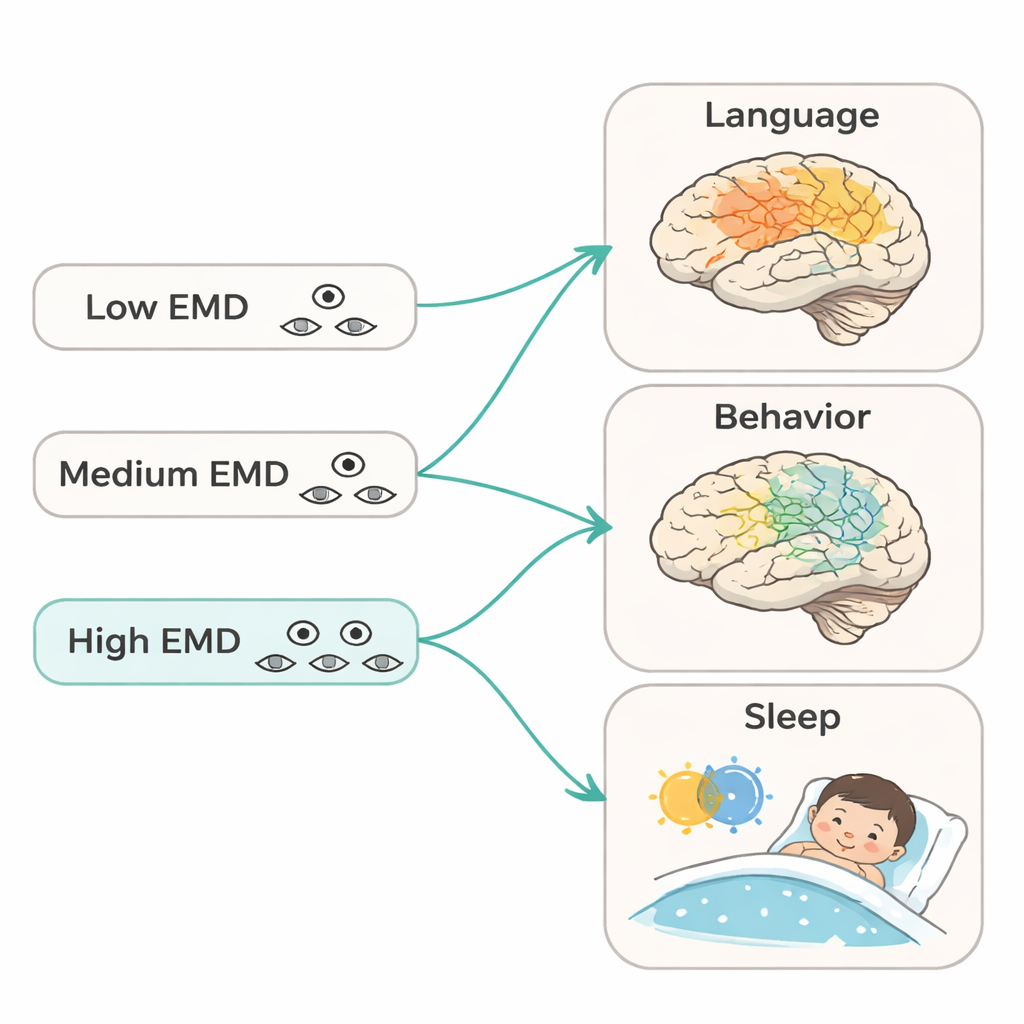
Children who had higher fetal eye movement density tended to show stronger language abilities at age three. They were better at understanding spoken words and following instructions (receptive language) and at using words and sentences to express themselves (expressive language). In contrast, lower fetal eye movement density was tied to more restricted and repetitive behaviors—such as rigid routines or repeated actions—which are core features of autism-related traits. Children with lower prenatal eye movement activity were also more likely to have scores in the range that signals clinically significant repetitive behavior. In terms of sleep, babies with lower fetal eye movement density were more likely to have a later bedtime at age one, suggesting a delay in settling into an earlier nighttime routine, although links to total sleep time and night awakenings were less consistent.
What May Be Happening Inside the Growing Brain
The authors argue that frequent fetal eye movements reflect active, REM-like sleep that helps organize developing brain circuits. REM sleep in early life is thought to fine-tune networks connecting the brainstem, deep emotional and movement regions, and the frontal areas that support attention, self-control, and flexible behavior. If this REM-like activity is reduced before birth, those networks may mature differently, contributing to later language delays, behavioral rigidity, and sleep regulation problems. The findings fit with animal research showing that sleep-related brain rhythms guide the wiring of sensorimotor and memory systems, and with human studies linking infant sleep patterns to later language and social development.
Why This Matters for Parents and Clinicians
This study, though modest in size and based on questionnaires, is the first to follow fetal eye movement patterns all the way to age three. It suggests that simple, noninvasive ultrasound measures late in pregnancy might someday help identify children at higher risk for developmental and behavioral challenges well before symptoms appear. While fetal eye movement density is not ready to be used as a screening test on its own, it offers a window into how sleep-related brain activity before birth may shape later language, behavior, and sleep, and highlights the potential value of looking earlier in life—perhaps even in the womb—when thinking about support and intervention.
Citation: Shimada, Y., Morokuma, S., Nakahara, K. et al. Association between fetal eye movement density and developmental problems at age 3 years. Sci Rep 16, 5588 (2026). https://doi.org/10.1038/s41598-026-35780-3
Keywords: fetal development, REM sleep, language development, autism traits, infant sleep