Clear Sky Science · en
Exploring associations of three evaluative subjective wellbeing measures (Cantril’s ladder, life satisfaction, happiness) with 15 childhood and demographic factors across 22 countries
Why How We Feel About Life Matters
Governments and researchers are increasingly interested in more than just economic growth; they also want to know how people feel about their lives. This study asks a deceptively simple question: what shapes our sense that life is going well? Drawing on answers from over 200,000 adults in 22 countries, the researchers compare three common ways of asking people to rate their lives and examine how these scores are linked to childhood experiences and adult circumstances. The results offer a global snapshot of what supports or undermines a fulfilling life—and show that the picture is far from the same everywhere.
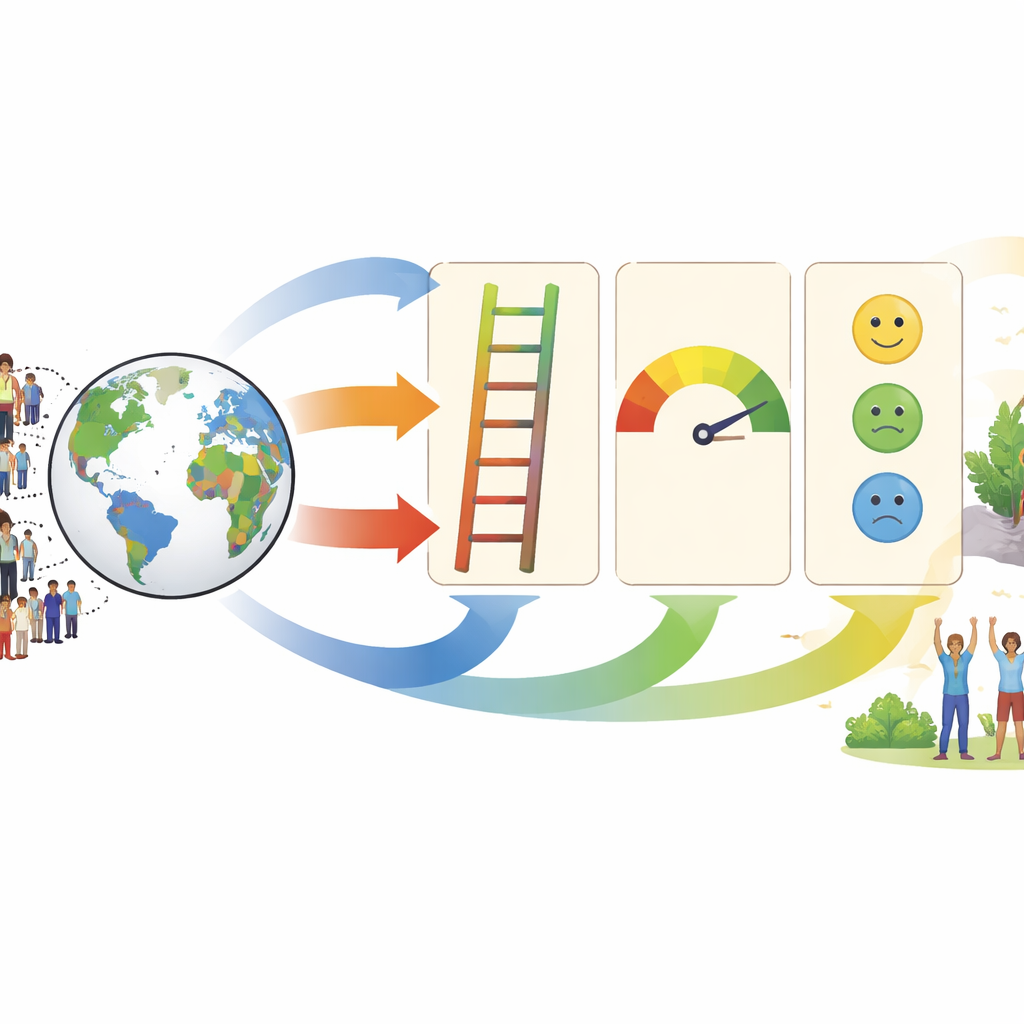
Three Different Ways to Ask “How Is Your Life Going?”
The study focuses on the “evaluative” side of wellbeing: how people judge their lives overall, rather than how they feel moment to moment. It compares three single questions that are widely used in surveys. One is “Cantril’s ladder,” which asks people to imagine a ladder from worst to best possible life and pick a step. A second asks how satisfied they are with life as a whole. A third asks how happy they usually feel. Although these questions sound similar, they do not capture exactly the same thing. By linking each one to a broader 12-item index of “flourishing” that covers health, relationships, purpose, character, and financial security, the authors find that life satisfaction and usual happiness track overall flourishing more closely than the ladder question, and that the ladder seems especially sensitive to material security and national income.
Early Life Leaves a Long Shadow
Because the survey also asked adults to look back on their childhoods, the researchers could see how early experiences relate to later life evaluations. People who reported excellent health as children, comfortable family finances, warm relationships with their mother and father, regular participation in religious or spiritual gatherings, and no experiences of physical or sexual abuse tended to rate their adult lives more positively on all three measures. By contrast, those who grew up in very difficult financial circumstances, had poor health, felt like outsiders in their own family, or experienced abuse scored lower. These links remained even after taking many other factors into account, suggesting that the conditions in which children grow up can tilt the odds for how they will judge their lives decades later.
Adult Circumstances Still Make a Difference
Childhood is not destiny, however. Adult demographic factors also showed clear connections to how people viewed their lives. On average across the 22 countries, people who were retired, married, better educated, and regularly attended religious services scored higher on all three wellbeing questions than those who were unemployed and looking for work, separated from a partner, or had little schooling. Life evaluations tended to dip in midlife, especially in the 40s, and then rise again in older age, forming more of a “J-shape” than the classic “U.” Women reported slightly higher scores than men, and those still living in their country of birth tended to feel a bit better about life than migrants, though this gap was small. These patterns highlight groups—such as job seekers in midlife—who may be at particular risk of lower wellbeing.
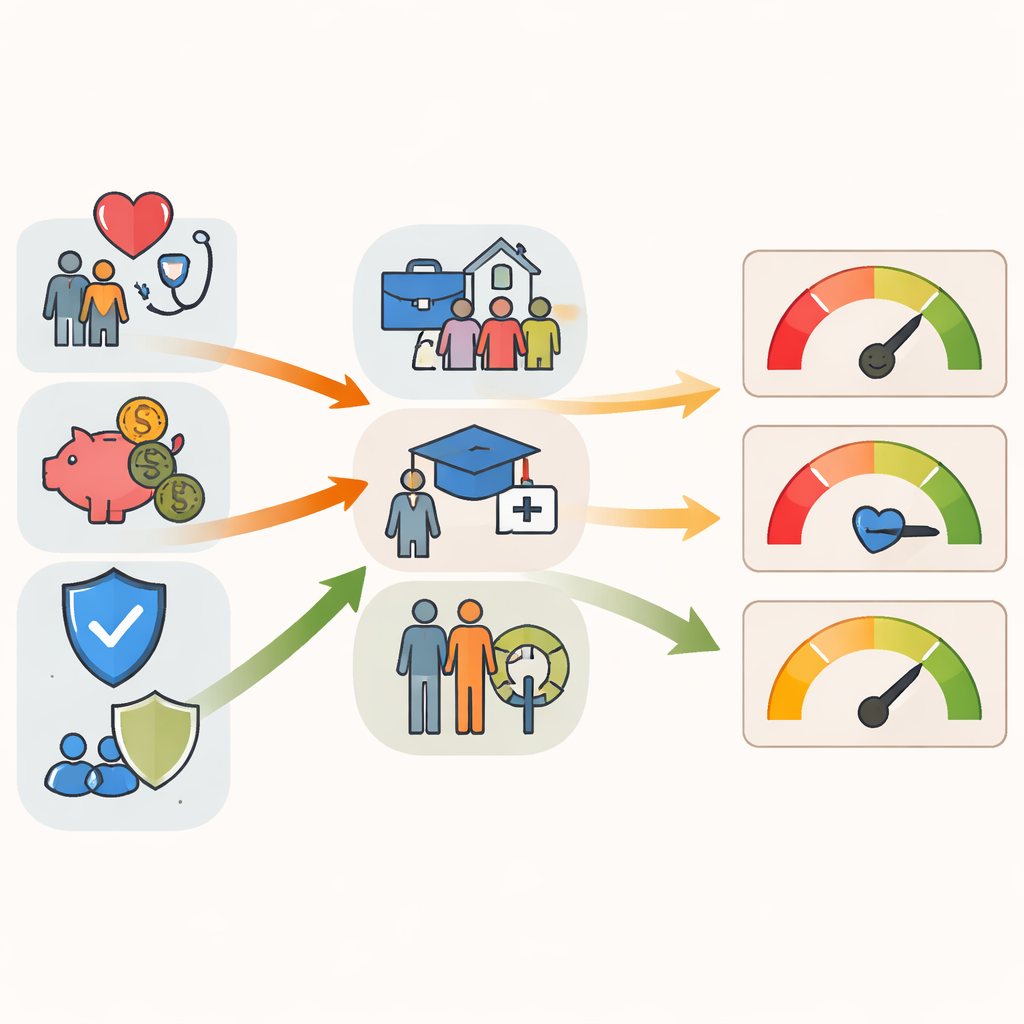
Different Countries, Different Stories
Because the Global Flourishing Study was designed as 22 parallel national studies, the authors could look closely at how these patterns change from place to place. Some countries with high incomes and relatively equal societies, such as Sweden, scored very well on the ladder question but only moderately on life satisfaction and happiness. Others, such as Indonesia and Mexico, had more modest ladder scores but very high life satisfaction and happiness, driven by strengths in areas like social relationships, community engagement, and meaning in life. The strength of links between childhood hardship, adult circumstances, and life evaluations also varied substantially across countries. This suggests that while certain factors—good health, financial stability, close family bonds—tend to support better lives, their impact depends heavily on local culture, institutions, and history.
What This Means for Improving Lives
For policy makers and organizations trying to improve wellbeing, this study offers three main lessons in plain terms. First, how you ask people about their lives matters: a simple life satisfaction question appears to be the single best overall gauge, with the happiness and ladder questions adding useful nuance. Second, both early-life conditions and adult circumstances shape how people judge their lives, highlighting the value of investing in children’s health and safety while also supporting adults through secure work, education, and social connection. Third, there is no single global formula; the same factor can matter more in one country than another. Together, these findings argue for using good measures of life evaluation, paying special attention to people facing multiple disadvantages, and tailoring efforts to the social realities of each place.
Citation: Lomas, T., Koga, H.K., Padgett, R.N. et al. Exploring associations of three evaluative subjective wellbeing measures (Cantril’s ladder, life satisfaction, happiness) with 15 childhood and demographic factors across 22 countries. Sci Rep 16, 8025 (2026). https://doi.org/10.1038/s41598-026-35777-y
Keywords: subjective wellbeing, life satisfaction, childhood experiences, cross-national study, human flourishing