Clear Sky Science · en
Dose-dependent effects of camel milk on immune function and metabolic health in weaning rats
Why milk choices after breastfeeding matter
As babies grow past six months, breast milk alone can no longer cover all their nutritional needs. Around the world, many families are exploring alternatives such as cow, goat, or camel milk. Camel milk, long valued in desert communities, has recently gained attention for its rich mix of vitamins, minerals, and immune‑active components. This study asked a practical question with big implications: if camel milk is used to support young children during weaning, how much is helpful—and at what point might it start to strain the body?
What makes camel milk special
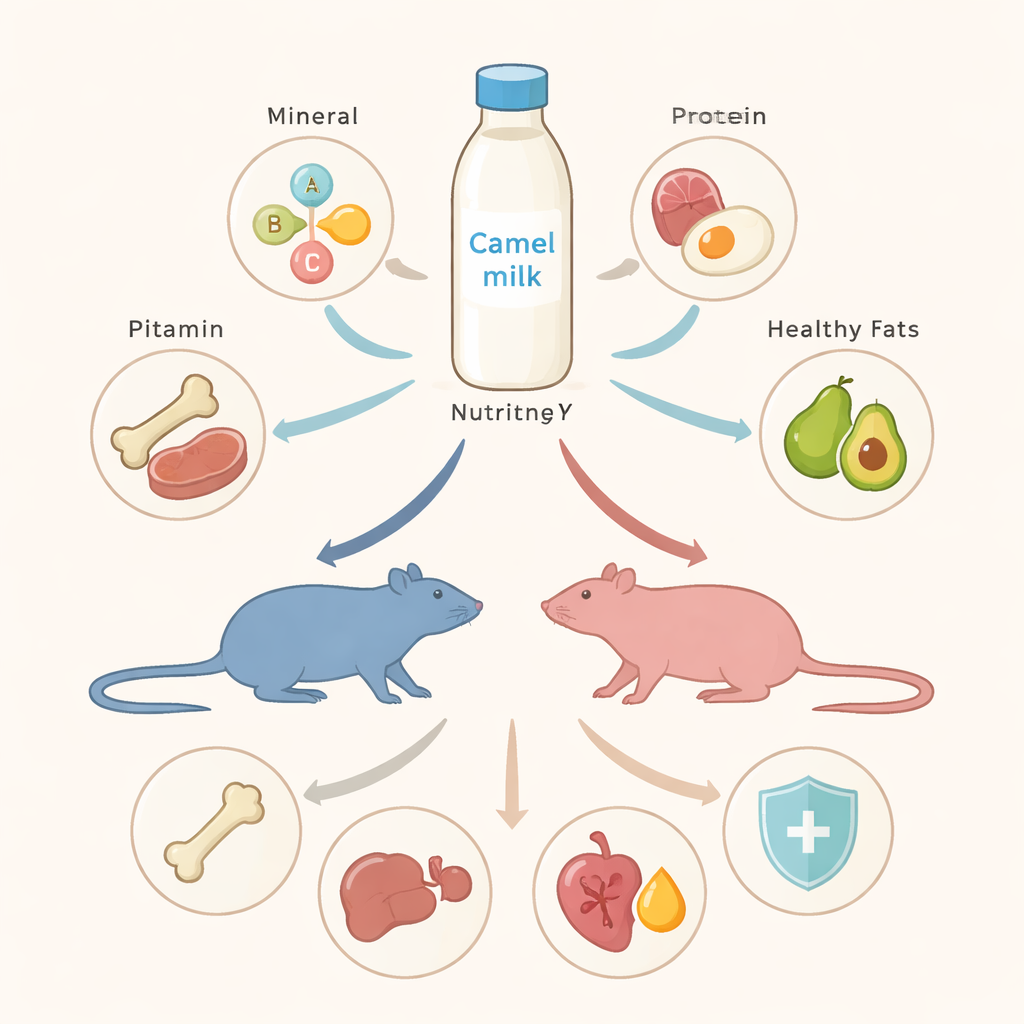
The researchers began by carefully dissecting what is actually in camel milk. They found it is mostly water but carries notable amounts of protein, fat, and natural milk sugar, alongside a dense supply of calcium, phosphorus, potassium, and sodium—minerals central to building bones and regulating fluids. Camel milk contained both water‑soluble vitamins, like vitamin C and several B vitamins, and fat‑soluble vitamins A, D, and E. Its proteins supplied all essential amino acids, and its fats included a mix of saturated and unsaturated fatty acids, with a pattern closer to human milk than to typical cow’s milk. Together, this profile helps explain why camel milk has been linked to benefits for bone strength, metabolism, and immune function.
How the study was done in young rats
To mimic the weaning period in humans, the team worked with young male and female rats at an age comparable to a toddler of about 19 months. Over six weeks, animals received one of four daily camel milk doses or no camel milk at all. One dose—3.4 milliliters per rat—was chosen to match the World Health Organization’s recommendation of roughly 473 milliliters (about two cups) of milk per day for a child. Below and above this level, the scientists tested smaller and larger amounts to map out a full dose–response curve. They tracked growth and body weight, analyzed blood for markers of bone building, liver and kidney workload, and blood fats, and challenged the rats’ immune systems using sheep red blood cells to see how inflammation and antibody production changed.
Benefits for bones and a calmer immune system
Camel milk clearly boosted markers linked to bone health. The “optimal” 3.4‑milliliter dose raised blood calcium, phosphorus, and vitamin D metabolites, which work together to mineralize the skeleton. Higher doses continued to improve these bone‑related indicators, especially in females, suggesting camel milk could be particularly helpful where rickets, stunting, or poor bone density are concerns. On the immune side, camel milk dampened inflammatory signals—key messenger molecules that normally surge after an immune challenge—and toned down early antibody responses. This calming effect was stronger in females, reflecting known sex differences in immune reactivity. In simple terms, camel milk seemed to help the body respond to a challenge without overreacting.
Hidden costs at high intakes
The story changed, however, at the highest camel milk doses. While no animals died or showed obvious sickness, rats receiving large amounts developed biochemical signs that their livers and kidneys were working harder. Enzymes that leak from stressed liver cells rose sharply, and waste products filtered by the kidneys climbed, particularly in males. Blood fat levels also shifted in an unhealthy direction as doses increased, with higher cholesterol and triglycerides and a pattern associated with greater cardiovascular risk. Tissue examinations under the microscope confirmed liver cell injury at high doses and subtle signs of strain in the spleen, the immune organ that helps filter blood and manage immune cells.
What this means for families considering camel milk
For lay readers, the takeaway is straightforward: camel milk is nutritionally rich and, at the right amount, may support stronger bones and a more balanced immune response in the weaning period. In this animal model, a dose equivalent to about two cups per day for a toddler provided clear benefits without detectable harm, while substantially higher intakes began to overload the liver, kidneys, and fat metabolism. The findings caution against assuming that more is always better. Instead, they suggest camel milk is best viewed as a promising supplement that should be given in carefully considered amounts, ideally guided by future clinical studies in children rather than used freely in very large volumes.
Citation: Farid, A., Mohamed, M., Amr, M. et al. Dose-dependent effects of camel milk on immune function and metabolic health in weaning rats. Sci Rep 16, 4802 (2026). https://doi.org/10.1038/s41598-026-35775-0
Keywords: camel milk, weaning nutrition, infant health, immune function, bone health