Clear Sky Science · en
AI and AR based digital reconstruction of Liangshan Yi lacquerware
Ancient craft meets everyday technology
Imagine pointing your phone at an empty table and seeing a glowing, eagle‑clawed drinking cup from a remote mountain community appear in front of you. This study shows how tools behind smartphone filters and video games—artificial intelligence (AI) and augmented reality (AR)—can help protect a fragile living tradition: the richly patterned lacquerware of the Yi people in southwest China. By turning these handmade objects into scientifically accurate, interactive 3D models, the researchers aim to keep a threatened craft visible and relevant in modern life.
A living art on the edge
Liangshan Yi lacquerware is part of China’s national list of intangible cultural heritage, valued not just as decoration but as a vessel for history, belief, and identity. For more than a thousand years, Yi artisans have coated wooden bowls, cups, saddles, and ceremonial objects with layers of sap-based lacquer, then painted them in bold black, red, and yellow. The forms are tailored to daily life—sturdy dishes for food, tightly sealed wine flasks, portable cups for nomadic travel—while also carrying symbolic roles in weddings, sacrifices, and other rituals. Yet rapid modernization has thinned the ranks of skilled makers and left many people, even within China, unfamiliar with this art. The authors argue that new digital tools are urgently needed if this knowledge is to survive and be shared widely.
Decoding shape, pattern, and color
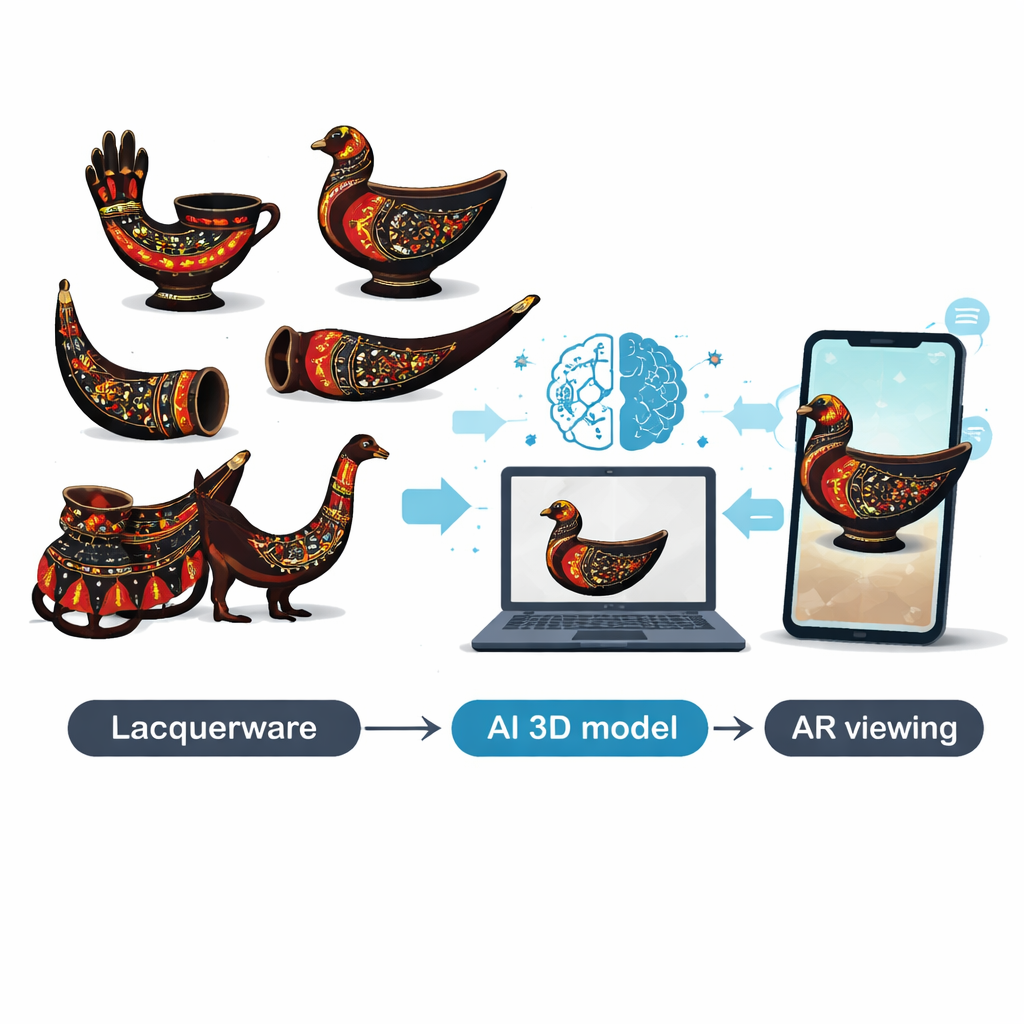
To build a faithful digital version, the team first had to understand what makes Yi lacquerware visually distinctive. Through field visits to master artisans, private collections, and local museums, they photographed objects and recorded oral histories. They then grouped what they saw into three key elements: form, pattern, and color. Forms range from practical spoons and bowls to animal‑shaped vessels like eagle claws and ox horns that embody strength, protection, and abundance. Patterns take inspiration from plants, animals, stars, water ripples, and everyday tools such as braids and ropes, arranged in spirals, radiating circles, and repeating bands. Color ties everything together: deep black backgrounds make bright reds and yellows pop, while each hue carries meaning—black for noble lineage, red for the sun and courage, yellow for fertility and harvest.
Proving the colors are real
Because any digital copy is only as trustworthy as the information behind it, the researchers went beyond photographs to study the materials themselves. Focusing on a representative lacquered wooden bowl, they carefully sampled black, red, and yellow areas and analyzed them with laboratory instruments that reveal chemical makeup and crystal structure. These tests confirmed that the coating is true natural lacquer, based on plant compounds called urushiols, and that the red and yellow tones come from traditional mineral pigments rich in mercury and arsenic, respectively. The pigments proved to be well preserved and structurally stable, even after long use. This scientific evidence gave the team confidence that the color values and surface qualities used in the digital models closely match the real objects, rather than being mere artistic guesses.
From tablet sketches to 3D objects in your hand
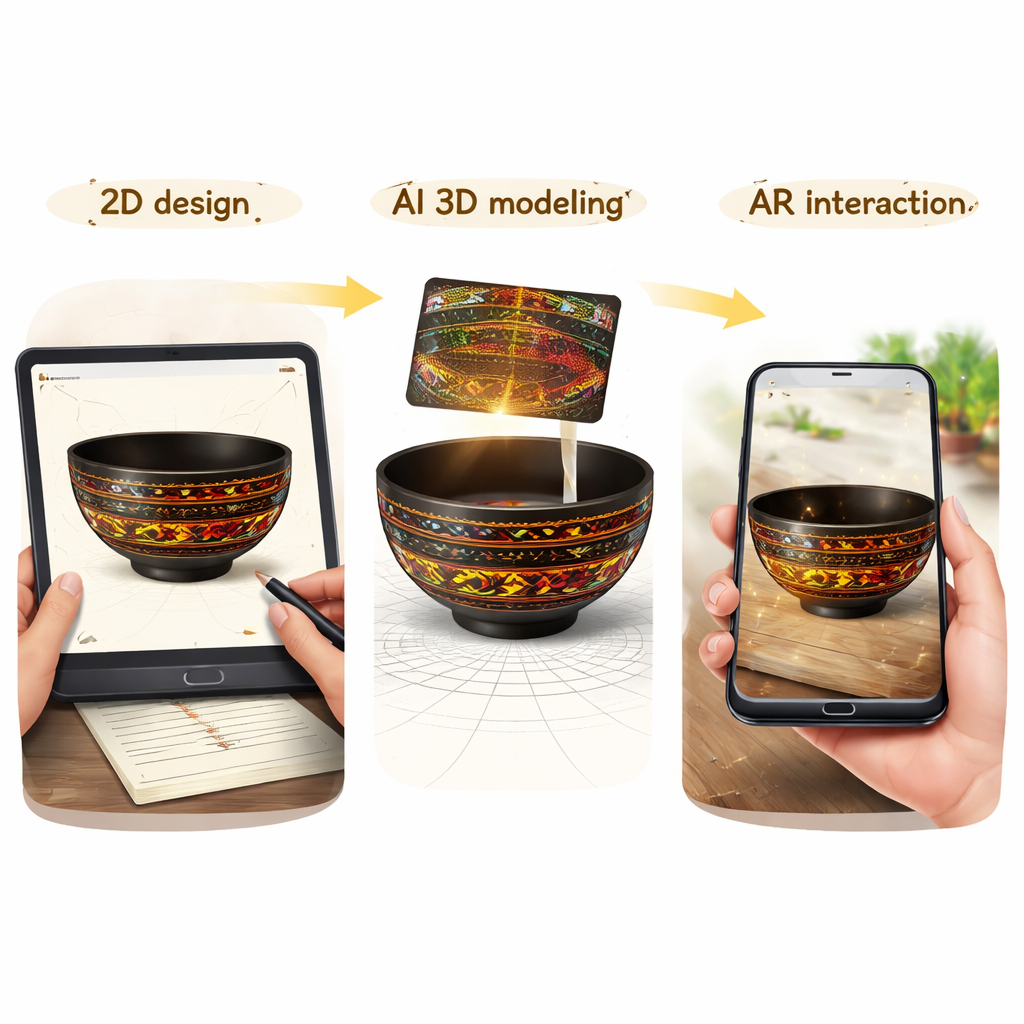
Armed with this visual and material knowledge, the team devised a low‑cost, three‑step digital workflow. First, they redrew five characteristic lacquerware types—such as the eagle’s claw bowl, pigeon‑shaped liquor vessel, and ox horn cup—on a tablet using illustration software, carefully applying the traditional patterns and the verified black‑red‑yellow palette. Second, they uploaded these 2D images to an AI platform that automatically generated 3D models, complete with curved geometry and surface textures adjusted to mimic the glossy yet warm feel of lacquered wood. Finally, they imported the models into a web‑based AR system, so that anyone with a smartphone or tablet could place, rotate, and scale the virtual objects in real space via a simple link or QR code. In tests with 80 art and design students and teachers, most rated the digital lacquerware as very good or perfect in capturing shape and color, though there is room to improve tiny pattern details.
Bringing a fragile tradition into the digital age
The authors conclude that their workflow offers a practical way to turn endangered crafts into accurate, interactive digital experiences without expensive equipment. For the Yi lacquerware tradition, this means that students, museum visitors, or travelers can explore intricate ceremonial objects up close, even if they never visit Liangshan or handle a fragile original. While the approach cannot replace living practice—or answer deeper questions about ritual meaning and community ownership—it can support teaching, tourism, conservation planning, and creative design inspired by traditional forms. In plain terms, the study shows that careful science plus accessible digital tools can help keep a small mountain community’s heritage alive on screens around the world, instead of letting it fade into obscurity.
Citation: Tang, X., Zhan, C., Tang, C. et al. AI and AR based digital reconstruction of Liangshan Yi lacquerware. Sci Rep 16, 5550 (2026). https://doi.org/10.1038/s41598-026-35772-3
Keywords: Yi lacquerware, digital heritage, augmented reality, traditional crafts, cultural preservation