Clear Sky Science · en
Dynamic global tracker for online multi camera multi vehicle tracking
Why Smarter Traffic Cameras Matter
Anyone who has been stuck in a traffic jam or worried about road accidents has felt the limits of today’s traffic systems. Modern cities now install networks of cameras along highways and at intersections to watch traffic in real time. But getting these cameras to work together—to follow the same car smoothly from one camera to the next—is surprisingly hard. This study introduces a new way to track vehicles across many cameras at once, promising faster, more reliable monitoring that could make roads safer and traffic management more responsive.
The Problem with Today’s Traffic Tracking
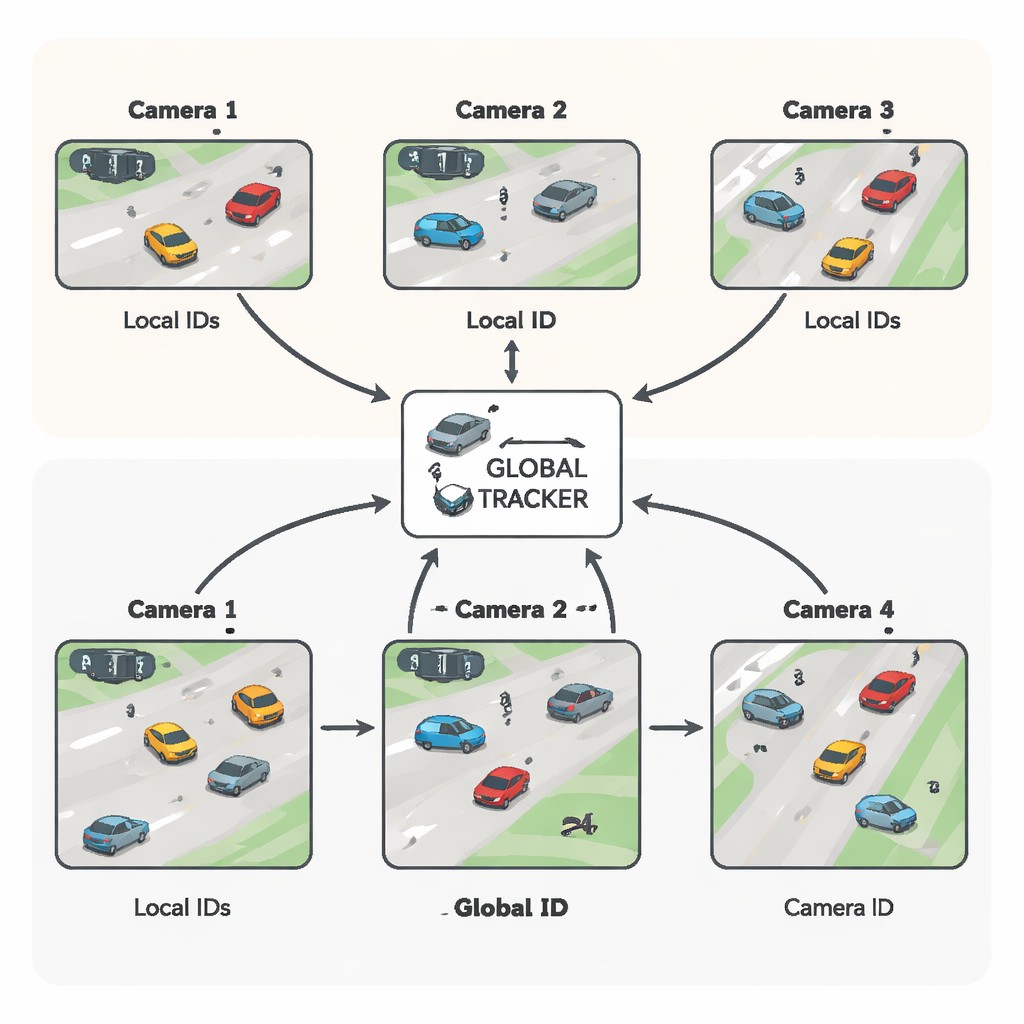
Traditional systems treat each camera almost like its own little world. First, they detect vehicles in each video, then build short paths for each car within a single camera’s view. Only after watching long stretches of recorded video do they try to “stitch” these paths together across cameras using heavy data clustering and hand-crafted rules about the road layout and camera positions. This offline, after-the-fact style is slow, consumes a lot of computing power, and struggles when traffic scenes change, cameras are moved, or new viewpoints are added. It also has trouble when cameras see vehicles at very different sizes and angles, which can make the same car look like two completely different ones.
A New Way: Track Everything in Real Time
The researchers propose a fresh framework called Dynamic Global Tracking, or DGT, that is designed from the ground up for real-time use. Instead of waiting until all the video is collected and then trying to link vehicle paths, DGT builds those links on the fly. Each camera still detects vehicles and builds short in-camera tracks, but as soon as these tracks are updated, they are immediately compared with tracks from other cameras. A classic matching algorithm is used to decide whether two tracks from different views belong to the same car. This online, step-by-step process replaces massive clustering over all past data, cutting down the computation and making it possible to keep up with live traffic.
Seeing the Same Car from Different Angles
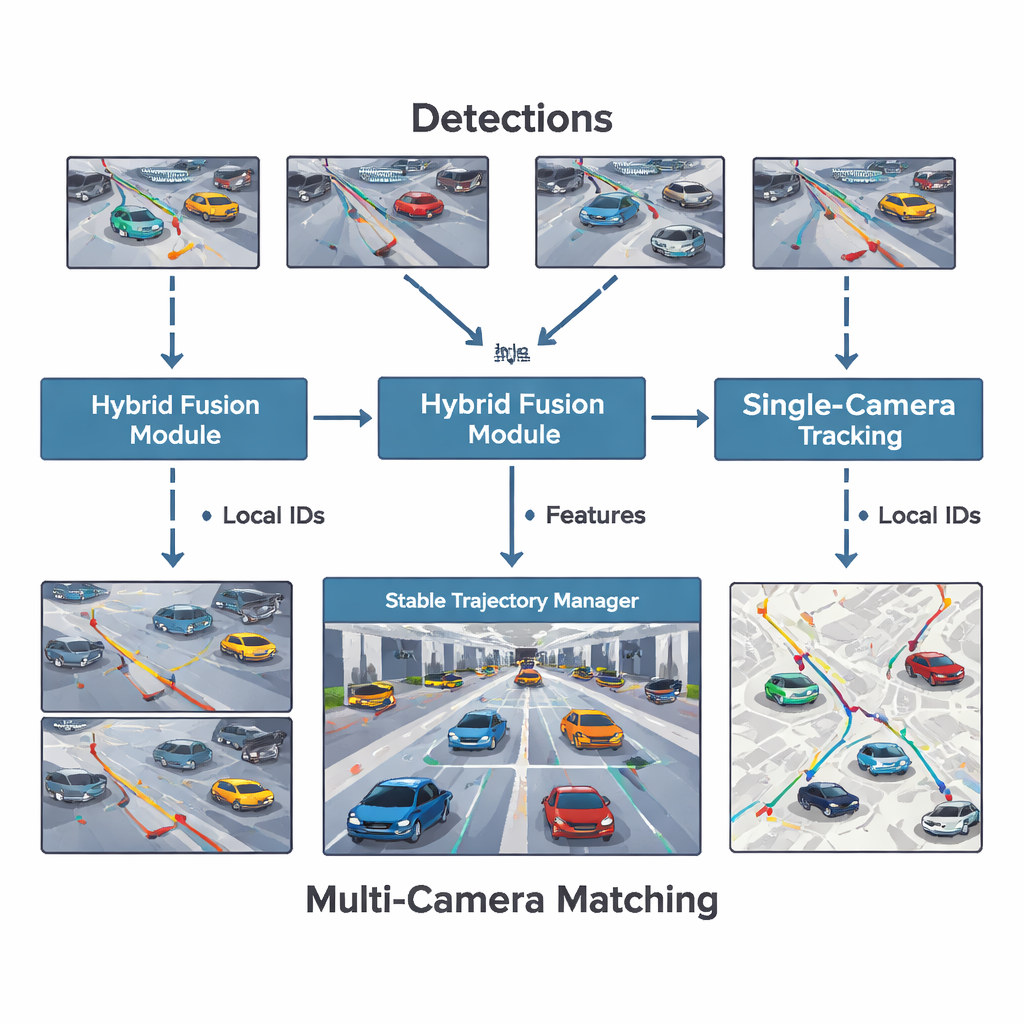
A major challenge is that the same vehicle may appear large and detailed in one camera and tiny and blurry in another, or lit differently in a tunnel versus an open road. To cope with this, DGT includes a Hybrid Fusion Module that blends fine details and broader context from each image. It processes the camera frames in two ways at once: one branch focuses on crisp, small-scale details like edges and textures, while the other branch focuses on more global patterns and context. The system then combines both views into a single, stable description of the vehicle’s appearance. Tests show that this approach keeps the system’s confidence high, even when the size or clarity of the car changes drastically between cameras.
Keeping Tracks Stable and Trustworthy
DGT also introduces a Stable Trajectory Manager, which acts like a quality control center for tracking decisions. It filters out uncertain detections, manages how long a car can disappear behind another vehicle or obstacle before it is considered “gone,” and removes objects that do not move over time, such as parked cars or roadside barriers. Carefully chosen time and movement thresholds allow the system to distinguish between a car briefly hidden in a tunnel and one that has truly left the scene or moved into another camera. Together, these rules help maintain consistent IDs for each vehicle, reducing sudden jumps, losses, or mistaken merges between tracks.
What This Means for Everyday Roads
In large-scale tests on both a Chinese highway tunnel and a busy American city intersection, DGT achieved strong accuracy while running fast enough for real-time use. Unlike many earlier systems that were tuned for a single type of scene, DGT handled both overlapping and non-overlapping camera views without needing detailed manual input about road layouts. For drivers and city residents, this kind of robust, flexible tracking means traffic centers could react more quickly to accidents, congestion, or unusual behavior, using a clearer, more continuous picture of how vehicles move through the network of roads and cameras.
Citation: Chen, X., Chan, S., Bin, G. et al. Dynamic global tracker for online multi camera multi vehicle tracking. Sci Rep 16, 6101 (2026). https://doi.org/10.1038/s41598-026-35768-z
Keywords: multi-camera vehicle tracking, intelligent transportation systems, real-time traffic monitoring, computer vision, smart cities