Clear Sky Science · en
Levels of aggregation of proteins related to mental illness, assayed by insolubility, vary across the brains of individuals
Why clumps in brain proteins might matter
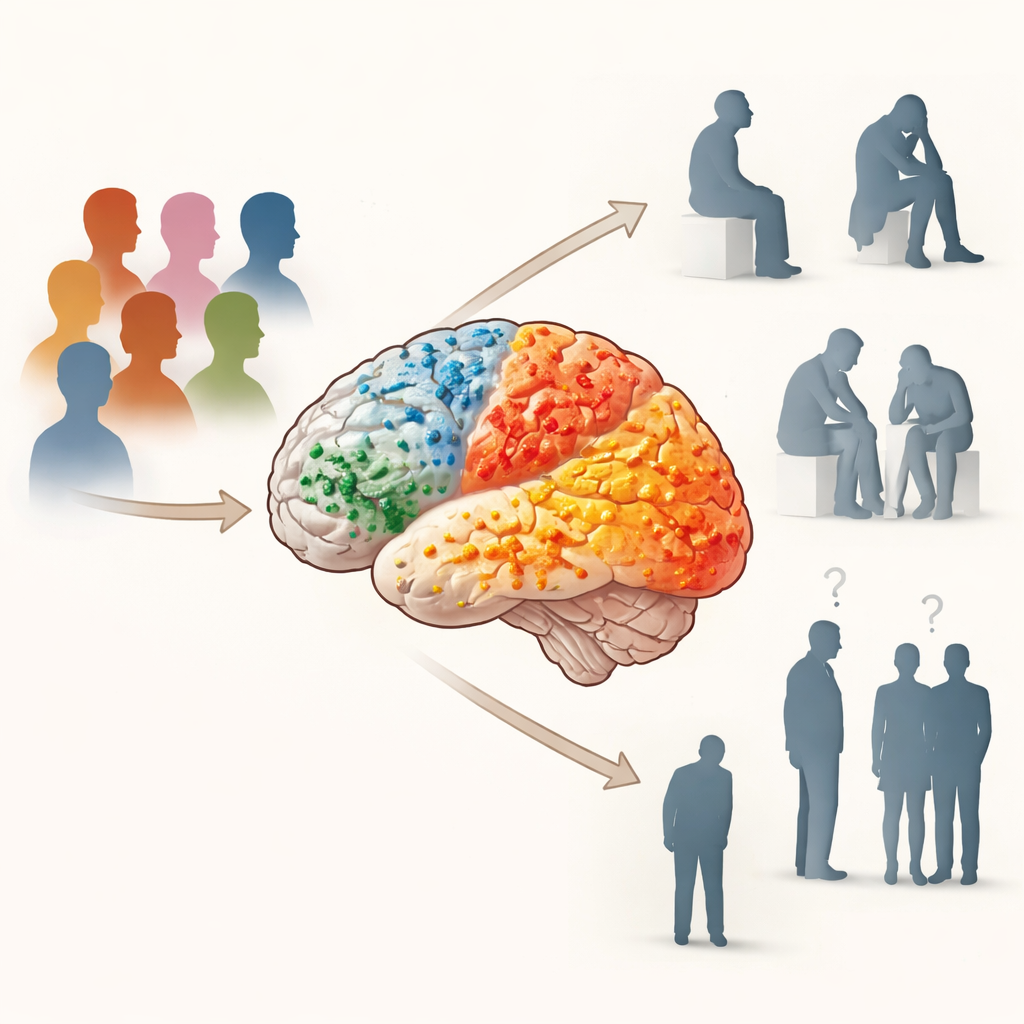
Many people know that conditions like Alzheimer’s involve harmful clumps of proteins in the brain. This study asks a bold question: could something similar also be happening, more quietly, in long‑lasting mental illnesses such as schizophrenia and major depression? By looking at how certain brain proteins shift from a normal, free state into stubborn, insoluble clumps, the researchers explore whether this hidden change might be more widespread—and more uneven—across the brain than earlier work suggested.
Following the trail of sticky proteins
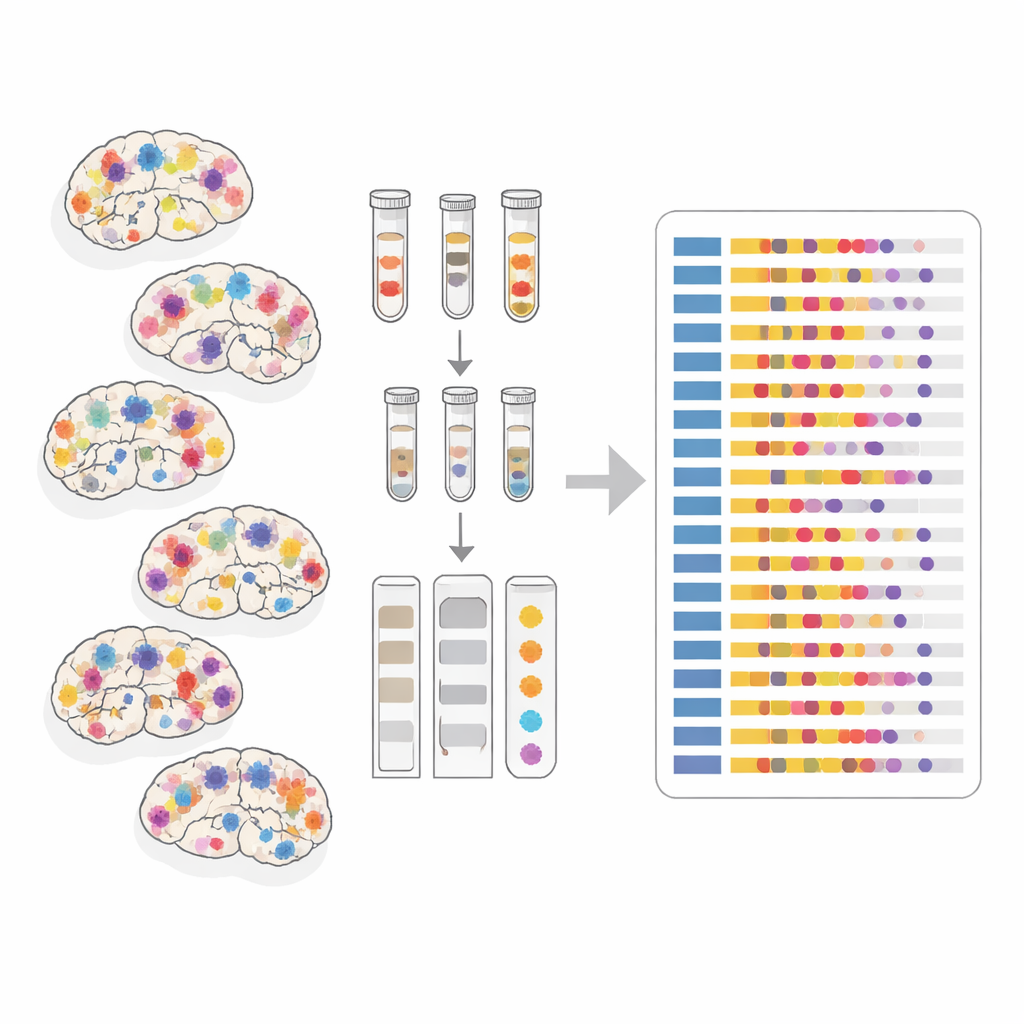
Instead of examining living patients, the team worked with carefully preserved brain samples taken after death. They focused on three proteins previously linked to serious mental illness: DISC1, CRMP1 and TRIOBP‑1. Under healthy conditions, these proteins should remain dissolved inside brain cells. When they misfold or clump, they become harder to dissolve, behaving more like grit than fluid. The scientists used a stepwise washing and spinning method to separate the insoluble portion of each sample, then used protein‑detecting techniques to see whether these three proteins had moved into that stubborn fraction, a strong sign that they were aggregating.
Looking across many parts of the brain
A key strength of this work is that it did not stop at a single brain area per person, which is the usual compromise when tissue is scarce. Instead, the researchers gathered multiple regions—from two to six per individual—in people with schizophrenia, major depression, Alzheimer’s disease, and in people who had died by suicide, alongside comparison samples from people with no diagnosed psychiatric condition. For one man who had both schizophrenia and Alzheimer’s, they had an exceptional twenty samples from ten regions in each hemisphere, giving a rare whole‑brain view of how these proteins behave.
Patchy patterns rather than uniform change
When they compared regions within the same brain, the picture was far from smooth. Some areas contained clear signs of insoluble DISC1, CRMP1 or TRIOBP‑1, while neighboring regions from the same person showed little or none. Even between matching regions in the left and right halves of the brain, the amount of insoluble protein could differ sharply. In the extensively sampled patient with schizophrenia and Alzheimer’s, insoluble DISC1 appeared in many regions but with strikingly different intensities, suggesting that clumping is not a simple all‑or‑nothing event. Similar uneven patterns were seen in additional individuals, including a control donor and a patient with Alzheimer’s disease.
Shared clumps and surprising controls
In some samples, more than one of the three proteins appeared in the insoluble fraction at the same time, echoing earlier hints that certain proteins may clump together or respond to the same kinds of cellular stress. Intriguingly, traces of insoluble protein also turned up in some people without a psychiatric diagnosis. This suggests that a low background level of such clumping might be part of normal aging or everyday wear and tear, whereas very high levels or particular patterns could be more closely tied to illness or suicide risk. However, the study was not designed to set diagnostic cutoffs; instead, it highlights how complex the landscape of protein changes in the brain really is.
What this means for future brain studies
For non‑specialists, the central takeaway is that protein clumps linked to mental illness are not neatly confined to a single “problem spot” in the brain. Rather, they appear in a patchwork, varying from region to region and even between the two hemispheres. This raises the concern that earlier studies, which often analyzed only one area, may have missed important signals and underestimated how common protein aggregation really is. The findings also fit with the idea—well known from Alzheimer’s and Parkinson’s disease—that harmful protein changes may gradually spread through brain networks over time. To truly understand and one day target these hidden clumps, future work will need to sample more brain regions, track patterns across different ages, and complement post‑mortem studies with tests on more accessible tissues such as blood, spinal fluid, or smell‑related nerve cells in living people.
Citation: Samardžija, B., Renner, É., Palkovits, M. et al. Levels of aggregation of proteins related to mental illness, assayed by insolubility, vary across the brains of individuals. Sci Rep 16, 8240 (2026). https://doi.org/10.1038/s41598-026-35767-0
Keywords: protein aggregation, schizophrenia, major depressive disorder, brain pathology, post mortem brain