Clear Sky Science · en
Green hybrid polymeric magnetic nanocomposite from natural polycationic polysaccharides for sustainable alum sludge conditioning
Turning a Hidden Waste into a Manageable Problem
Every glass of clean tap water leaves behind an invisible legacy: tons of soggy sludge loaded with aluminum compounds from water treatment plants. This alum sludge is difficult and costly to handle because it is mostly water, making it heavy to transport and hard to dispose of safely. The study behind this article explores a “green” way to squeeze out that water more efficiently, using a magnetic material built from a natural shell-derived polymer and iron oxide, potentially cutting both costs and environmental impact for drinking-water utilities.
A Growing Mountain of Wet Waste
Across the world, drinking-water treatment plants rely on aluminum salts to clump together dirt and microbes so they can be removed. The downside is a steady stream of alum sludge: millions of tons per year in countries like China, the United States, Malaysia, and Egypt. Because this sludge can be about 97% water, it occupies large volumes and is expensive to move and dry. Traditional additives called polyelectrolytes help it drain, but they are often synthetic, costly, and can linger in the environment. Utilities and regulators are therefore looking for conditioning methods that are effective, affordable, and made from safer, more sustainable ingredients.
A Natural Polymer Meets Magnetic Iron
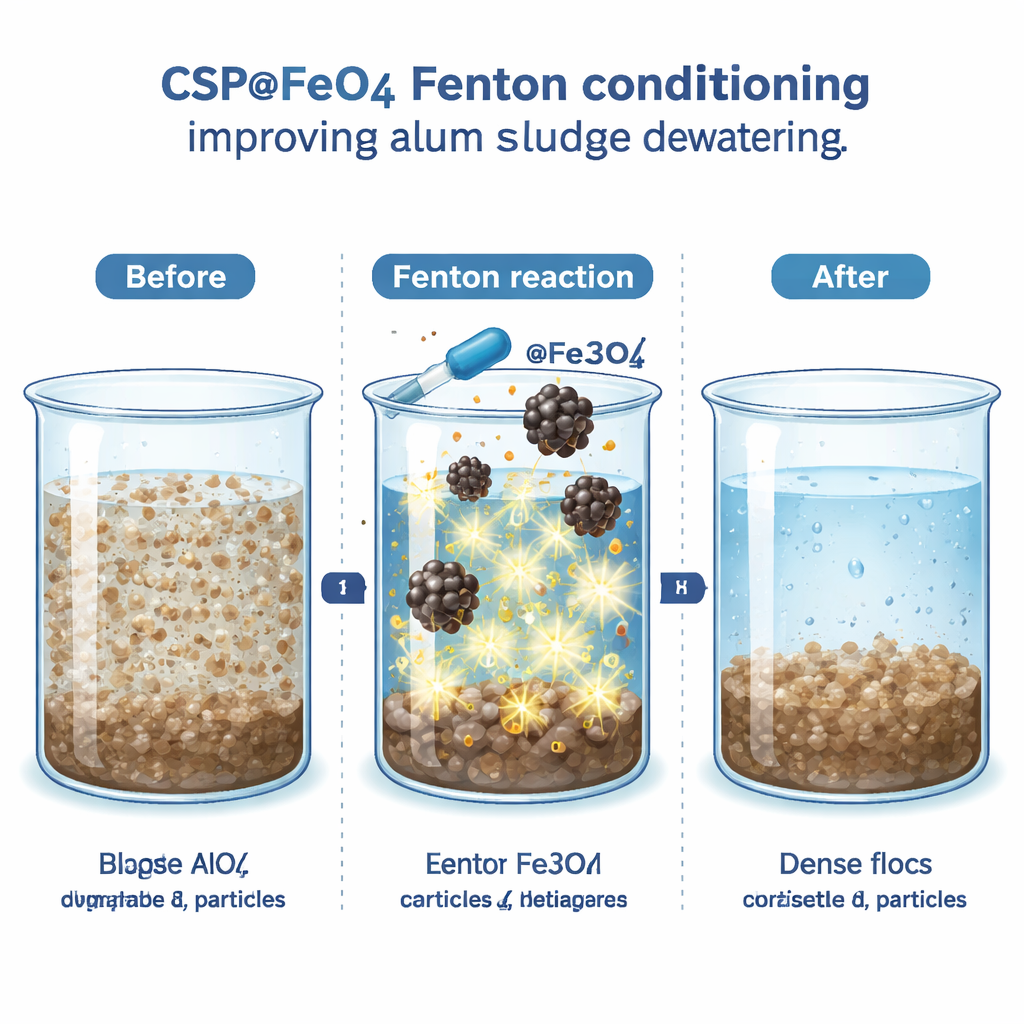
The researchers designed a new sludge conditioner built from chitosan, a natural polymer obtained from chitin (found in crab and shrimp shells), combined with tiny particles of magnetite, an iron oxide. This hybrid material, called CSP@Fe3O4, serves a double purpose. As a polymer, chitosan helps fine particles in the sludge stick together into larger clumps, while the iron in magnetite drives a powerful “Fenton-like” reaction when hydrogen peroxide is added. That reaction produces highly reactive species that can attack the sticky organic coatings that hold water inside the sludge. The team prepared three versions of the composite with different chitosan-to-magnetite ratios and carefully examined their structure and particle size with X-ray and electron microscopy to ensure the material was truly nanoscale and well mixed.
Making Sludge Drain Faster and Settle Better
To test the new conditioner, the authors collected alum sludge from a major water plant in Egypt and measured how fast water could be drawn out of it using a standard metric called capillary suction time (CST). Shorter CST means better dewatering. Under optimized conditions—40 mg/L of the CSP@Fe3O4 composite with a 2:1 chitosan-to-magnetite ratio, plus 400 mg/L of hydrogen peroxide at mildly acidic pH 3.0—the sludge’s CST dropped by 75% compared with untreated sludge. That performance clearly surpassed common commercial products: conventional polymers and a surfactant achieved only about 37% CST reduction under their best doses. The treatment also lowered the sludge’s resistance to filtration and produced larger, denser flocs that settled faster, without greatly worsening the water quality of the liquid above the sludge.
How the Green Conditioner Does Its Job
The study shows that the new material works through several reinforcing mechanisms. Chitosan carries positive charges that neutralize the naturally negative surfaces of alum sludge particles, allowing them to bind together more readily. At the same time, the iron oxide component activates hydrogen peroxide, generating reactive species that partially break down the organic “glue” known as extracellular polymeric substances. This breakdown releases water that was tightly bound inside the sludge structure. Measurements of surface charge (zeta potential) and particle size distributions confirmed that, after treatment, the sludge particles became less strongly repulsive, clumped into larger aggregates, and developed a more porous texture—changes that favor faster drainage and easier mechanical dewatering.
Toward Cleaner Water and Cleaner Waste Streams
From a layperson’s perspective, the key outcome is simple: by using a magnetically active, shell-derived polymer instead of more aggressive or persistent chemicals, water plants can dry their waste sludge more efficiently and with fewer environmental downsides. The CSP@Fe3O4-based approach reached strong dewatering in less than two minutes, compared with much longer times reported for many other Fenton-based methods. Because chitosan is biodegradable and magnetite is relatively benign and even reusable, this strategy fits well with circular-economy goals. If scaled up, such green hybrid conditioners could make the back end of drinking-water production—what happens to the waste—cleaner, cheaper, and more sustainable.
Citation: Tony, M.A., Elsayed, Z.A., Abdel-Bary, H.M. et al. Green hybrid polymeric magnetic nanocomposite from natural polycationic polysaccharides for sustainable alum sludge conditioning. Sci Rep 16, 4717 (2026). https://doi.org/10.1038/s41598-026-35765-2
Keywords: alum sludge, sludge dewatering, chitosan magnetite, Fenton oxidation, water treatment waste