Clear Sky Science · en
Five years of oxen grazing enhances soil carbon and structure in alpine vineyards
Why cows in vineyards matter
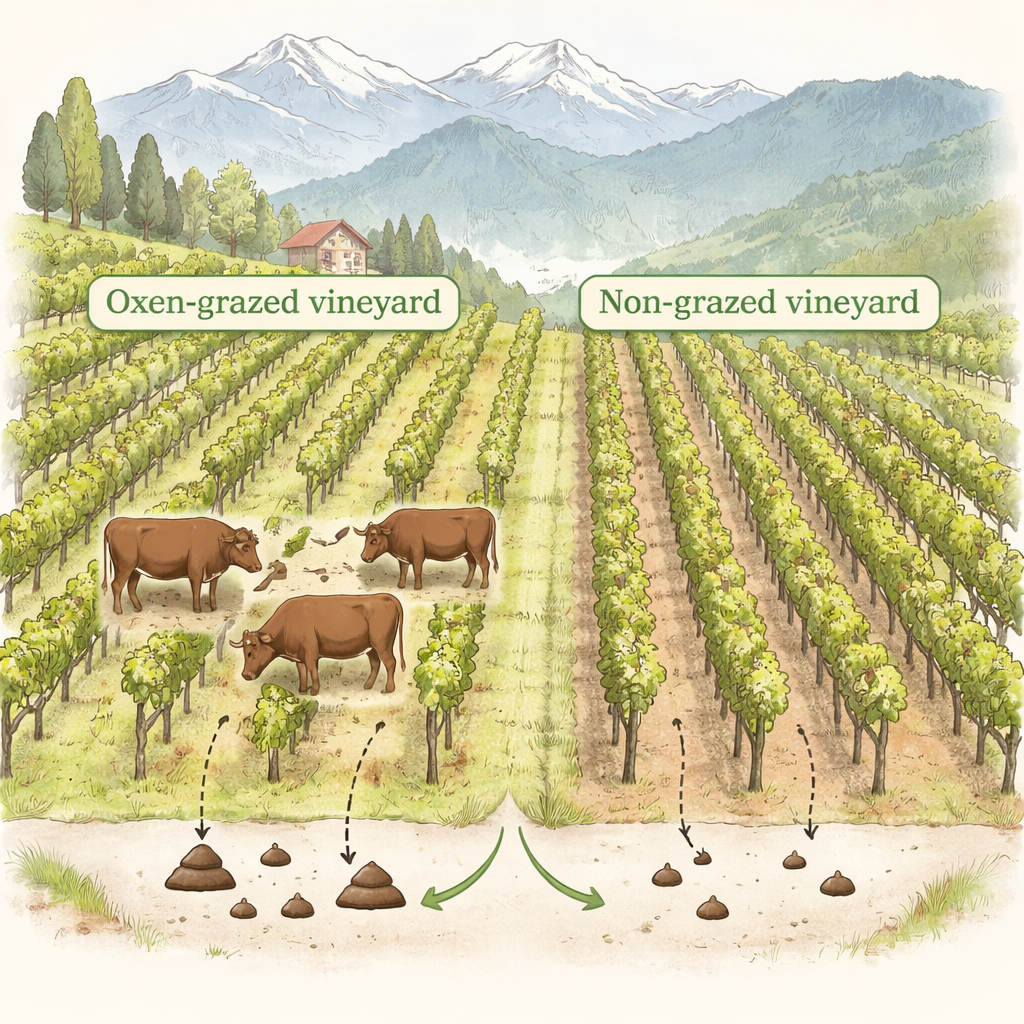
Wine lovers don’t usually think about cows when they picture a vineyard, yet bringing large animals back among the vines could help soils store more carbon and stay healthier. This study followed an alpine vineyard in northern Italy where a team of researchers let oxen graze between the grape rows for five years and compared the soil to a nearby, identical vineyard without animals. Their goal was to see whether this old-fashioned practice could support modern goals: farming that locks carbon into the ground, reduces chemical inputs, and keeps land productive under a changing climate.
Bringing animals back to the vines
For much of history, farms mixed crops and livestock: animals ate crop leftovers and returned nutrients to the soil as manure. Over the last century, however, machinery and synthetic fertilizers encouraged farms to separate animals from fields. Today, interest is growing again in “circular” systems where plants and animals share the same land. Vineyards cover millions of hectares in Europe, so even small improvements in how they are managed could have big environmental effects. While some wineries already use sheep or geese to control grass, the impact of heavier animals like oxen had not been carefully measured—especially in steep, fragile alpine landscapes where soil compaction is a real worry.
Two neighboring fields, one key difference
The researchers worked in a Chardonnay vineyard in South Tyrol, Italy, split into two adjacent blocks with the same climate, soil type and management. One block hosted oxen from late autumn through early spring every year for about five years; the other remained animal-free but otherwise managed in the same way. In late spring 2024, the team collected 15 soil samples from each block and examined them for a suite of properties: how much organic carbon and nitrogen they contained, how dense or compacted they were, how stable their aggregates (crumb structure) were, and how many bacteria and fungi lived there. This side‑by‑side design allowed them to attribute differences primarily to the presence or absence of grazing oxen.
More carbon, better soil crumbs, no extra compaction
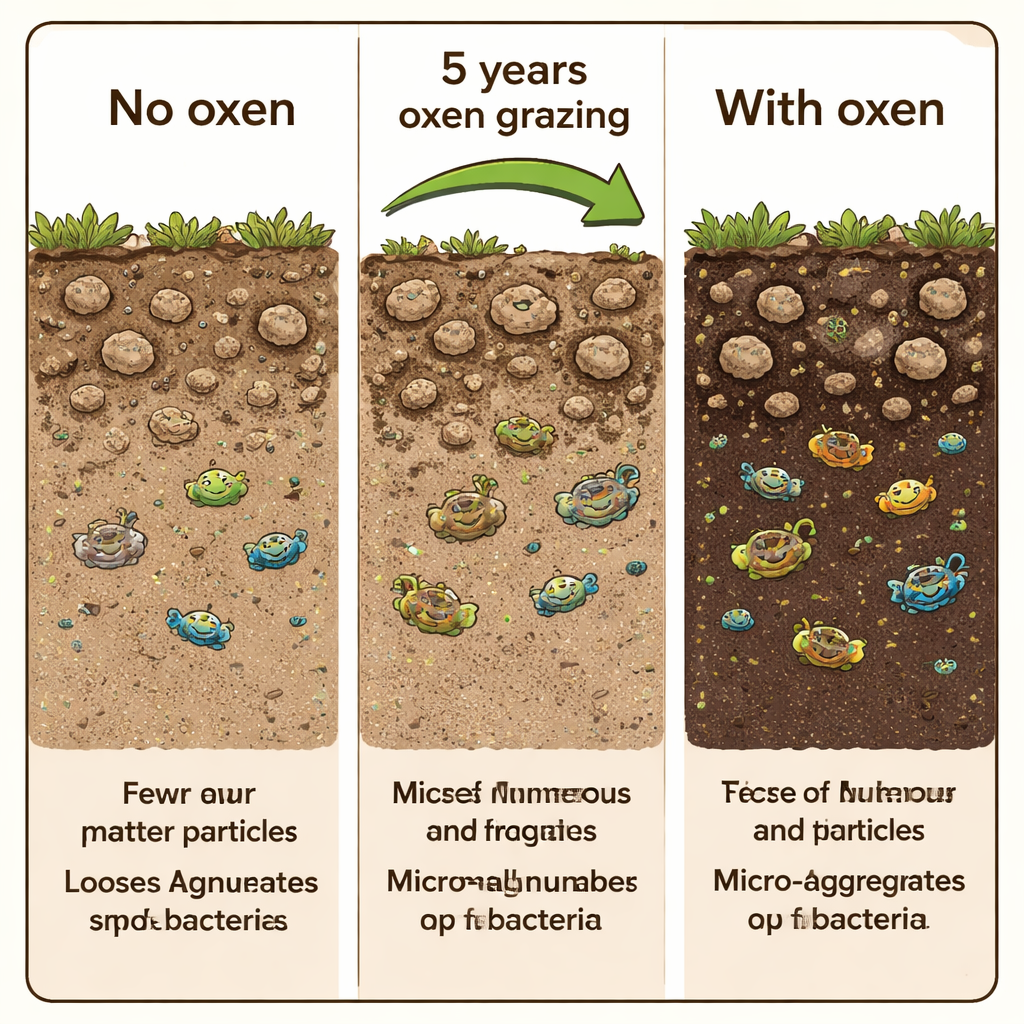
Contrary to fears that heavy hooves would squash the earth, bulk density—an indicator of compaction—was the same in grazed and ungrazed soils. Yet the grazed soils held more life-supporting material. Total organic carbon was about 14–15% higher under oxen, and total nitrogen rose by roughly 12%. The ratio of carbon to nitrogen increased slightly, and the amount of dissolved organic carbon, the easily available “snack food” for microbes, also went up. At the same time, fine water-stable aggregates, tiny soil crumbs that resist being washed apart by rain, became more abundant in the grazed plots. Larger aggregates and the availability of key nutrients such as phosphorus and potassium stayed similar in both fields, suggesting the system gained carbon and structure without major chemical imbalances.
Soil life responds to the new menu
Soil microbes drive decomposition and carbon storage, so the team also looked at the microscopic community. Overall microbial biomass—the total mass of microorganisms—did not differ between the two fields. However, DNA measurements showed that bacteria were slightly more numerous where oxen grazed, while fungal abundance remained steady. This pattern fits with the structural changes: the smaller soil aggregates that increased under grazing are known to favor bacterial communities. The extra manure and dissolved carbon created more niches and food sources for bacteria in particular, which in turn help bind soil particles into long‑lasting organo‑mineral complexes that stabilize carbon.
What this means for wine and the wider world
To a layperson, the bottom line is simple: in this alpine vineyard, carefully managed oxen grazing made soils richer in organic matter and improved their crumbly structure without squeezing them harder or stripping nutrients. Over time, such gains can help vineyards store more carbon, soak up water better, and resist erosion—all while producing grapes on the same piece of land that also supports livestock. The study is a proof of concept from a single farm, so larger trials are still needed, but it suggests that letting animals quietly graze between the vines could be a practical tool for more sustainable wine production and climate‑friendly agriculture.
Citation: Ilaria, F., Ekaterina, T., Raphael, T. et al. Five years of oxen grazing enhances soil carbon and structure in alpine vineyards. Sci Rep 16, 6088 (2026). https://doi.org/10.1038/s41598-026-35761-6
Keywords: vineyard grazing, soil carbon, mixed crop-livestock, agroecology, soil health