Clear Sky Science · en
Bioremediation of lunar regolith simulant through mycorrhizal fungi and plant symbioses enables chickpea to seed
Growing Dinner on the Moon
For future astronauts living on the Moon, fresh salad won’t be a luxury—it will be a necessity. Hauling packaged food from Earth is costly and limited, so space agencies are looking for ways to grow crops directly in lunar material. This study explores whether a humble Earth crop, chickpea, working together with beneficial fungi and organic compost, can turn harsh lunar dust into a living, food-producing surface.
Why Moon Dust Is a Tough Place for Plants
Lunar regolith—the gray, powdery “soil” that covers the Moon—is nothing like garden dirt. It contains useful minerals, but almost no organic matter, no natural community of microbes, and has sharp, irregular grains that hold water poorly and can damage living tissues. Some of its metals can become toxic to plants, and nitrogen, an essential plant nutrient, is scarce. Earlier experiments showed that seeds can sprout in lunar material, but the plants grow slowly, look stressed, and often fail to thrive. To make lunar regolith truly farmable, it must be transformed both chemically and physically.
Using Earth’s Underground Helpers
On Earth, plant roots rarely work alone. They partner with arbuscular mycorrhizal fungi—microscopic allies that wrap around roots and extend far into the soil, trading nutrients and water for sugars from the plant. These fungi can also trap heavy metals and help glue soil particles together into stable clumps. Vermicompost, created when earthworms and their gut microbes break down organic waste, adds nutrients and a rich community of beneficial organisms. In this study, the researchers combined chickpea plants, these root-friendly fungi, and vermicompost with a high-fidelity lunar regolith simulant to see whether the trio could create a fertile growth medium for space crops. 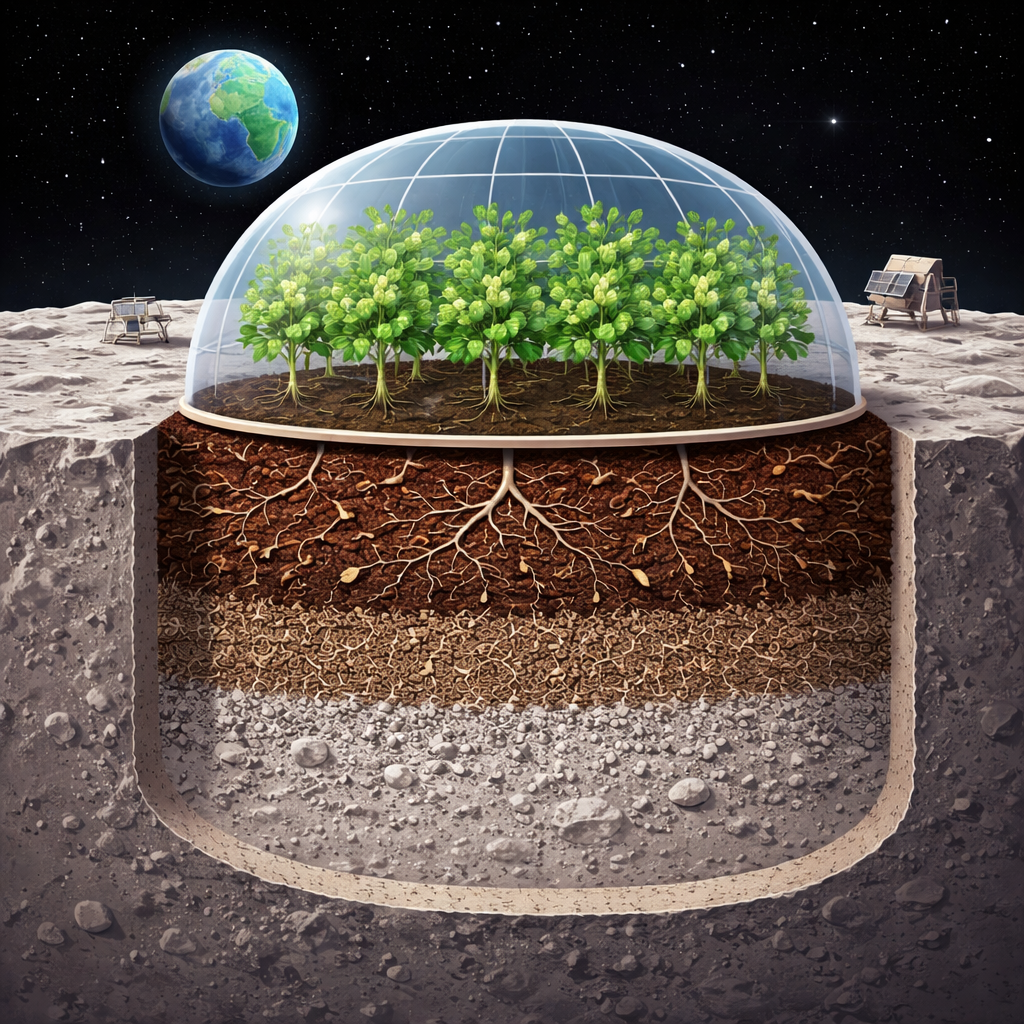
Testing Chickpeas in Simulated Moon Soil
The team grew chickpeas in mixtures of lunar regolith simulant and vermicompost ranging from mostly compost to 100% simulant, with and without fungal inoculation. All seeds germinated, meaning early growth was not blocked by contact with the simulant. As the plants matured, high-regolith mixes caused visible stress: stunted shoots, yellowing leaves, and fewer branches, likely reflecting a shortage of key nutrients and poor water conditions. Yet, by day 56, plants that received the fungal treatment clearly looked healthier, especially in the harshest 100% simulant, where they stayed greener and turgid longer than untreated plants. Although all plants in pure simulant eventually died, the fungal partners extended their lives by about two weeks, demonstrating that this biological support can buy valuable time in an extreme environment.
From Flowers to Seeds in Harsh Conditions
For a space farm, it is not enough for plants to survive—they must produce seeds to support continuous harvests. In this experiment, chickpeas set flowers and seeds only in normal potting soil and in the regolith–compost mixes that also received fungi. Higher amounts of lunar simulant reduced the total number of seeds, but the seeds that did form were similar in size and weight to those grown in Earth-like controls. This suggests that early stress limits how many seeds develop, but once seeds start to fill, the fungal partnerships help maintain their quality. At the same time, the fungi altered the chemical environment: in regolith–compost mixes, they kept pH in a slightly acidic range that favors nutrient availability while still leaving open questions about how metals are partitioned between plant tissues and fungal structures. 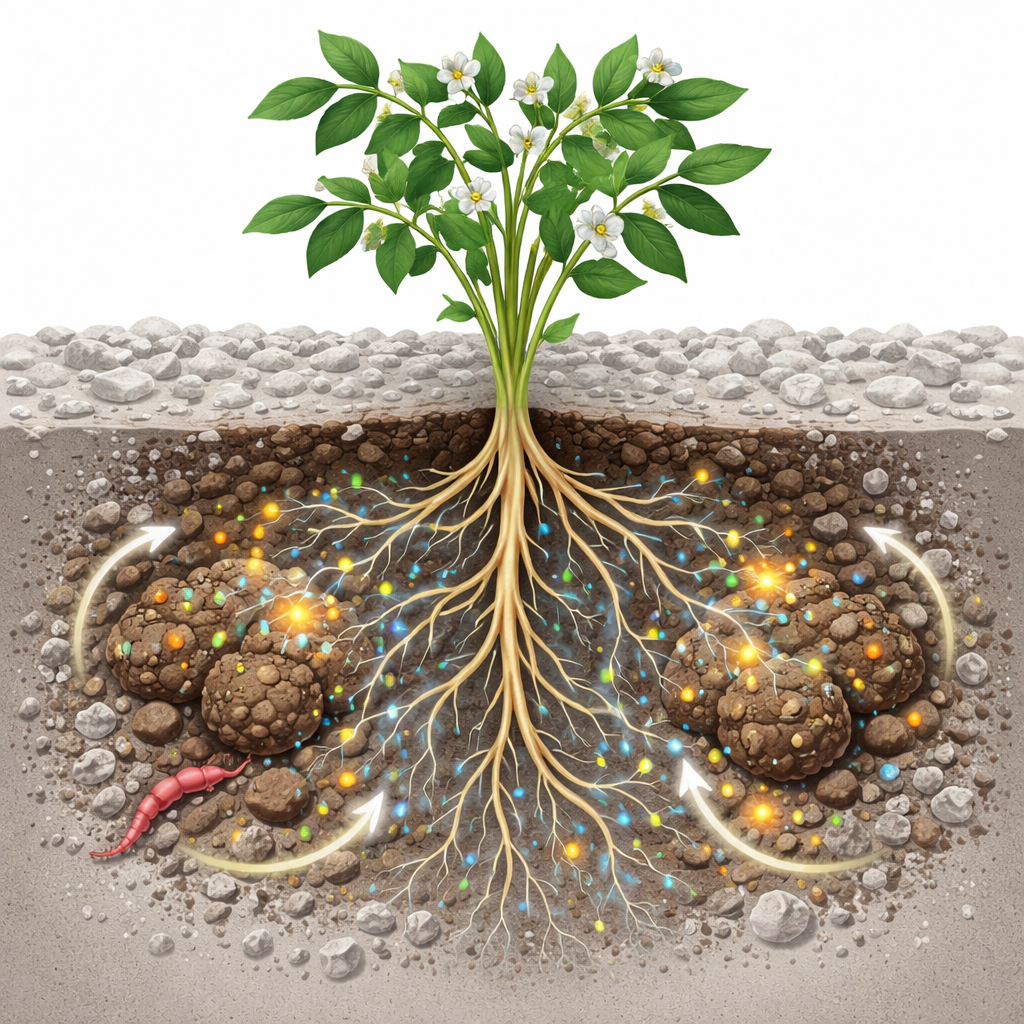
Strengthening Fragile Dust into Real Soil
Beyond supporting plant growth, the biological partners also began reshaping the simulant itself. Mycorrhizal fungi weave through particles and release sticky substances that bind grains together into aggregates—crumb-like structures that resist crumbling in water. Using a smartphone-based test of aggregate stability, the researchers found that all mixtures with fungal-treated chickpeas had stronger, more stable clumps than untreated ones, including those with high proportions of simulant. This improved structure can enhance water retention, nutrient movement, and root access, turning loose, abrasive dust into something closer to true soil within a single plant generation.
What This Means for Moon Farms—and Earth
The study shows that Earth-style soil regeneration—using hardy crops, helpful fungi, and recycled organic waste—can push lunar-like material a crucial step toward becoming farmable ground. Chickpeas inoculated with mycorrhizal fungi were able to flower and set seeds in regolith–compost mixtures, and even in pure simulant the partnership prolonged plant survival and strengthened the substrate. While plants still showed signs of stress and many challenges remain, the work suggests that future lunar greenhouses could rely less on imported soil and more on living systems that gradually tame the Moon’s dust. The same strategies may also help rehabilitate degraded soils back on Earth, linking space agriculture with sustainable farming at home.
Citation: Atkin, J., Pierson, E., Gentry, T. et al. Bioremediation of lunar regolith simulant through mycorrhizal fungi and plant symbioses enables chickpea to seed. Sci Rep 16, 7498 (2026). https://doi.org/10.1038/s41598-026-35759-0
Keywords: space agriculture, lunar regolith, mycorrhizal fungi, chickpea, vermicompost