Clear Sky Science · en
The extended TODIM method under q-rung orthopair fuzzy environment and its application to multi-path parallel transmission in mobile networks
Why smarter choices matter for complex networks
Modern technologies, from mobile phones to smart factories, rely on networks that must juggle speed, reliability, and cost all at once. Engineers and managers often have to pick one design out of many, even when the facts are fuzzy and experts disagree. This paper presents a new way to make such difficult choices more consistent and transparent, focusing on how to select the best multi-path transmission scheme in a mobile network where data can travel along several routes in parallel.
Turning vague opinions into usable data
In many real decisions, experts cannot give exact numbers; instead, they express partial belief, doubt, or hesitation. Traditional "fuzzy" methods can capture some of this nuance but quickly run into limits when evaluations become highly uncertain or unbalanced. The authors build on a newer framework called q‑rung orthopair fuzzy sets, which let an expert state how strongly they support and oppose an option, plus how unsure they are, with more flexibility than earlier approaches. This richer description is crucial in engineering tasks like mobile networking, where performance depends on many interacting factors and the available evidence is incomplete or noisy.

Seeing uncertainty as shapes and curves
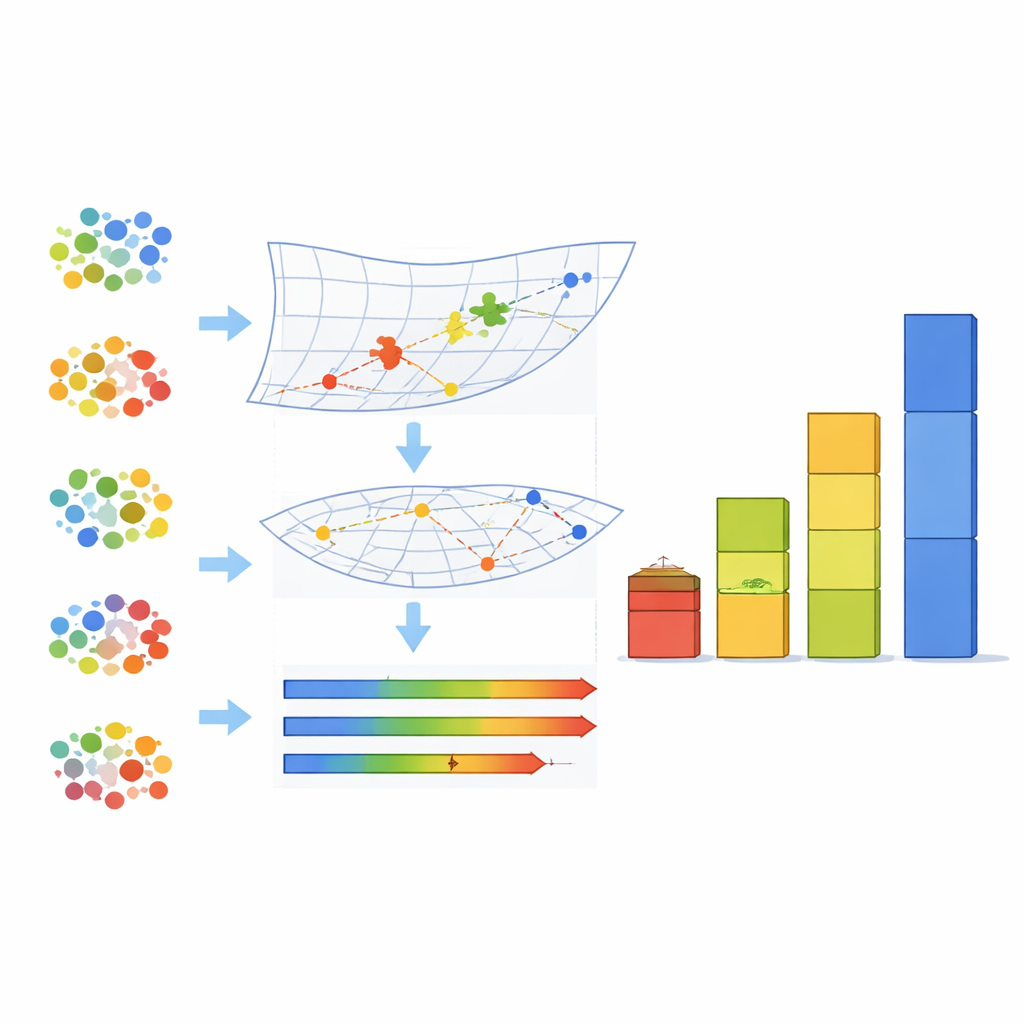
A central contribution of the paper is a visual way to compare these complex fuzzy evaluations. Each assessment is mapped to a point on a two-dimensional plane whose axes represent agreement and disagreement. All valid assessments lie within a curved boundary that encodes the mathematical limits of the model. For any point, the authors measure several arc lengths along this boundary, which together summarize how strong the support is, how strong the opposition is, and how much hesitation remains. Instead of compressing all this into a single opaque formula, these arc lengths behave like geometric fingerprints: they allow different fuzzy evaluations to be compared more intuitively and, as the authors show, more stably when a key parameter of the model (q) changes.
Measuring distances and preferences more faithfully
Beyond ranking single evaluations, decision methods need a way to say how far apart two options are. Standard distance formulas often treat agreement and disagreement as simple coordinates and can lose subtle structure, especially when the model’s flexibility is increased. The paper introduces a new distance measure tailored to the q‑rung setting, designed to preserve higher-order patterns that appear when experts express very strong or very weak opinions. The authors prove that this distance behaves as a proper metric and test it across a range of parameter values, showing that it does not produce wild swings in outcomes. This careful treatment of distance is important because later steps in the decision process depend on these differences when comparing alternatives.
Bringing human-like risk behavior into the method
The third piece of the work adapts a behavioral decision approach called TODIM, which is based on prospect theory, into the q‑rung fuzzy world. TODIM mimics common human patterns such as valuing losses more than equivalent gains. In the authors’ extended version, each alternative (for example, a candidate network transmission scheme) is evaluated across several criteria like packet loss, congestion, and switching speed. The new geometric ranking and distance formulas feed into TODIM’s dominance calculations, which weigh gains and losses between pairs of options. This produces an overall "advantage" score for each alternative that respects both the underlying uncertainty and realistic risk attitudes.
Testing the method on mobile network choices
To show how the framework works in practice, the authors apply it to a real-world style case: a small internet company choosing among five multi-path transmission schemes for mobile users, using technologies such as Wi‑Fi, 4G, and 5G in parallel. Experts rate each scheme on four criteria that together capture stability, resource efficiency, congestion control, and agility in switching paths. Using the new method, the schemes are ranked in a clear order, with one option emerging as best overall because it keeps packet loss and congestion low while achieving acceptable performance on the other factors. The authors compare their rankings with those produced by other advanced methods and run sensitivity tests by varying the model’s parameters. Their approach shows more consistent and robust rankings, without the reversals that trouble some existing techniques.
What this means for real decisions
In plain terms, the paper offers a more reliable and explainable way to choose among complex technical options when the evidence is fuzzy and people care deeply about avoiding bad outcomes. By turning abstract uncertainty into geometric pictures, refining how distances between options are measured, and embedding all of this into a risk-aware decision framework, the method helps decision-makers see not just which alternative comes out on top, but why. Although demonstrated on mobile network design, the same ideas could support choices in fields such as energy planning, infrastructure investment, or environmental management, wherever experts must weigh multiple uncertain criteria to reach a defensible decision.
Citation: Qiu, S., Deng, X., Jin, Z. et al. The extended TODIM method under q-rung orthopair fuzzy environment and its application to multi-path parallel transmission in mobile networks. Sci Rep 16, 7963 (2026). https://doi.org/10.1038/s41598-026-35755-4
Keywords: fuzzy decision making, multi-criteria analysis, mobile networks, risk-sensitive choices, network optimization