Clear Sky Science · en
The peak shifting electricity consumption management and influencing factors of smart grid from recurrent neural network model and deep learning
Why smarter campus power use matters
University campuses hum with activity around the clock: classes, labs, dorm life, late-night study sessions, and the steady whir of servers and lights. All of this adds up to big swings in electricity demand—sharp peaks when many devices are on at once and deep valleys when buildings sit underused. Those peaks are expensive for the grid and wasteful for the planet. This study explores how combining modern AI tools with hydrogen-based energy storage can help campuses predict when they will need power, smooth out those peaks, and use electricity more efficiently without dimming the lights on learning.
Seeing patterns in daily campus life
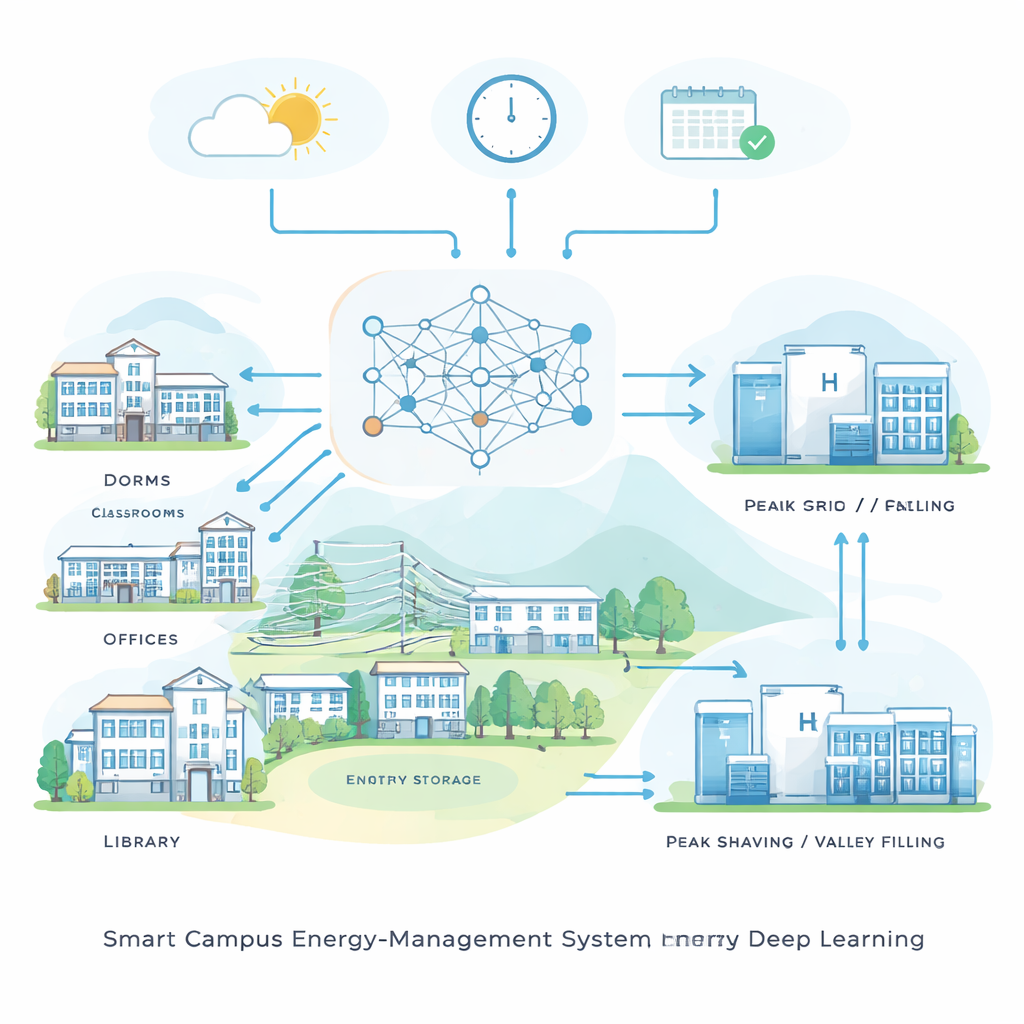
At the heart of the work is the idea that electricity use on a campus is not random—it closely follows human routines. The researchers collected detailed power data from 15 buildings at a Chinese university over about a year and a half, along with weather records and class schedules. They then used colorful heat maps to show how energy use rises and falls hour by hour in different places: dorms, classrooms, offices, cafeterias, and lighting systems. From these pictures, they defined six everyday patterns, such as dorms with two big spikes at lunchtime and late night, classrooms that peak only during class hours, and street lights that burn steadily through the night. These patterns form the basis for tailored energy-saving tactics for each building type.
Teaching a neural network to forecast demand
To act on those patterns, you first need to know what tomorrow will look like. The team trained a type of artificial intelligence called a recurrent neural network (RNN) to forecast how much electricity each building would use from one hour to the next. RNNs are designed to work with sequences, making them well suited to follow how power demand evolves over time. The model digested 24 hours of recent history at once—past electricity use, temperature, humidity, time of day, weekday or weekend, and even whether classes were scheduled—and then predicted the next hour’s consumption. The authors were careful with data cleaning: they filled in missing readings by looking for similar days with similar weather and schedules, and they split the data chronologically into training, validation, and test sets to avoid overfitting.
Beating other prediction methods
The RNN’s performance was tested against several common forecasting tools, including simple linear regression, more flexible nonlinear regression, traditional statistical models such as ARIMA and Grey models, and another deep-learning method called LSTM. Across campus data and three public electricity datasets, the RNN consistently produced lower errors. In real campus tests, the RNN’s mean squared error—a measure that punishes big misses—was dramatically smaller than that of linear regression, and its average percentage error stayed in the single digits. Error distributions showed that the RNN’s mistakes were tightly clustered and that its predicted curves almost overlapped the actual load, indicating both accuracy and stability. While the authors note this does not mean RNNs always beat LSTMs in general, it does show that a relatively simple network can work very well in this specific setting.
Flattening the power curve with hydrogen storage
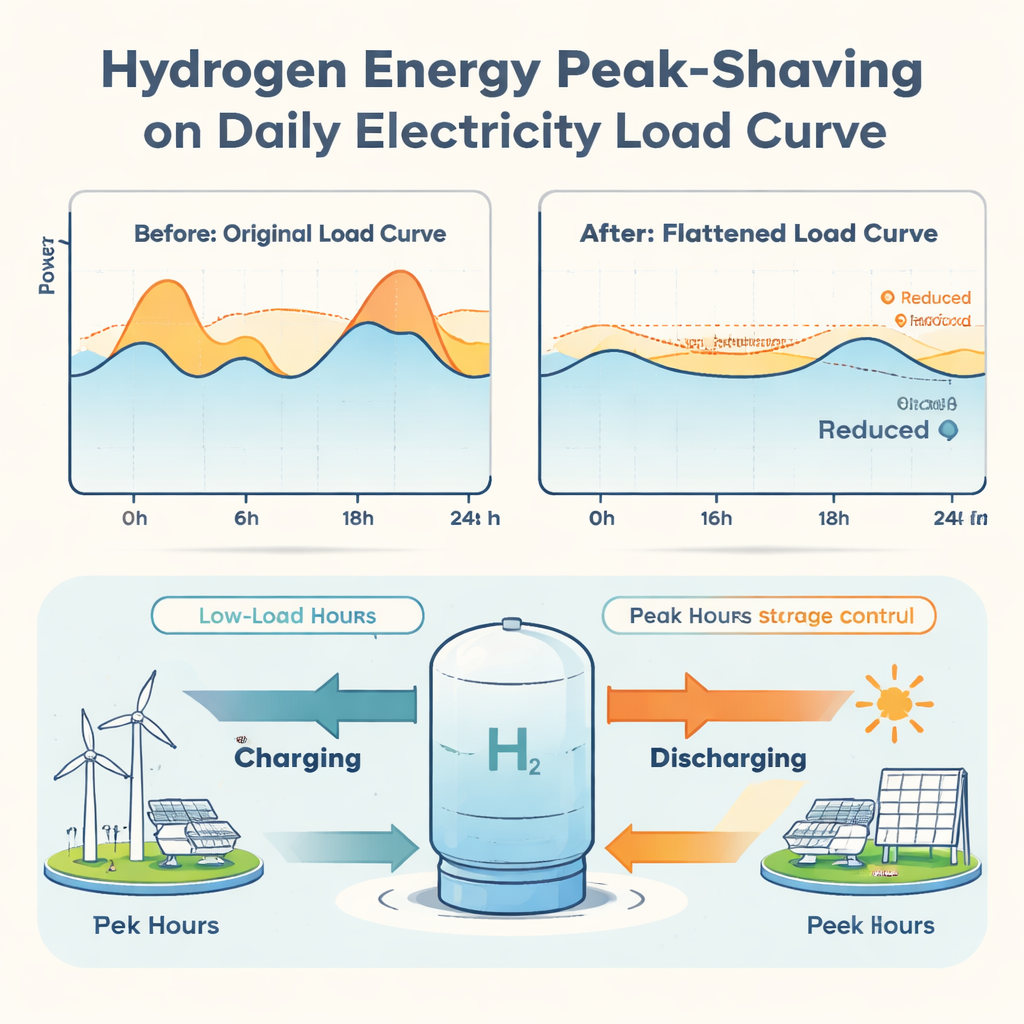
Prediction alone does not cut the bill; you also need a way to reshape demand. Here, the study introduces a virtual hydrogen energy storage system that behaves like a giant rechargeable buffer. When the RNN forecast signals low-load hours, the system “charges” by converting electricity into hydrogen; when peaks loom, it “discharges,” feeding stored energy back to the campus. A dynamic programming routine decides, hour by hour, whether the storage should charge, discharge, or sit idle, all while respecting limits on its capacity, power, and efficiency. In a representative 24-hour example, this strategy cut the daily maximum load from about 46 kilowatt-hours to roughly 33, reduced the difference between peak and average usage, and eliminated all periods where demand exceeded a preset quota. The price was a tiny rise in total daily energy use—less than one percent—due to losses in the storage cycle.
What this means for everyday energy users
In plain terms, the study shows that campuses—and by extension, office parks, hospital complexes, or residential districts—can use AI to not only see their energy future but also shape it. By predicting when and where electricity will be needed, and coupling those forecasts with flexible storage such as hydrogen tanks or batteries, operators can shave off costly peaks, make better use of off-peak power, and reduce strain on the wider grid. The authors caution that their results come from one campus and a simulated storage unit, and that real-world rollouts must factor in prices, carbon, and comfort. Still, the framework offers a realistic blueprint for smarter, cleaner electricity use in places where tomorrow’s energy habits are being formed today.
Citation: Wang, F., Huang, D. & Lu, W. The peak shifting electricity consumption management and influencing factors of smart grid from recurrent neural network model and deep learning. Sci Rep 16, 5569 (2026). https://doi.org/10.1038/s41598-026-35754-5
Keywords: smart grid, campus energy, load forecasting, hydrogen storage, deep learning