Clear Sky Science · en
Research on the design of non-destructive assembly and disassembly interference fit for aircraft engines
Why this matters for safer, cheaper flights
Hidden deep inside every jet engine are tightly pressed metal parts that must never slip, even while spinning thousands of times a minute in searing heat. Today, taking these parts apart for inspection often scratches and weakens them, driving up maintenance time and cost. This study shows how a redesigned connection between engine parts can be taken apart and put back together without damage, while still gripping strongly enough to safely transmit power.
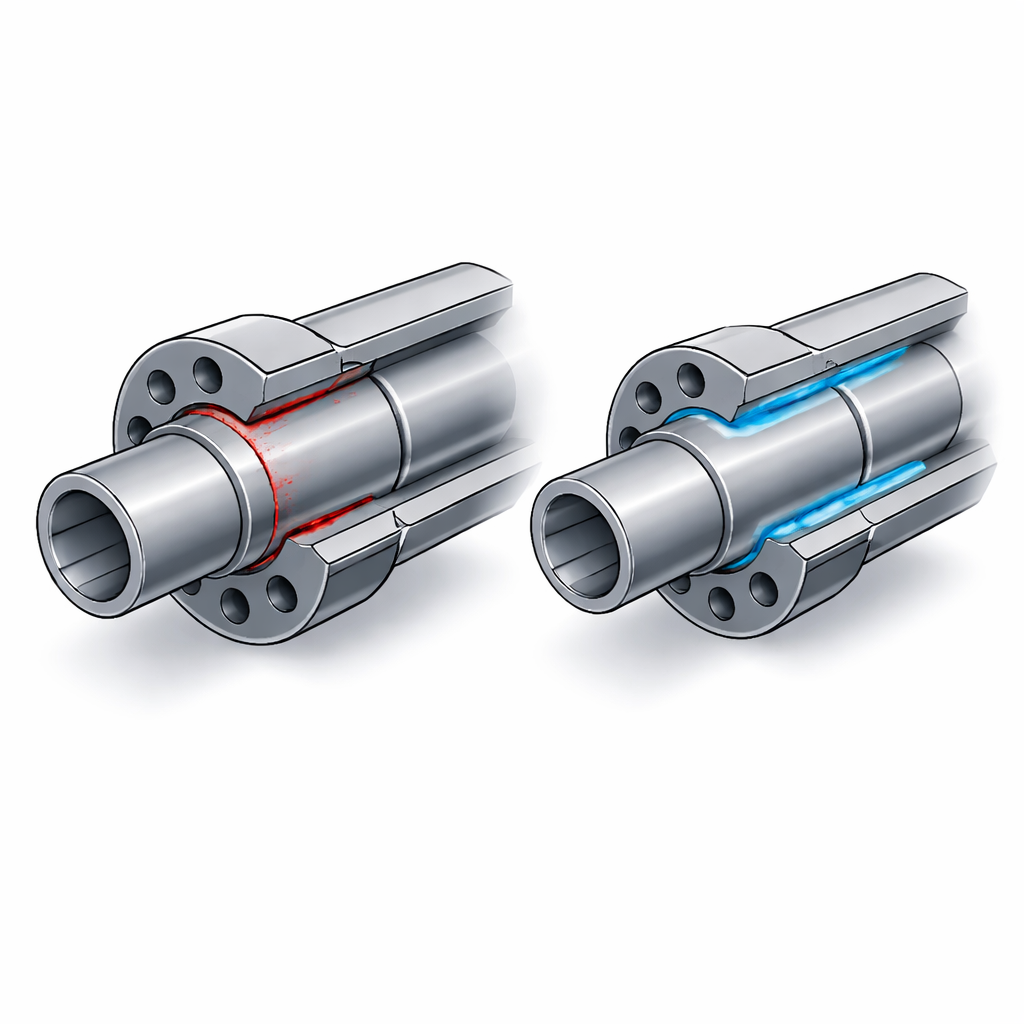
The hidden handshake inside an engine
Many rotating engine parts are joined by what engineers call an interference fit: one metal part is made just slightly larger than the hole it is pressed into. When forced together, the parts squeeze each other so tightly that friction alone holds them, allowing torque (twisting force) to be passed from one to the other. In aircraft engines, these fits sit in harsh conditions of high temperature, speed and vibration. Over time, parts must be removed for checks or replacement. The usual way to separate a cylindrical interference fit is to heat the outer piece or cool the inner one so that they temporarily loosen. But uneven heating and cooling can change the metal’s structure, and sliding the parts together or apart can score the contact surfaces, leaving scratches that may grow into cracks.
From brute force to a gentler oil cushion
The authors explore a different approach: replacing the simple cylinder-on-cylinder contact with a shallow cone-on-cone contact that includes a narrow circular groove for oil. Under high pressure, oil is pumped into this groove to form a thin film between the parts. This oil film reduces friction during assembly and disassembly, so the pieces can slide without gouging each other, yet once the oil pressure is released the metal surfaces again grip tightly. The conical shape also helps the parts center themselves as they come together, improving alignment and reducing the chance of mechanical jamming. The challenge is to shape this new joint so that it still carries as much torque as the original cylindrical design.
Designing a new joint that behaves like the old one
To achieve this, the team built a mathematical description of how torque is transmitted across the contact surface, taking into account material stiffness, friction and the detailed distribution of contact pressure. Using similarity theory, they derived a set of dimensionless groups that must match between the existing (prototype) joint and the new conical design if their torque-carrying behavior is to be equivalent. They then focused on the parameters engineers can change—mainly the cone’s taper and the geometry of the oil groove—while keeping the materials and the basic interference (how much larger one part is than the other) the same. Computer simulations showed how different tapers altered where and how strongly the surfaces press against each other, guiding the selection of a 1:15 taper that best matched the original pressure pattern.
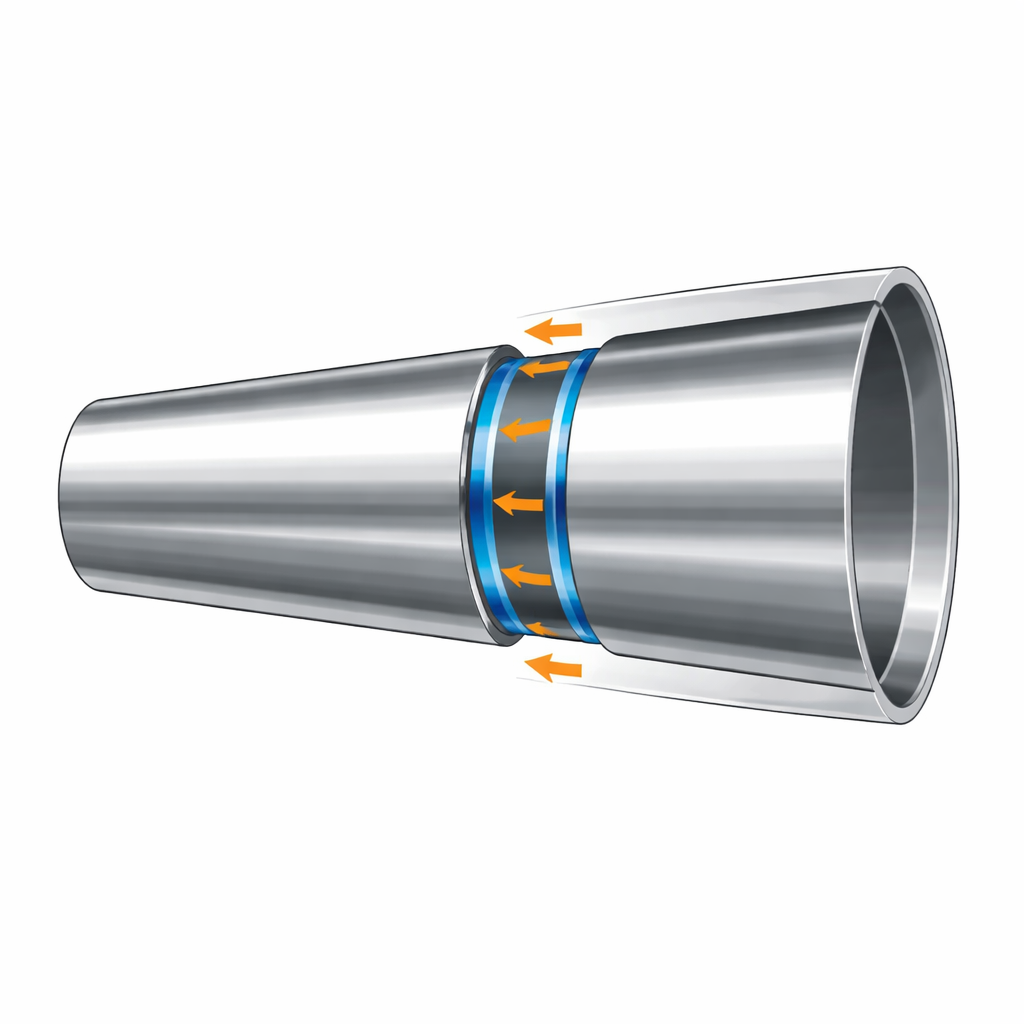
Putting the new design to the test
After fixing the design, the researchers machined real test pieces from typical engine steels, added the ring-shaped oil groove in the low-pressure region of the contact, and built laboratory rigs to measure friction and torque capacity. First, they carefully calibrated how the maximum static friction between the metals changes with contact pressure. Next, they assembled conical joints with different interference levels using hydraulic oil, measured the torque at which the inner and outer parts began to slip, and compared these values with their theoretical predictions and with the original cylindrical joint. The new conical, oil-assisted joints carried essentially the same torque—within a few percent—as the old design, confirming that the similarity-based design method worked. Importantly, after twisting and then disassembling the parts hydraulically, only fine circular marks were seen, with no deep or axial scratches.
What this means for future engines
In plain terms, the study shows that it is possible to redesign a critical “press fit” connection in aircraft engines so that it can be repeatedly taken apart and reassembled without damaging the parts, while still handling the same twisting loads. The key ingredients are a carefully chosen cone angle, an internal oil groove fed with high-pressure oil, and a design method that ensures the new joint faithfully mimics the old one’s strength. If adopted in real engines, such non-destructive joints could extend component life, reduce the need for replacements, and make heavy engine overhauls quicker and safer.
Citation: Fu, W., Wang, D. & Wang, Z. Research on the design of non-destructive assembly and disassembly interference fit for aircraft engines. Sci Rep 16, 5188 (2026). https://doi.org/10.1038/s41598-026-35753-6
Keywords: aircraft engine maintenance, interference fit, hydraulic disassembly, torque transmission, conical joint design