Clear Sky Science · en
Mechanism of Babao Dan on fluorouracil-induced bone marrow suppression and T cell immune disorder through MAPK pathway
Helping Cancer Treatment Hurt Less
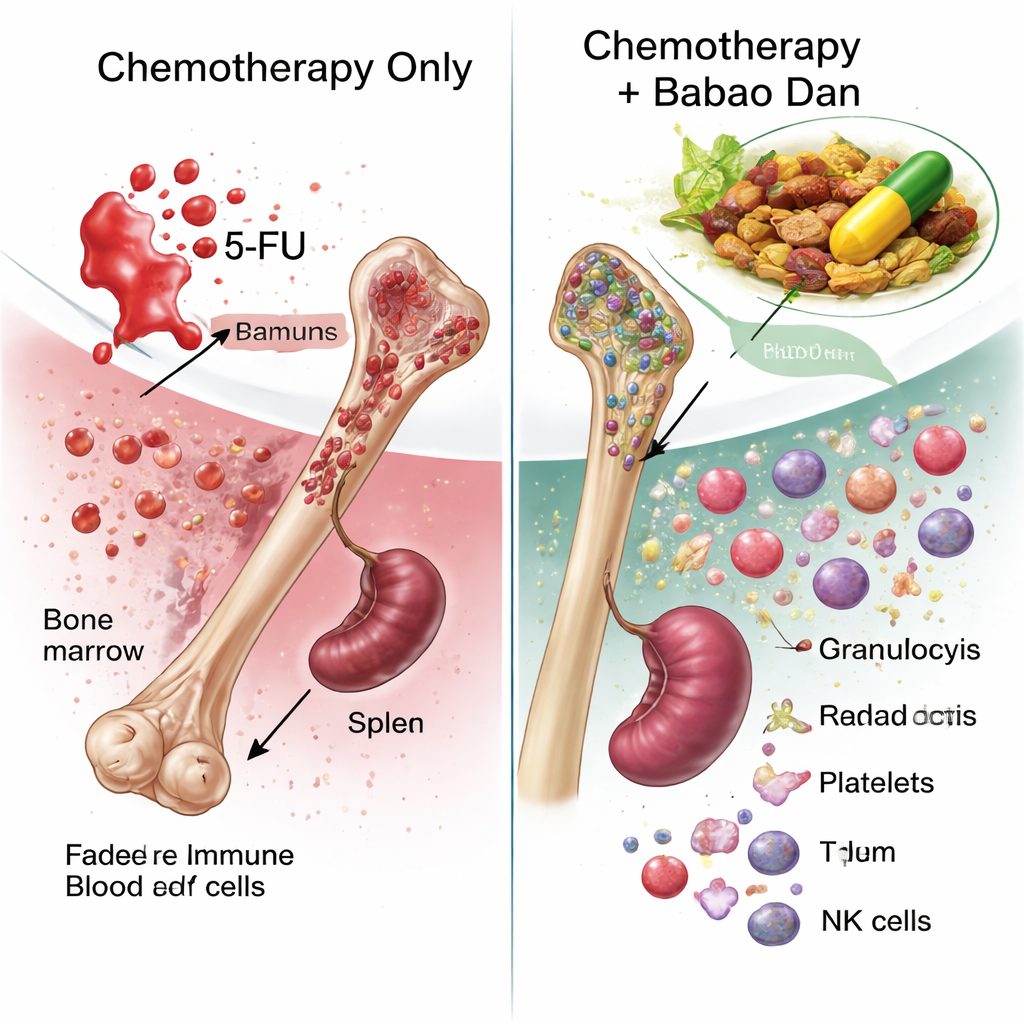
Chemotherapy drugs save lives, but they can also badly weaken the blood and immune system, leaving patients exhausted, vulnerable to infection, and sometimes unable to continue treatment. This study explores whether Babao Dan, a traditional Chinese herbal medicine, can protect the bone marrow and immune cells of mice treated with the common chemotherapy drug 5-fluorouracil (5‑FU), and how it might work inside the body.
An Old Remedy Meets Modern Cancer Care
Babao Dan is a state‑protected traditional formula made from multiple plant and animal ingredients rich in fatty acids, plant steroids, flavonoids, and related compounds. It is already used in China alongside standard cancer treatments, and earlier work showed that it can ease gut damage, weight loss, and general toxicity caused by 5‑FU while also slowing tumor growth in several cancer models. In this study, researchers focused on a different question: can Babao Dan shield bone marrow—the “factory” that makes blood cells—and help restore the balance of infection‑fighting T cells after chemotherapy? To do this, they treated mice with 5‑FU, with or without Babao Dan, and then measured survival, blood counts, bone marrow health, and detailed patterns of immune cells.
Protecting Blood‑Making Tissues
5‑FU alone caused many of the same problems seen in people: mice lost weight, their spleens (key immune organs) shrank, and their bone marrow struggled to produce new cells. White blood cells, especially neutrophils that fight bacteria, dropped sharply, and early red blood cells (reticulocytes) became scarce. Under the microscope, bone marrow showed fewer mature granulocytes and a distorted mix of developing cells. When the animals also received Babao Dan, survival improved dramatically, weight loss eased, spleens remained larger, and blood tests showed higher white cell and platelet counts. The bone marrow contained more mature neutrophils and more reticulocytes, indicating that the herbal medicine helped the blood‑forming system recover from chemotherapy stress.
Rebalancing the Immune Army
Chemotherapy can also scramble the body’s immune “chain of command,” especially among T helper cells that coordinate responses to infections and tumors. In 5‑FU‑treated mice, the study found a shift away from Th1 helper cells, which support strong cellular immunity, and toward regulatory T cells that dampen immune reactions—an imbalance associated with weakened defenses. Detailed profiling of T cells in blood and spleen also showed that 5‑FU preferentially depleted highly experienced “effector memory” T cells while sparing more naïve cells, and it blunted key activation markers (CD25 and CD69) and proliferation signals (Ki‑67 and PCNA). With Babao Dan, these trends reversed: Th1 levels rose, regulatory T cells fell toward normal, activation markers on CD4+ and CD8+ T cells recovered, and more cells entered active division. In short, the herbal treatment helped rebuild both the numbers and the readiness of T cells after chemotherapy.
How the Herbal Formula Works Inside Cells
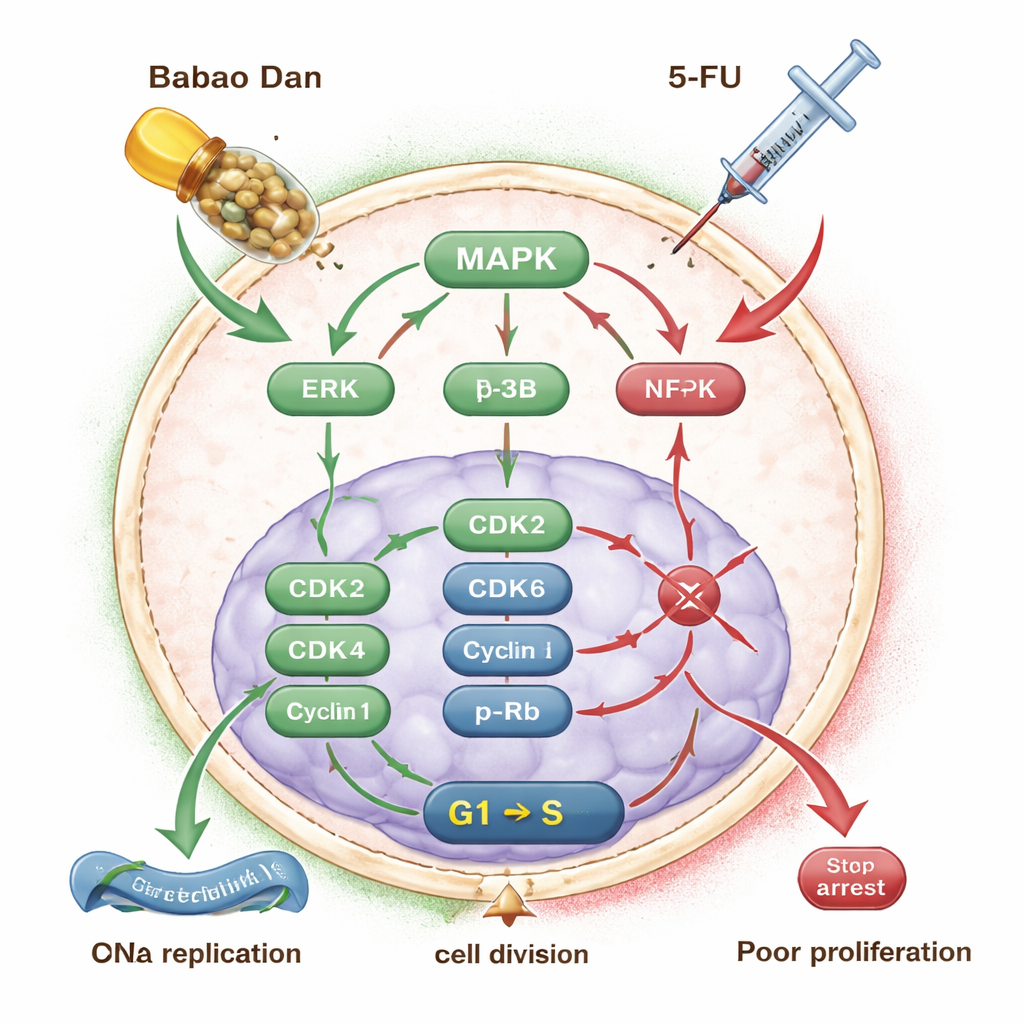
To understand the inner workings, the researchers examined the cell cycle—the carefully timed sequence of steps that cells use to grow and divide—and a major control network called the MAPK pathway. 5‑FU pushed bone marrow cells to stall in the early G0/G1 phase, preventing them from progressing into DNA copying (S phase) and division. It also lowered levels of key cell‑cycle regulators such as CDK2, CDK4, CDK6, Cyclin D1, Cyclin E1, and the active, phosphorylated form of the Rb protein, which normally opens the gate from G1 to S. At the same time, 5‑FU dampened activation of MAPK‑related proteins (ERK, p38, NF‑κB and their partners), signaling a broad slowdown in growth signals. Babao Dan reversed many of these changes: MAPK signaling switched back on, the G1/S checkpoint proteins rose, Rb became more highly phosphorylated, and more cells moved from G1 into S and on to division. This suggests that Babao Dan helps bone marrow cells escape chemotherapy‑induced “traffic jams” in the cell cycle and resume healthy proliferation.
What It Could Mean for Patients
In everyday terms, the study suggests that Babao Dan acts like a shield and a repair crew for the blood and immune system during harsh chemotherapy. In mice, it kept more animals alive, reduced weight loss, restored blood production in the bone marrow, and brought important T‑cell populations and their activity closer to normal. By reactivating specific growth‑signal pathways inside cells, it helped bone marrow cells re‑enter the division cycle and rebuild the immune army. While these results are promising, they are preclinical; careful human studies will be needed to confirm safety, dosing, and benefits in people. Still, the work illustrates how a complex traditional remedy can be dissected with modern tools, and how it might one day help make life‑saving chemotherapy both safer and more tolerable.
Citation: Yan, S., Sun, R., Yuan, J. et al. Mechanism of Babao Dan on fluorouracil-induced bone marrow suppression and T cell immune disorder through MAPK pathway. Sci Rep 16, 5057 (2026). https://doi.org/10.1038/s41598-026-35751-8
Keywords: chemotherapy side effects, bone marrow suppression, T cell immunity, traditional Chinese medicine, MAPK cell signaling