Clear Sky Science · en
Combining gait analysis and finite element modeling to optimize offloading insoles for calcaneal ulcers
Why Protecting the Heel Matters
For people living with diabetes, a small sore on the heel can turn into a serious wound that is slow to heal and may even lead to amputation. These heel wounds, called calcaneal ulcers, are often driven by high pressure under the heel every time a person stands or walks. This study looks at something deceptively simple—how we carve out space under the heel inside a shoe insole—and shows that the exact shape and size of that empty space can make a big difference in protecting fragile skin and keeping wounds from coming back.
Every Step as a Source of Damage
When we walk, the heel is the first part of the foot to strike the ground, momentarily carrying more than half the body’s weight. In people with diabetes, nerve damage can blunt pain, so dangerous levels of pressure may go unnoticed. Over time, this repeated loading can crush tiny blood vessels, starve tissues of oxygen, and break down skin, creating ulcers that are painful, hard to heal, and very costly for health systems. Offloading—a strategy that spreads pressure away from high‑risk spots—is already central to diabetic foot care. Yet, while clinicians use cut-outs and soft materials in insoles, there has been surprisingly little hard evidence about which cut-out shapes work best under the heel.
Testing Different Hollow Shapes
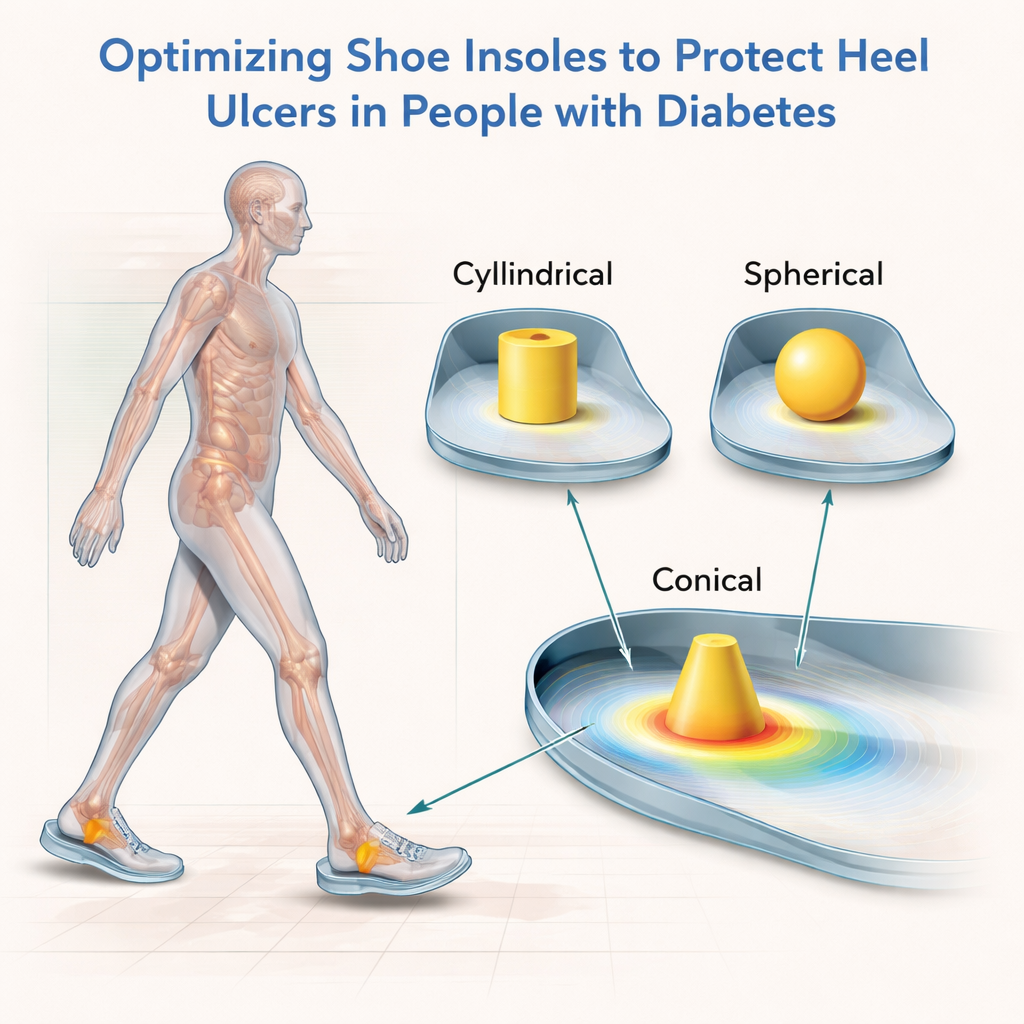
The researchers focused on three simple geometries for an empty space (or “void”) under a simulated heel wound: a cylinder, a sphere, and a cone. Each shape was tested at three sizes: 50% smaller than a common clinical size, the common size itself, and 50% larger. All insoles were made from the same cushioning foam and precisely milled from computer‑aided designs so that only the shape and size of the void changed. A healthy volunteer walked barefoot and then with each insole over a pressure‑sensing platform, allowing the team to measure how each design redistributed pressure under the feet during natural walking.
Combining Real Walking with Computer Models
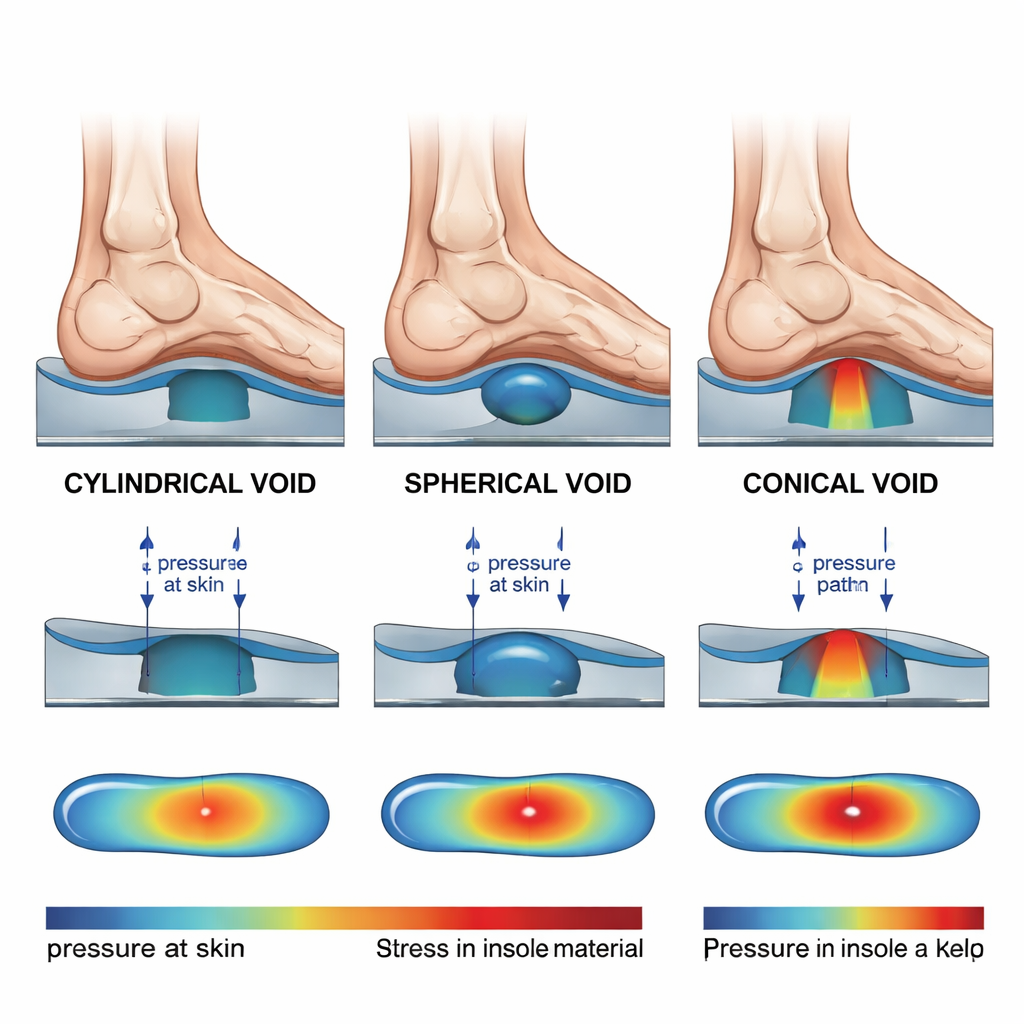
Measuring pressures on the skin surface tells only half the story. An insole that greatly reduces pressure at the heel might still develop dangerous internal stress that leads to cracking, deformation, or loss of support over time. To tackle this, the authors combined their gait measurements with detailed computer simulations known as finite element analysis. Using real material tests of the foam to set up their model, they calculated how each void shape and size changed stress and deformation within the insole during two key moments of walking: the instant the heel hits the ground and the period when the heel is fully loaded.
What Helped the Heel—and What Stressed the Insole
The walking tests showed that all three void shapes lowered peak pressure compared with barefoot walking, but not equally. The conical void produced the largest drop, cutting peak heel pressures by about one‑third in both feet. The spherical void performed almost as well, while the cylindrical void gave a smaller yet consistent reduction. The computer models, however, revealed a trade‑off: larger conical and spherical voids tended to generate high, focused stress inside the foam, which may shorten insole life or cause performance to deteriorate. Cylindrical voids, especially at larger diameters, spread stress more evenly and kept internal forces lower and more predictable, although they did not reduce peak skin pressure as aggressively.
Finding a Practical Balance for Patients
Taken together, the results suggest there is no single “perfect” void shape; instead, each offers a different balance between immediate protection and long‑term durability. Conical voids may be best when maximum short‑term pressure relief is needed for a severe or stubborn heel ulcer, but they may demand closer monitoring and more frequent replacement. Spherical voids offer a middle ground, with strong offloading and more favorable internal stress, making them promising for longer‑term use. Cylindrical voids deliver the most robust and predictable behavior, which could be valuable for wider clinical use or for patients with larger risk areas. Although this feasibility study used only one healthy volunteer, it demonstrates a powerful approach—combining real‑world walking data with computer modeling—to design smarter, patient‑specific insoles that better protect vulnerable heels.
Citation: Karatoprak, A.P., Aydin, L. Combining gait analysis and finite element modeling to optimize offloading insoles for calcaneal ulcers. Sci Rep 16, 6383 (2026). https://doi.org/10.1038/s41598-026-35750-9
Keywords: diabetic foot ulcers, heel pressure, offloading insoles, gait analysis, finite element modeling