Clear Sky Science · en
AI-enhanced virtual reality martial arts training: how technology readiness, instructional design, usefulness, and instructor competency drive learning performance through cognitive absorption
Training for the Future of Martial Arts
Imagine learning martial arts from a coach who never gets tired, can replay every move in slow motion, and gives instant, precise feedback on each punch and kick. This study explores exactly that kind of training, combining artificial intelligence (AI) with virtual reality (VR) to see whether high-tech dojos can genuinely improve real-world fighting skills—and why some people learn more from them than others.
A High-Tech Dojo in Your Headset
The research centers on an AI-enhanced VR system built specifically for martial arts. Participants wore VR headsets and tracking suits while training in lifelike digital dojos against virtual opponents modeled on elite athletes. Behind the scenes, AI analyzed their body movements in real time, compared them to thousands of hours of expert techniques, and delivered tailored corrections and difficulty adjustments. Across karate, taekwondo, boxing, mixed martial arts, and traditional Chinese styles, 847 practitioners from six countries completed at least six supervised sessions, while the system recorded fine-grained data on accuracy, timing, balance, and engagement.
The Secret Ingredient: Total Mental Immersion
Rather than just asking whether the technology "works," the study set out to explain how it works. The author proposed a Technology-Enhanced Experiential Learning (TEEL) framework, which puts a mental state called "cognitive absorption" at the center. In everyday terms, this is the feeling of being completely absorbed in an activity: losing track of time, focusing intensely, and enjoying the challenge. The framework suggests that four things shape how deeply people get into this state during AI-VR training: their comfort with technology, the quality of the lesson design, how useful they believe the system to be, and how skilled the (human or virtual) instructor is at guiding them.
From Focused Mind to Sharper Strikes
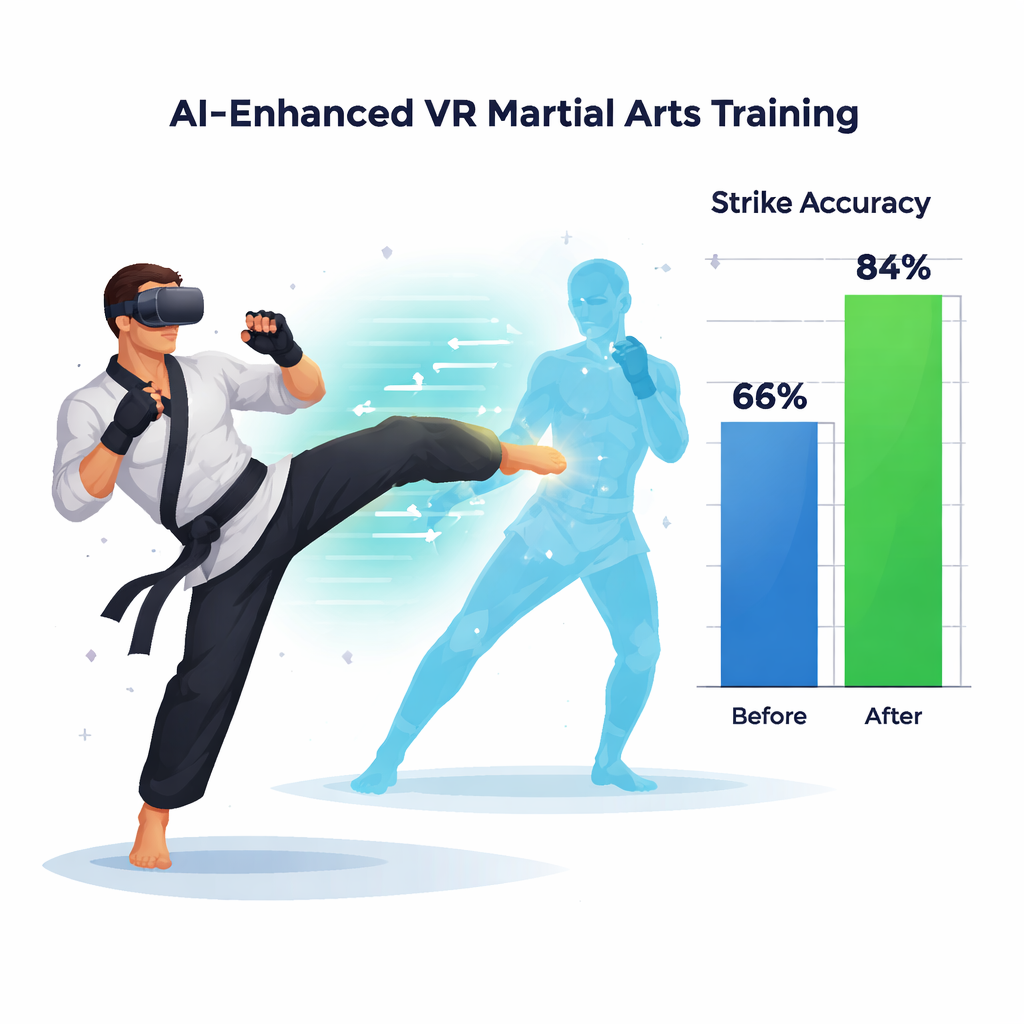
Using advanced statistical modeling with survey data and system logs, the study found that these four factors all strongly fed into cognitive absorption, and that this absorbed state, in turn, was the main driver of learning gains. People who felt ready for technology, followed clearly structured VR lessons, trusted the system’s usefulness, and experienced competent instruction were far more likely to report being “in the zone.” That deep focus was closely linked to better performance measures, from higher self-rated skill and confidence to objective improvements. Strike accuracy, for example, climbed from about 64% in the first session to nearly 88% by the sixth, and most technical errors were corrected within just a few rounds of AI feedback.
Voices from Inside the Headset
To go beyond numbers, the researcher interviewed 45 participants. Many described the training as so immersive that they “forgot time” and felt like they were in real combat rather than a simulation. They praised the AI’s ability to pinpoint weaknesses and adapt the difficulty so that the training stayed challenging but not overwhelming. Several reported starting out nervous about the technology but quickly growing confident, and many said that movements practiced in VR carried over into live sparring. These personal accounts echoed the statistical findings: when the technology felt approachable, the lessons were well designed, and feedback was clear, learners slipped into deep engagement and progressed faster.
Why AI Makes a Difference
The study also compared AI-enhanced VR with a simpler VR setup that lacked intelligent feedback. The AI version explained much more of the improvement in learning performance, suggesting that it is not just the virtual environment that matters, but how smart and responsive it is. Still, experience and age played a role: seasoned practitioners and older learners tended to gain slightly more, likely because they could better connect the virtual drills to their existing skills. The findings point toward design priorities for future training systems: build users’ confidence with the technology, craft clear and motivating practice routines, and ensure that both human and virtual instructors use AI feedback effectively.
What This Means for Everyday Learners
For non-specialists, the takeaway is straightforward: high-tech martial arts training pays off most when it pulls you fully into the moment. Fancy hardware alone does not guarantee better kicks or punches; what really counts is a training experience that feels engaging, personal, and well guided. In this study, AI-enhanced VR did exactly that, helping hundreds of practitioners reach a state of intense focus that translated into real, measurable improvements. As similar systems spread to sports, workplaces, and classrooms, the lesson is clear: the best learning technologies will be the ones that are not just impressive to look at, but are carefully designed to help our minds lock in and stay absorbed.
Citation: Zhang, Z. AI-enhanced virtual reality martial arts training: how technology readiness, instructional design, usefulness, and instructor competency drive learning performance through cognitive absorption. Sci Rep 16, 6301 (2026). https://doi.org/10.1038/s41598-026-35749-2
Keywords: virtual reality training, martial arts learning, artificial intelligence coaching, immersive education, sports technology