Clear Sky Science · en
Research on surrounding rock deformation characteristics and support optimization measures for tunnel TBM crossing through fault fracture zones
Why tunnels through mountains can suddenly misbehave
Long highway and railway tunnels now thread through some of the world’s highest and most rugged mountains. These passages are usually carved by giant tunnel boring machines (TBMs) that grind steadily through solid rock. But when a TBM meets a hidden fault zone—rock that has been shattered and weakened by ancient earthquakes—the tunnel can deform, collapse, or even trap the machine. This study examines such a high‑risk encounter in a Chinese mountain tunnel and shows how a carefully designed support system can sharply cut those dangers.
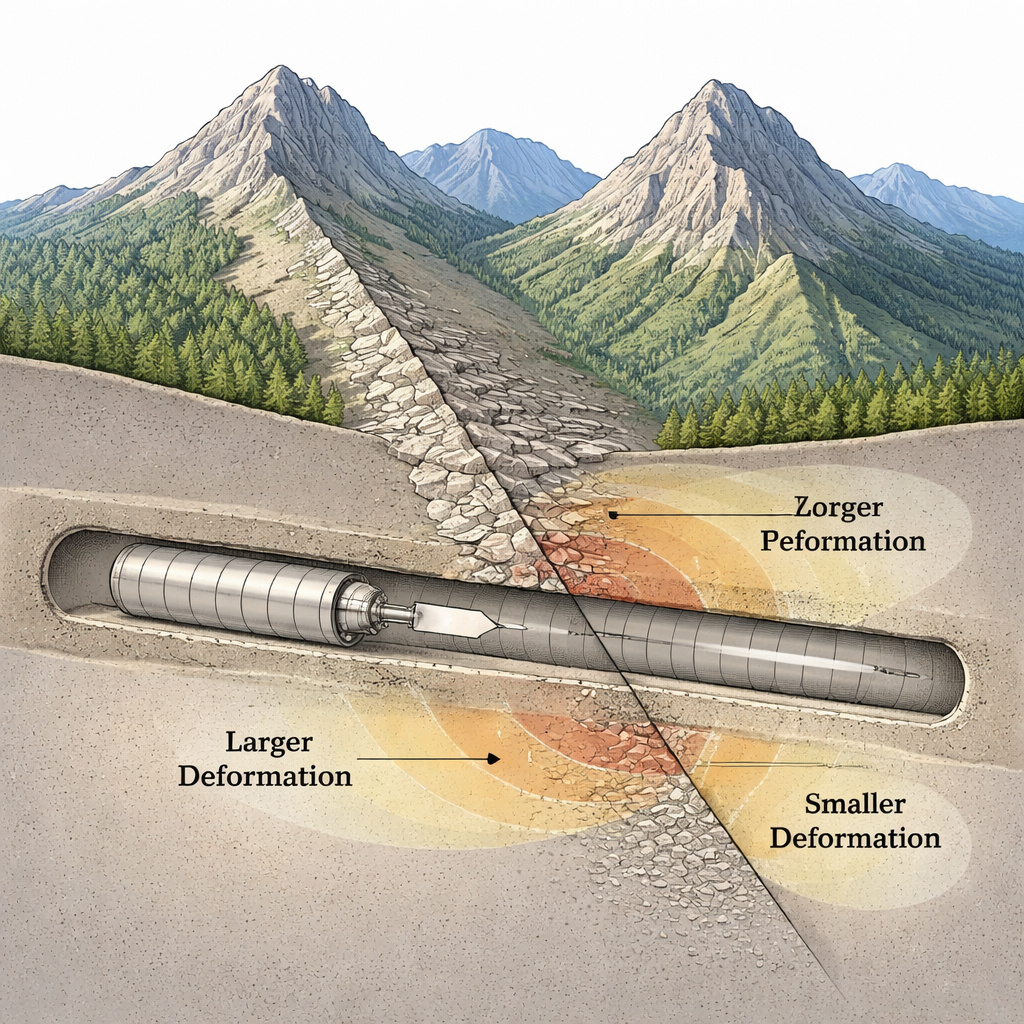
A troubled stretch in a deep mountain tunnel
The research focuses on the Daliangshan No. 1 Tunnel in Sichuan Province, which runs more than 10 kilometers under steep, V‑shaped valleys. Most of the route passes through relatively strong rock, but one section crosses the F1 fault fracture zone, where once‑solid basalt and tuff have been broken into weak, weathered fragments. In this zone, the rock ceiling and walls shed blocks, large cavities open, water seeps in, and the usual contact points where the TBM braces itself against the rock lose strength. During early excavation, these conditions led to heavy rock fall, distorted steel supports, convergence of the tunnel walls, and even an episode where the TBM became stuck after a shutdown.
Measuring how the ground moves
To understand what was happening—and how to control it—the team combined three approaches. In the laboratory, they tested powdered core samples from the fault zone to determine how weak the altered rock really was. In the computer, they used the ABAQUS finite‑element program to simulate a TBM advancing through an 8‑meter‑wide tunnel intersecting a 40‑meter‑wide fault band dipping at 40 degrees. And in the field, they installed instruments along several cross‑sections to monitor how the tunnel roof (vault), walls, and ground surface moved as excavation progressed. This mix of testing, modeling, and on‑site measurement allowed them to link what was seen underground with the invisible redistribution of stresses in the surrounding mountains.
What happens when the machine meets the fault
The simulations and measurements revealed a clear pattern: deformation was “larger in the middle and smaller at both ends” of the fault zone. As the TBM entered the weakest core of F1, the tunnel roof sagged dramatically—up to 92 millimeters—while the ground surface above settled by as much as 42 millimeters. The roof began to settle about 10 meters before the machine reached a monitored section, and continued to move until roughly 10 meters beyond it. The sidewalls responded later and less strongly, with maximum movements around 15 millimeters. Away from the fault, where rock was more intact, settlement increments fell below 5 millimeters and the tunnel behavior became much more stable. Without intervention, however, the large displacements in the fault core threatened both worker safety and the TBM’s ability to keep moving.
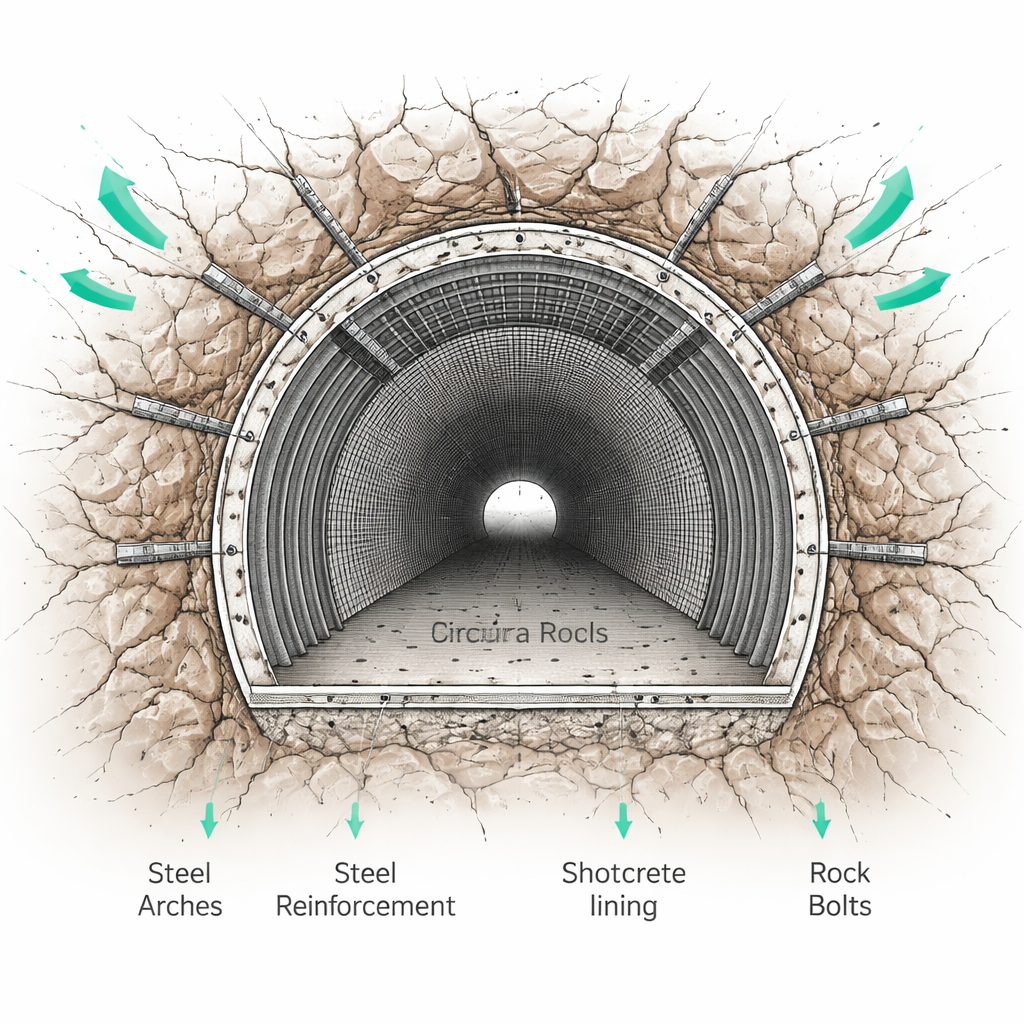
Building a stronger shell around the tunnel
Guided by these findings and experience from other projects, the engineers designed a reinforced support system tailored to the faulted ground. Instead of relying only on steel ribs and basic shotcrete, they added a dense array of new steel reinforcement strips around much of the tunnel circumference, upgraded the sprayed concrete to higher‑strength mixes, and used formwork and grouting to create a solid bearing seat where the TBM’s gripper shoes press against the walls. In very loose or collapsing areas, they installed self‑drilling rock bolts and glass‑fiber anchors and filled cavities and karst voids with concrete. Numerical models incorporating these measures predicted much smaller movements, and field monitoring confirmed the improvement.
How much safer the tunnel became
After reinforcement, maximum roof settlement at all monitored sections dropped to about 17 millimeters, and surface settlement to about 7 millimeters—reductions of roughly 80 percent compared with the unreinforced case. The tunnel walls and arch foot moved only a few millimeters, and the overall deformation pattern became smoother and more predictable. Rock spalling and collapse cavities were significantly reduced, the bearing capacity for the TBM’s shoes improved, and the machine could advance continuously without renewed entrapment. In practical terms, the upgraded support turned a highly unstable reach of tunnel into a manageable engineering problem.
What this means for future tunnels
For non‑specialists, the key message is that “bad ground” in fault zones does not have to derail deep tunnel projects. By first measuring how the rock behaves, then simulating how the tunnel and mountain interact, and finally tailoring reinforcement to those conditions, engineers can greatly limit the amount the tunnel deforms—even in crushed, weathered rock one kilometer below the surface. The approach used in the Daliangshan No. 1 Tunnel offers a roadmap for other mountain tunnels that must cross similar combinations of weathered rock and active or ancient faults, improving safety and reducing the risk of costly TBM stoppages.
Citation: Lan, F., Du, W., Li, R. et al. Research on surrounding rock deformation characteristics and support optimization measures for tunnel TBM crossing through fault fracture zones. Sci Rep 16, 5572 (2026). https://doi.org/10.1038/s41598-026-35748-3
Keywords: tunnel boring machine, fault fracture zone, tunnel support, ground settlement, mountain tunnels