Clear Sky Science · en
Effect of Ti addition on microstructure and mechanical properties of Co–Cr–Mo alloy developed by µ-plasma arc metal powder additive manufacturing process
Stronger metals for longer-lasting knees
When we receive a knee implant, we trust it to carry our weight, day after day, for many years. Yet real implants can slowly wear out, loosen, or crack. This study explores a way to make one widely used implant metal not just stronger and tougher, but also friendlier to the body, by adding a small amount of titanium and building it with a precise 3D-printing-like process.
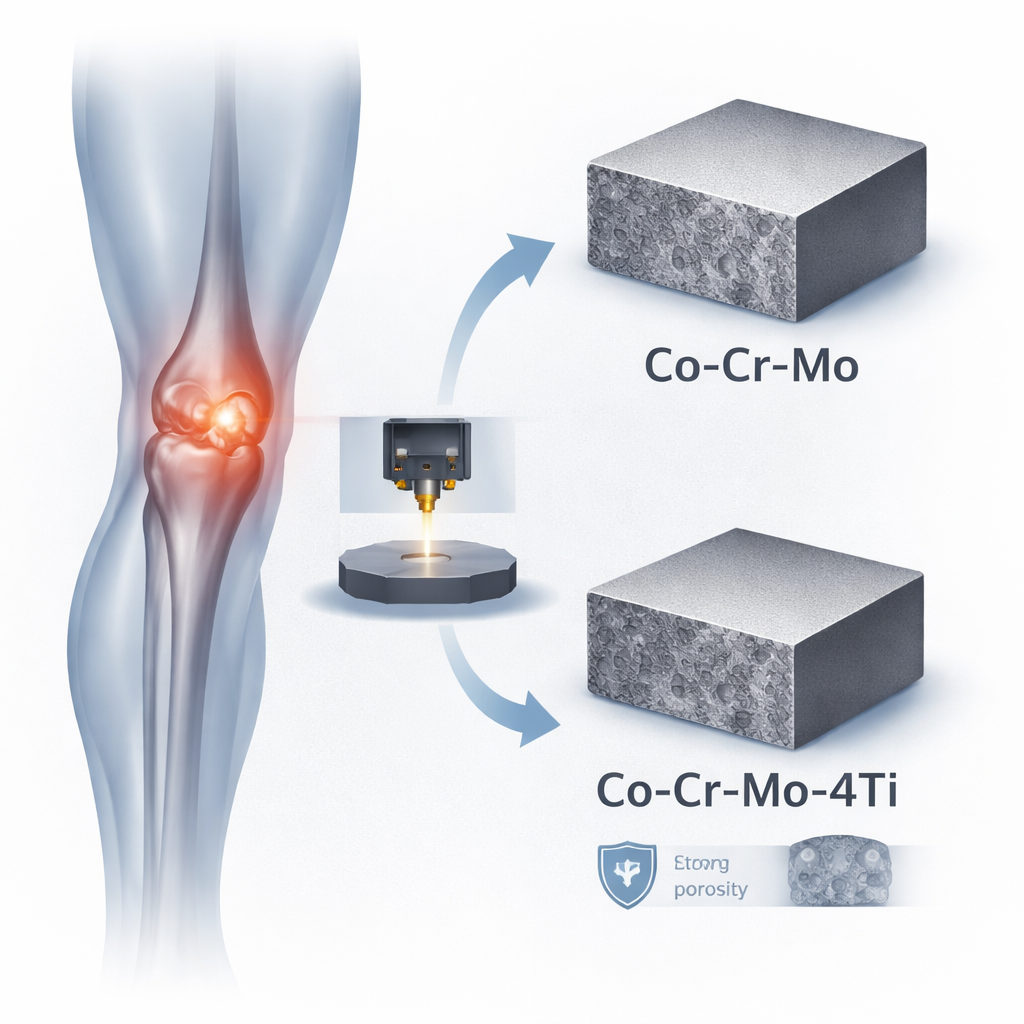
Why a common implant metal needs an upgrade
Modern artificial knees are often made from a cobalt–chromium–molybdenum alloy, chosen because it resists rusting inside the body and holds up well under the constant rubbing in a joint. However, this alloy is very stiff, which can shift stress away from bone, sometimes weakening it over time, and it can develop tiny pores and cracks that shorten the life of the implant. Titanium and its alloys are kinder to bone and lighter, but they do not resist wear as well. The authors set out to blend the best of both worlds by adding just 4 percent titanium by weight to the cobalt–chromium–molybdenum mix and fabricating it using a micro-plasma arc metal powder additive manufacturing process, a fine-scale metal 3D-printing method.
Printing a new kind of knee metal
Instead of casting or laser-melting the alloy in bulk, the team used a custom-built five-axis machine that feeds metal powders into a tiny plasma torch, laying down the material in thin layers. They first mixed high-purity powders of cobalt, chromium, molybdenum, and, for the new version, titanium, then dried them and deposited eight stacked layers on a titanium base plate. From these deposits they cut small test pieces for measuring density, porosity, hardness, and mechanical behavior in tension, compression, and bending. They also polished and chemically etched samples to look at the metal’s internal structure under powerful microscopes and to identify the different crystalline phases present.
What happens inside when titanium is added
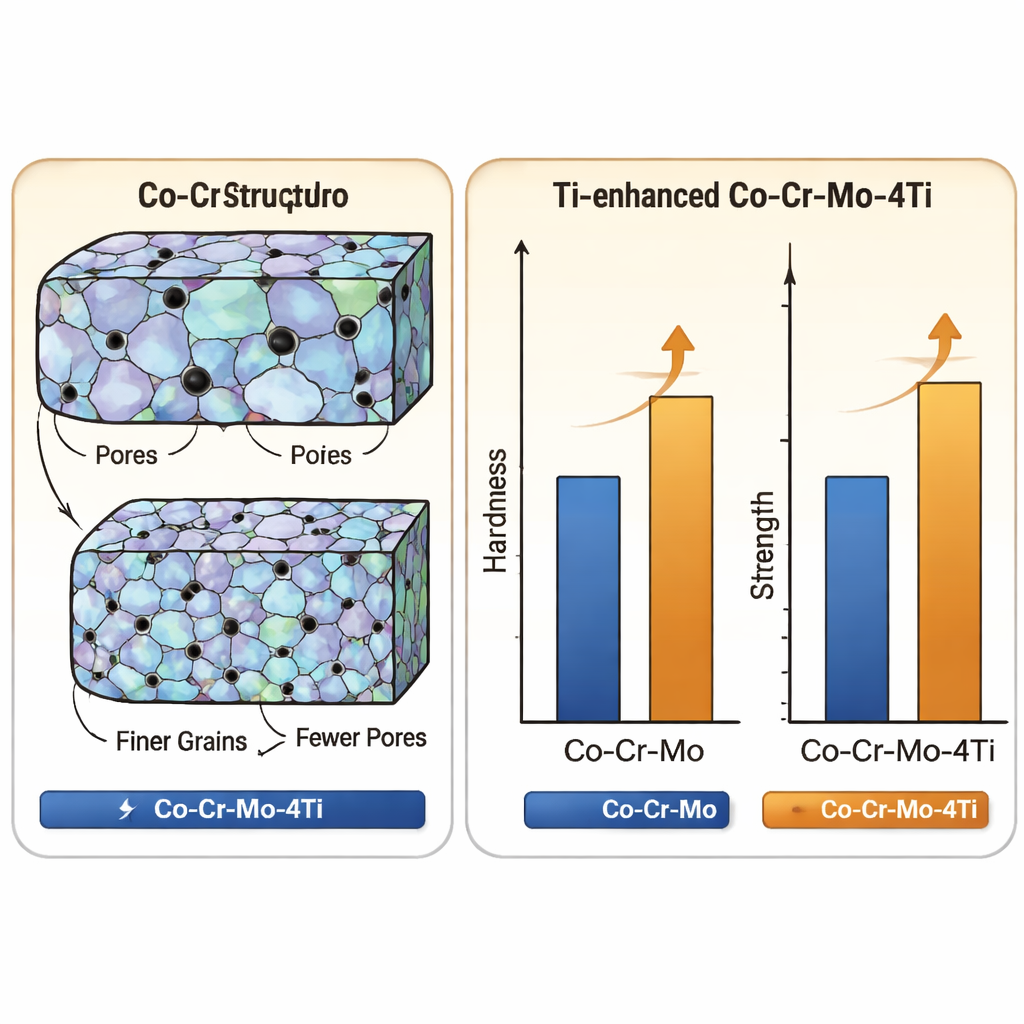
In the original alloy, the researchers saw a cobalt-rich structure with two main crystal forms, plus hard chromium carbides and small cracks linked to voids. When titanium was added, the grains inside the metal became finer and the number of micro-cracks dropped. New titanium-containing regions appeared, including a phase that is stable at high temperature and a cobalt–titanium compound that acts like a hard reinforcing particle. At the same time, overall porosity fell and density decreased slightly because titanium is lighter than cobalt, chromium, and molybdenum. A protective film of titanium oxide helped limit further oxidation, which also reduced pore formation.
From microstructure to real-world strength
These internal changes translated into clear performance gains. The titanium-modified alloy showed higher hardness values, indicating greater resistance to indentation and wear. In pulling tests, it had higher yield strength and ultimate tensile strength, while also stretching more before breaking, meaning it became both stronger and more ductile. In compression, the new alloy withstood higher loads and showed a larger increase in cross-sectional area, a sign that it could absorb more energy without failing. Three-point bending tests, which mimic out-of-plane loading that implants may experience, also favored the titanium-containing version, with higher flexural strength and greater bending before fracture. The combination of finer grains, fewer pores, and hard cobalt–titanium particles worked together to block the tiny shifts in the crystal lattice that lead to permanent deformation and crack growth.
What this means for future knee implants
Overall, adding a small amount of titanium and shaping the alloy via micro-plasma additive manufacturing produced a metal that is lighter, less porous, harder, and mechanically superior in stretching, squeezing, and bending compared with the standard cobalt–chromium–molybdenum alloy. Because it is slightly less stiff and more forgiving under load, it should reduce the mismatch in stiffness between metal and bone, easing the so-called stress-shielding problem. While further biological and long-term testing is needed, this work suggests that carefully tuned titanium additions and advanced metal 3D-printing techniques could lead to knee implants that last longer, fail less often, and feel more natural for patients.
Citation: Negi, B.S., Arya, P.K., Jain, N.K. et al. Effect of Ti addition on microstructure and mechanical properties of Co–Cr–Mo alloy developed by µ-plasma arc metal powder additive manufacturing process. Sci Rep 16, 7308 (2026). https://doi.org/10.1038/s41598-026-35741-w
Keywords: knee implants, cobalt chromium alloy, titanium reinforcement, additive manufacturing, biomedical materials