Clear Sky Science · en
Rough cubic intuitionistic fuzzy soft relation framework for risk identification and hospital selection in breast cancer treatment
Why choosing the right hospital can be so tricky
When someone is facing breast cancer, doctors must weigh many uncertain clues: tumor size, scan images, lymph-node involvement, family history, and more. None of these pieces of information is perfectly clear, and specialists may hesitate or disagree. This paper presents a new mathematical decision tool designed to navigate that uncertainty, helping clinicians identify higher-risk patients and match them to the most suitable hospital, while being honest about what is known, what is doubtful, and what lies in between. 
Many shades of "yes," "no," and "not sure"
Traditional decision models often treat information as either true or false, or at best somewhere along a single fuzzy scale between 0 and 1. But real medical data are richer and messier. A test result can partly support a diagnosis, partly argue against it, and still leave room for doubt. The framework in this study keeps track of four aspects at once: how strongly evidence supports a statement (membership), how strongly it speaks against it (non-membership), how much genuine hesitation remains, and how wide a range these values might span. Instead of squeezing all uncertainty into one number, it represents it as a small data “cube” that captures both degree and spread of belief.
Linking patients, test results, and hospitals
On top of this multi-layered description of uncertainty, the authors add another ingredient: soft relations. These are flexible links between different sets of objects—for example, between patients and diagnostic factors, or between diagnostic factors and hospitals. Each link can be weak or strong, and can vary from one setting or expert to another. By combining these links with the cubic uncertainty cubes, the model can form lower and upper “approximations” of risk: a conservative estimate of who is definitely high risk, and a broader boundary that includes those who might be high risk given the current doubts.
Zooming in on breast cancer risk and hospital choice
To demonstrate how this works in practice, the authors build a case study involving five hypothetical breast cancer patients and four clinically important factors: tumor size, uniformity of tumor shape in images, lymph-node status, and family history. Experts express their opinions about each patient-factor pair using the new uncertainty cubes. The framework then propagates this information through the soft relations that connect patients to hospitals, computing scores that reflect both evidence and hesitation. In the example, one patient clearly emerges as having the highest current risk level, while family history stands out as the single most influential factor when looking at possible future developments. 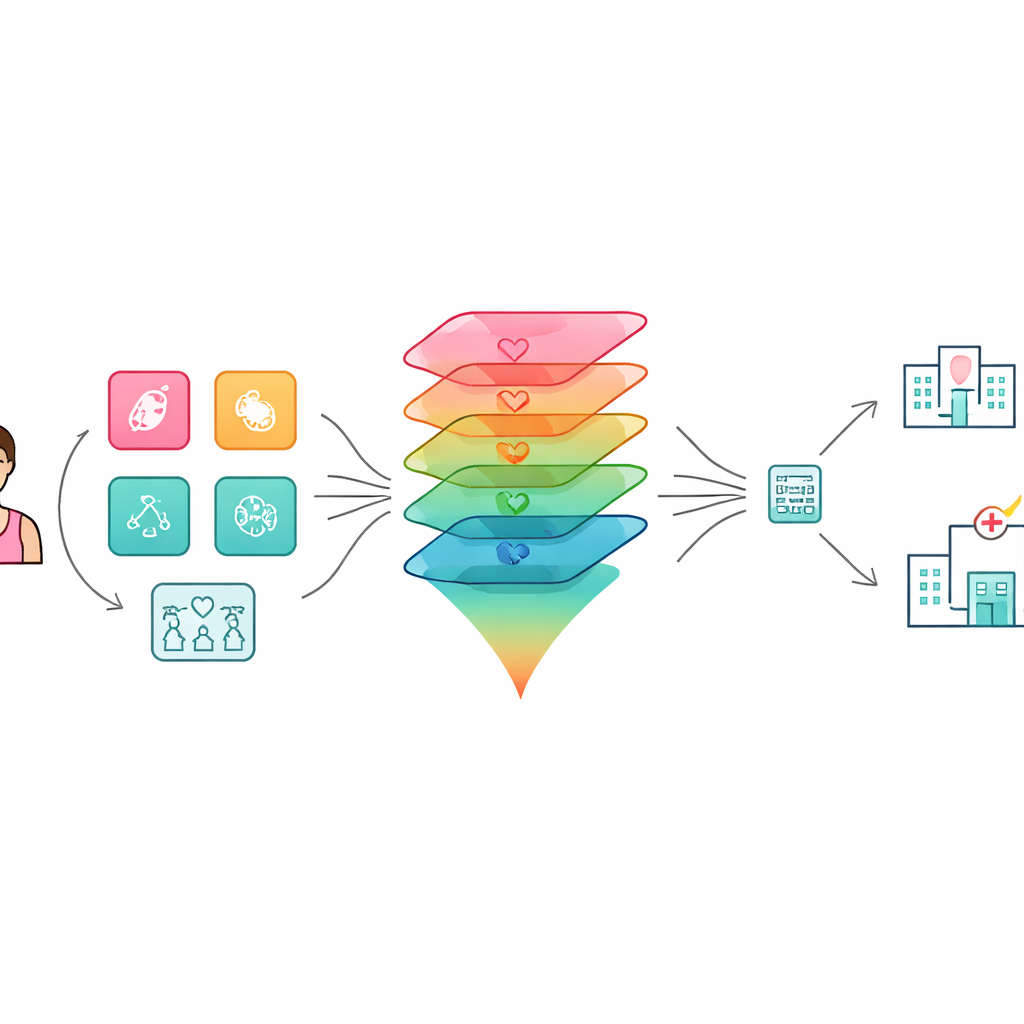
Outperforming older decision tools
The team compares their approach with several established methods based on fuzzy sets, intuitionistic fuzzy sets, and rough sets used separately. Those earlier tools can either measure partial truth, or draw crisp boundaries, but they struggle to handle overlapping uncertainties, interval ranges, and expert hesitation in a unified way. Using the same data, the new framework produces tighter boundaries between high- and low-risk groups, which means less “gray zone” where decisions are ambiguous. Quantitative tests show that their method yields higher cumulative scores indicating clearer, more decisive approximations, while qualitative analysis suggests it is also more interpretable for complex, multi-criteria choices.
From breast cancer to wider real-world decisions
Although the paper focuses on breast cancer risk and hospital selection, the authors emphasize that their framework is a general decision engine for any situation where data are incomplete, conflicting, or imprecise. Environmental policy, financial risk assessment, engineering design, and group decision-making among multiple experts are all possible applications. The main message for non-specialists is that better mathematical handling of uncertainty can support more transparent and defensible choices: clearly highlighting which patients are safest, which are most at risk, and how confident we should be in those calls, rather than masking doubt behind a single oversimplified score.
Citation: Bashir, S., Shabir, M., Bibi, A. et al. Rough cubic intuitionistic fuzzy soft relation framework for risk identification and hospital selection in breast cancer treatment. Sci Rep 16, 9141 (2026). https://doi.org/10.1038/s41598-026-35732-x
Keywords: breast cancer risk, medical decision support, uncertainty modelling, hospital selection, fuzzy rough sets