Clear Sky Science · en
Influence of coir and flax fiber lengths on fracture toughness of fly ash, slag, and silica fume-based geopolymer concrete
Greener Concrete That Can Take a Hit
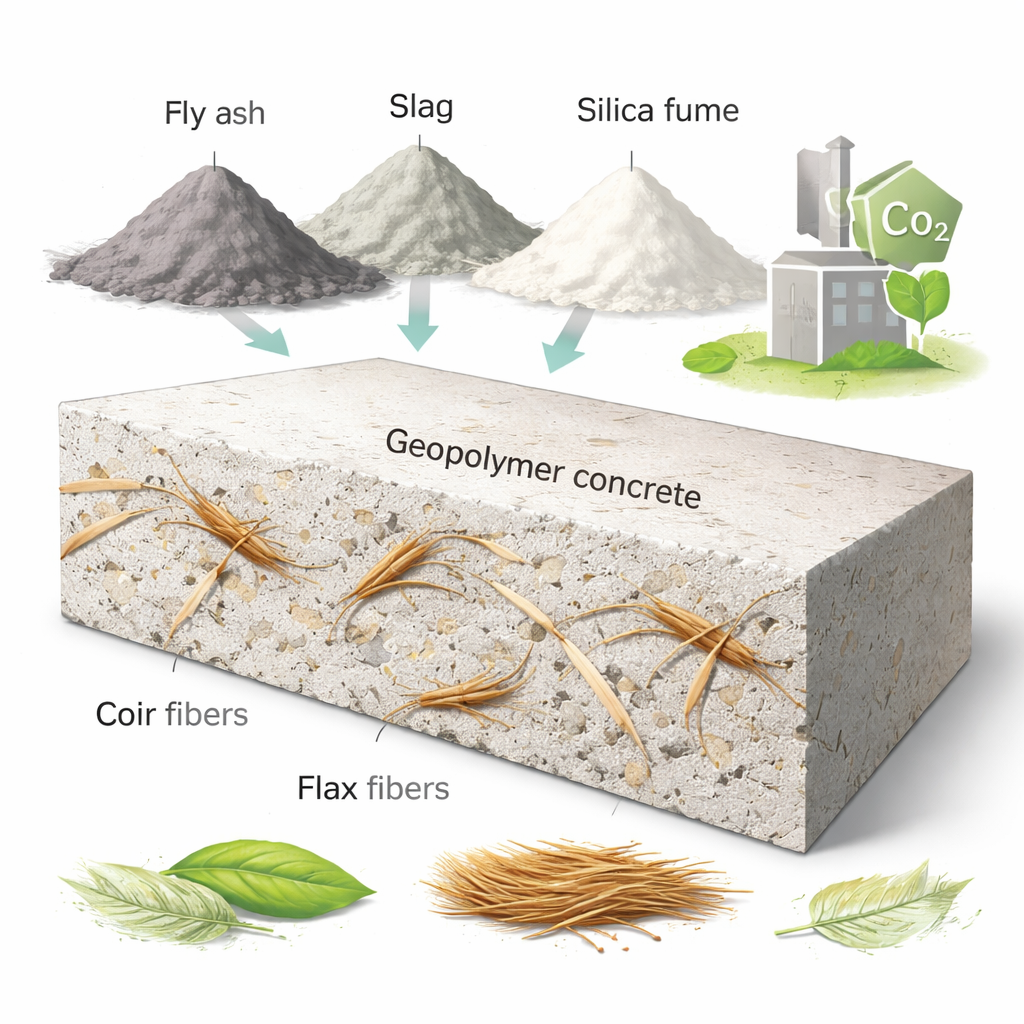
Concrete is everywhere—from bridges and buildings to sidewalks—but the way we make it today pumps large amounts of carbon dioxide into the atmosphere. Engineers are searching for greener versions that still stand up to heavy use, impacts, and cracking. This study looks at a promising alternative called geopolymer concrete, made from industrial by-products instead of Portland cement, and asks a simple, practical question: can adding short plant fibers from coconuts (coir) and flax make this greener concrete tougher and more crack‑resistant?
From Industrial Waste to Building Blocks
Traditional cement is responsible for roughly 8% of global CO₂ emissions. Geopolymer concrete tackles this problem by replacing much of the cement with waste powders such as fly ash from power plants, slag from steelmaking, and silica fume from metal production. When these powders are mixed with an alkaline solution, they form a dense, stone-like binder that can rival or even exceed the durability of ordinary concrete. However, like glass, this material tends to be brittle: once a crack starts, it can race through the structure, threatening safety and shortening service life. Improving its “fracture toughness”—its ability to resist crack growth—is therefore critical if geopolymer concrete is to be used widely in real structures.
Weaving Natural Fibers into the Mix
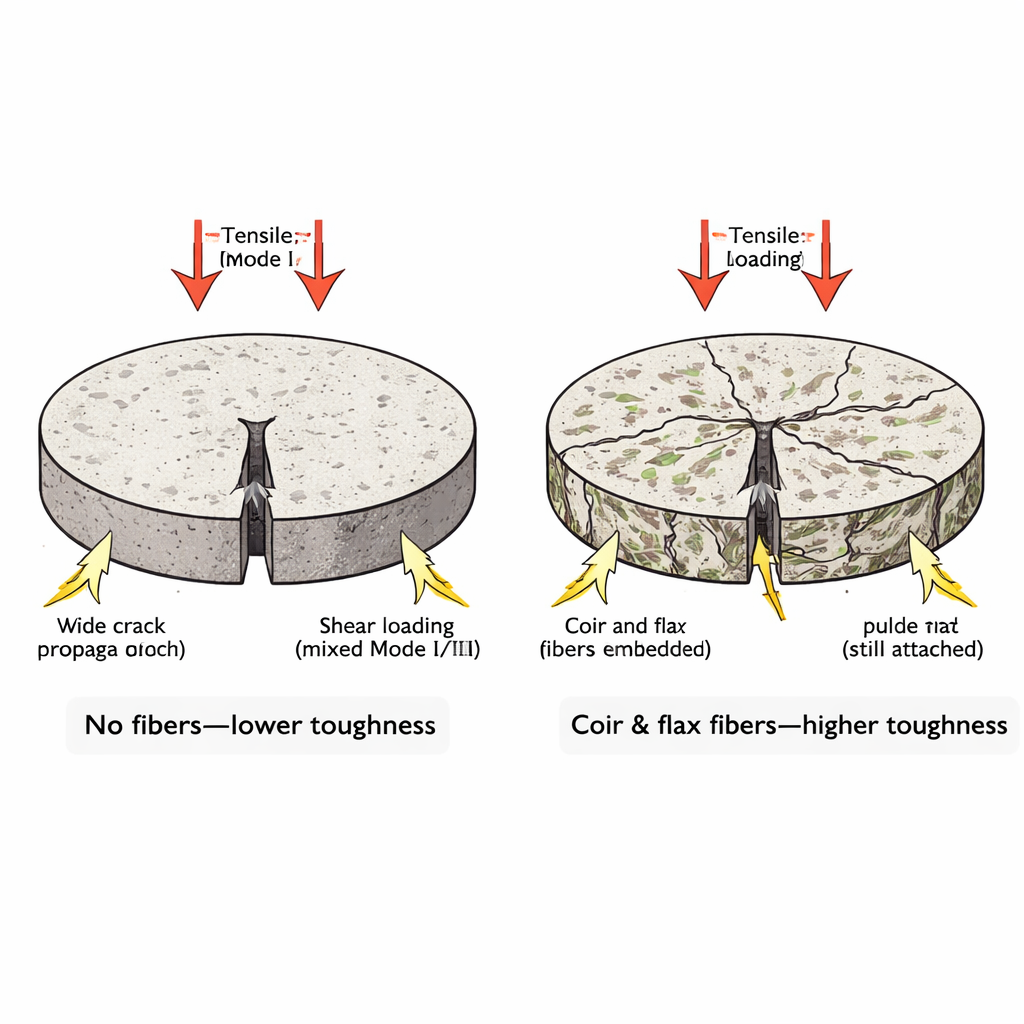
The researchers focused on two plant fibers that are abundant and inexpensive: coir, taken from coconut husks, and flax, used in textiles. Both are renewable and light, and earlier work hinted that they could help concrete absorb more energy when it cracks. In this study, the team kept the fiber content low (only 0.5% of the concrete volume) but adjusted the fiber length to 20, 40, or 60 millimeters. They cast disc-shaped geopolymer specimens and cut a notch in each, then broke them under carefully controlled loading setups that mimic how real cracks open (mode I), slide under twisting (mode III), or experience a combination of both. By comparing how much force each specimen could withstand before the crack took off, they quantified how tough each mixture really was.
Finding the Sweet Spot for Crack Resistance
The results revealed a clear “sweet spot.” Fibers 40 millimeters long provided the greatest gains in toughness across all loading conditions. Under simple crack opening, coir at this length boosted fracture toughness by almost 19%, while flax improved it by about 15%. When tension and twisting were combined—closer to the complex stresses found in real structures—the 40 millimeter coir mix raised toughness by over 20%, with flax trailing slightly behind. Shorter 20 millimeter fibers helped, but not as much, because they do not span cracks as effectively. Surprisingly, making the fibers even longer, to 60 millimeters, made the concrete worse than the fiber‑free control in some tests. These long fibers tended to clump together, create voids, and disrupt smooth load transfer, acting more like weak spots than reinforcements.
What Happens Inside the Concrete
Microscope and chemical analyses shed light on why the 40 millimeter fibers work best. The geopolymer binder itself forms a dense, continuous gel that fills space between sand and stone particles, with some leftover crystals such as quartz and mullite acting as rigid fillers. Coir fibers, with their rough surfaces and ability to stretch, bond well to this matrix and then gradually debond when stressed, pulling out slowly and bridging the crack as it grows. This controlled pull‑out process soaks up energy and slows fracture. Flax fibers, although stronger in pure tension, are stiffer and smoother; they tend to lose grip more suddenly and are surrounded by more reaction products, making the interface less stable. Thermal and infrared measurements further showed that the matrix is relatively dense and stable, with limited porosity and some beneficial carbonation that tightens the microstructure—but shear‑dominated cracking still remains difficult to control.
What This Means for Future Structures
For non-specialists, the takeaway is straightforward: a low dose of medium‑length plant fibers can make greener geopolymer concrete noticeably tougher without changing its basic recipe. Coir, in particular, acts like tiny, natural stitches that hold cracks together after they form, allowing the material to absorb more punishment before breaking apart. Making the fibers too long backfires, however, because they clump and create weak zones. This work suggests practical guidelines for designing next‑generation, lower‑carbon concretes that are not only kinder to the climate but also better able to resist cracking in real‑world bridges, pavements, and buildings.
Citation: Bazarkhankyzy, A., Aibuldinovńska, Y., Iskakova, Z. et al. Influence of coir and flax fiber lengths on fracture toughness of fly ash, slag, and silica fume-based geopolymer concrete. Sci Rep 16, 5596 (2026). https://doi.org/10.1038/s41598-026-35731-y
Keywords: geopolymer concrete, natural fiber reinforcement, coir and flax fibers, fracture toughness, sustainable construction materials