Clear Sky Science · en
Comparative analysis of ovine and human aortic valve tissue for bioprosthetic valve development using relaxation tests and numerical simulation
Why Heart Valve Materials Matter
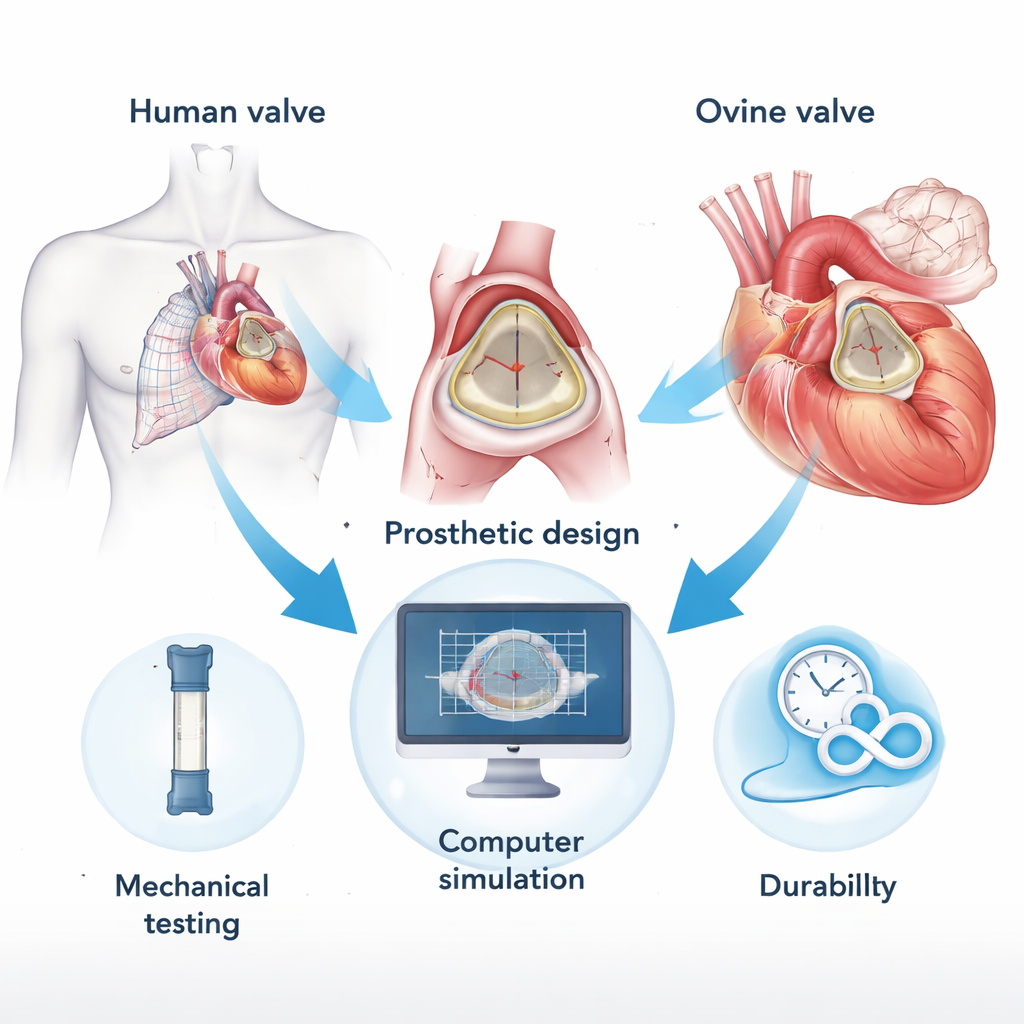
Every time your heart beats, its aortic valve opens and shuts to keep blood flowing in the right direction. Over a lifetime, that valve moves billions of times, and if it fails, people often need an artificial replacement. Mechanical valves last a long time but require lifelong blood thinners; softer biological valves feel more natural but can wear out. This study asks a practical question: could carefully treated sheep (ovine) aortic valves behave enough like human valves—and even better than today’s common materials—to build longer-lasting, safer bioprosthetic heart valves?
Looking for a Better Replacement
Current biological (bioprosthetic) valves are often made from cow heart sac tissue, which can stiffen and break down over the years. The authors explored an alternative: using the actual aortic valve tissue from sheep, treated with chemicals to preserve it and reduce immune reactions and calcification. They compared this treated ovine tissue with natural human aortic valve leaflets, focusing on how the tissues stretch, relax, and handle the loads they would experience inside the body. Because valve performance depends heavily on the structure and behavior of collagen fibers—tiny strands that give the leaflets strength and flexibility—finding a material whose fibers behave like, or better than, human tissue is crucial.
Putting Valve Tissues to the Test
The team cut small, precisely shaped samples from the strongest, most uniform region of sheep valve leaflets, then chemically fixed them to mimic what is done for commercial valves. They pulled these tiny strips in one direction until they broke, recording how much force they could withstand and how stiff they were. Treated ovine tissue had an elastic modulus (a measure of stiffness) around 20 megapascals, while human valve samples in the literature ranged from about 6 to 28 megapascals. The sheep tissue turned out to be somewhat less stiff but more stretchable at failure than human tissue—an advantage for modern minimally invasive valves that must be tightly crimped into catheters and then expanded inside the heart without tearing.
How Valves Soften Under Constant Load
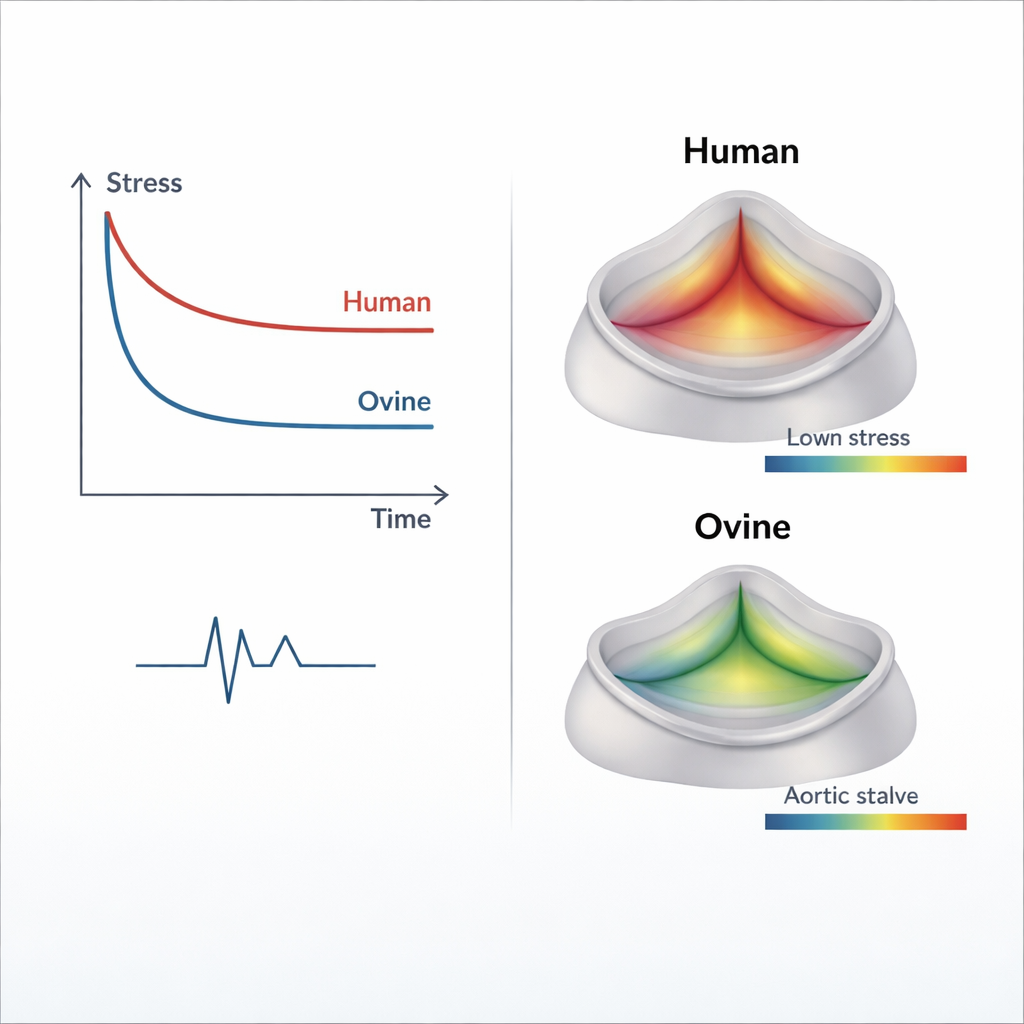
Valves are not rigid springs; they are viscoelastic, meaning they slowly relax and redistribute stress when stretched. To capture this time-dependent behavior, the researchers performed stress relaxation tests: they stretched each sample quickly to a set fraction of its breaking strain and held it there for five minutes, watching how the internal stress decayed. Human leaflets lost about 21% of their initial stress over 300 seconds, while treated ovine tissue lost about 41%, indicating that the sheep valves are more viscoelastic and better at soaking up shock and spreading out load over time. Using a standard mathematical framework called quasi-linear viscoelasticity, they fitted a detailed model to these data, extracting parameters that describe both the instant elastic response and the slower relaxation phases.
Simulating the Beating Heart
To see what these differences mean inside a working heart, the team built a three-dimensional computer model of an aortic valve in a common engineering program and assigned it either human or treated ovine tissue properties. They then applied realistic pressure waves from the left ventricle and aorta and followed how the virtual valve opened and closed through the heartbeat. At peak opening (systole), the maximum stress in the treated ovine valve leaflets was about 0.36 megapascals, roughly half the 0.72 megapascals found in the human-tissue model. During closure (diastole), patterns of stress and strain shifted from the attachment rim towards the central “belly” of the leaflets, matching clinical observations of where real valves tend to deteriorate. Overall, the ovine model showed lower or more favorably distributed stresses than human tissue and lower stresses than cow pericardium reported in earlier work.
What This Means for Future Heart Valves
In plain terms, the study suggests that carefully treated sheep aortic valves bend and relax in a way that is close to human valves but may experience lower peak stresses and greater flexibility. These features are promising for building bioprosthetic valves that can better survive the constant opening and closing inside the heart, especially in catheter-based implants that undergo intense crimping and expansion. While more complex tests—including multi-directional stretching, longer fatigue studies, and full fluid–structure simulations—are still needed, this work points to ovine aortic valve tissue as a strong candidate material for the next generation of softer, more durable heart valve replacements.
Citation: Masoumi, S.F., Rassoli, A., Changizi, S. et al. Comparative analysis of ovine and human aortic valve tissue for bioprosthetic valve development using relaxation tests and numerical simulation. Sci Rep 16, 7315 (2026). https://doi.org/10.1038/s41598-026-35729-6
Keywords: aortic valve, bioprosthetic valves, sheep heart tissue, viscoelasticity, finite element simulation