Clear Sky Science · en
Development of a shop floor scheduling and allocation framework for operations management excellence using cutting-edge technologies
Why smarter factory floors matter
Behind every car, crane, or washing machine lies a maze of people, machines, and materials that must work in sync. When this coordination on the factory floor breaks down, companies waste time, energy, and money—and customers wait longer for products. This article explores how a heavy-equipment manufacturer used modern digital tools to redesign the way work is scheduled and resources are allocated on its shop floor, dramatically boosting productivity and cutting waste.
A new way to run the factory day
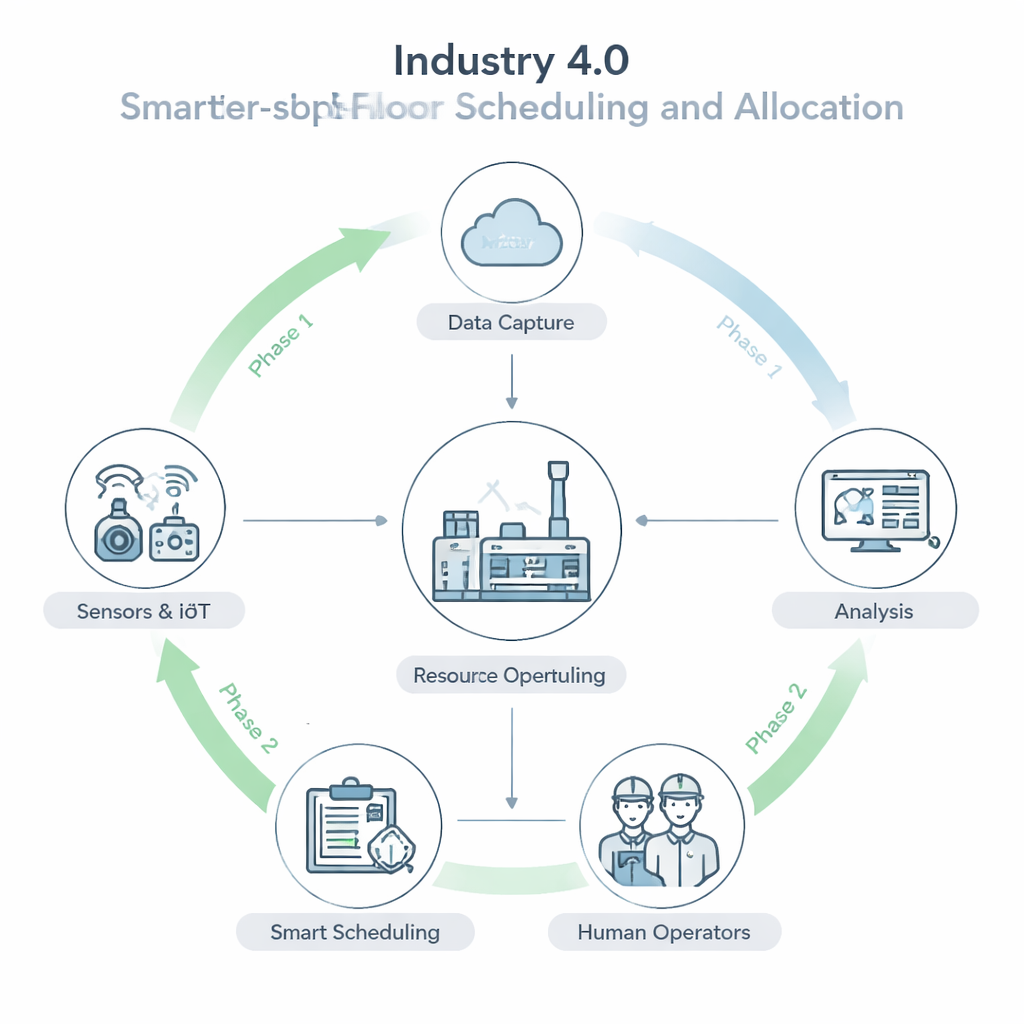
The authors propose a two-step strategy for improving how factories are run. First, they focus on understanding current operations in detail: how long tasks actually take, where machines sit idle, how workers move, and how much energy is used. They gather this information through connected sensors, cameras, and real-time monitoring tools inspired by the ideas of Industry 4.0, the latest wave of industrial digitalization. Second, they design an “intelligent” system that uses those data to create better schedules and assign people, machines, and floor space where they are most needed, instead of relying on rough estimates or paper-based plans.
From scattered data to a living control system
To turn scattered shop-floor information into a practical control framework, the researchers break the problem into five levels. At the base, they collect data on performance, availability, logistics, workforce activity, and energy use. Next, they store and organize these data using tools such as RFID tags for parts, real-time condition monitoring for machines, and cloud or server databases. Then they classify the information into clear categories—outputs, constraints, and resource use—so that managers can see patterns instead of raw numbers. On top of this, they design action plans to change layouts, adjust workflows, and fine-tune monitoring rules. Finally, they verify outcomes with supervisors and experts, closing the loop between digital insights and everyday decisions.
Putting the framework to the test in a real factory
The team applied this framework to the inspection department of a company that builds skid steer loaders, a type of compact construction machine. This department was plagued by familiar problems: no clear work plan, long idle times, large piles of work-in-progress, weak monitoring, and frequent delays in finishing orders. By mapping ten key inspection sections and identifying five major causes of poor performance—such as machine failures, communication gaps, and a weak resource allocation system—they built a detailed picture of how time and effort were being lost. Using that picture, they introduced targeted upgrades, including sensor-based condition monitoring, paperless work instructions, digital dashboards, big-data analysis, and automated alerts for unusual events.
What changed when the shop floor went smart
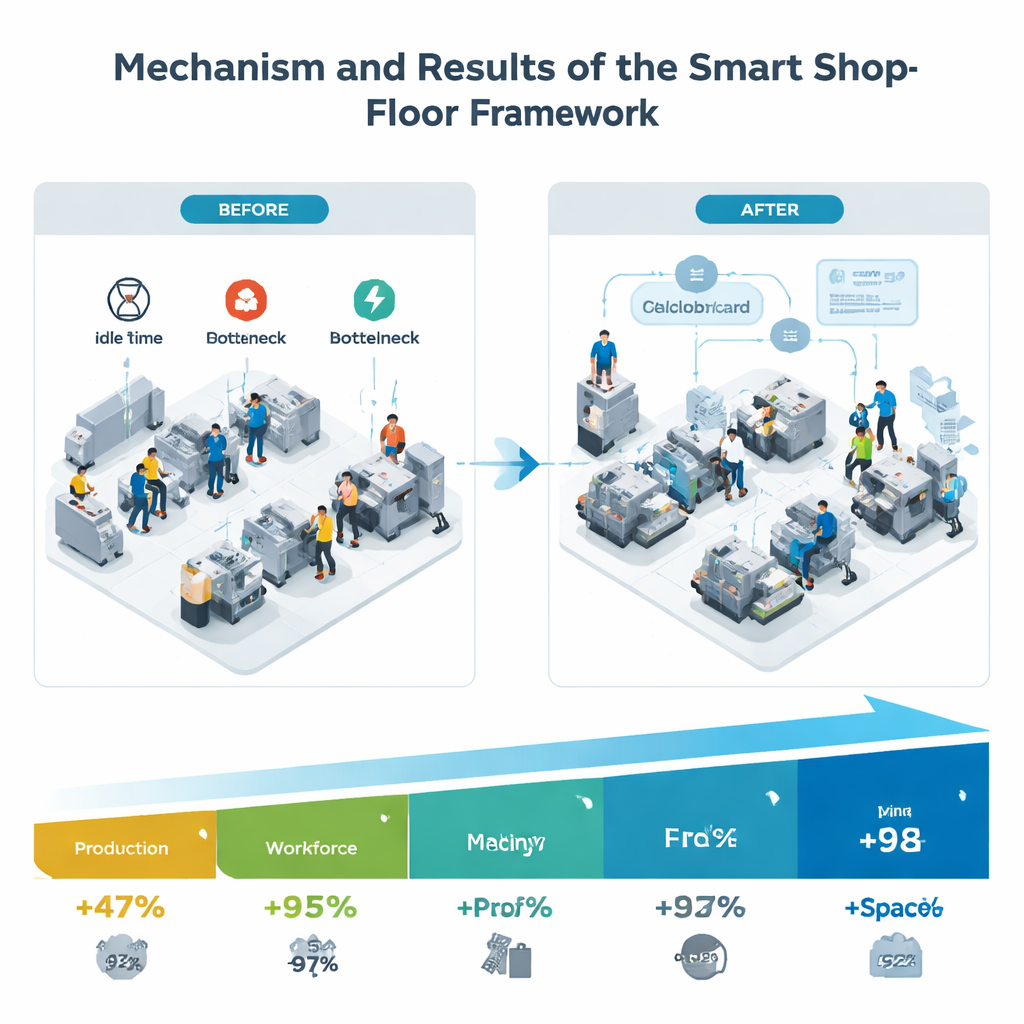
After the new system was in place, the researchers compared the upgraded shop floor with its previous state. Production per hour rose sharply, even though total available time changed only modestly. Machines ran more of the day instead of sitting idle, and workers spent a higher share of their shifts on value-adding tasks rather than waiting or searching for information. The numbers are striking: production rate increased by 47%, workforce contribution by 95%, machine utilization by 97%, and overall economic strength—essentially profit margin—by 75%. The system also made better use of energy and space, with the effectiveness of resource allocation up 92%, energy-related performance up 82%, and plant floor utilization up 98%.
What this means for factories and for all of us
For non-specialists, the message is straightforward: when factories combine real-time data with thoughtful planning, they can do far more with the people, machines, and energy they already have. Instead of adding new production lines or pushing workers harder, this approach makes existing operations smarter—cutting errors, reducing waste, and stabilizing quality. In practical terms, that can mean more reliable delivery times, lower costs, and a smaller environmental footprint for the products we use every day. The study suggests that as artificial intelligence and digital twin technologies mature, such intelligent shop-floor systems could become a standard route to operational excellence across many industries.
Citation: Tripathi, V., Chattopadhyaya, S. & Dewangan, S. Development of a shop floor scheduling and allocation framework for operations management excellence using cutting-edge technologies. Sci Rep 16, 6694 (2026). https://doi.org/10.1038/s41598-026-35726-9
Keywords: smart manufacturing, shop floor scheduling, Industry 4.0, IoT in factories, production optimization