Clear Sky Science · en
Functional movement screen and asymmetries in female volleyball players across playing positions
Why how you move matters in volleyball
Volleyball players leap, dive, twist, and land hundreds of times in a single match. These demanding motions can build impressive athleticism—but they can also quietly create imbalances in the body that may set the stage for injury. This study looked closely at how professional female volleyball players move, using a simple test called the Functional Movement Screen (FMS), to see whether different court positions show different movement patterns, and whether hidden left–right differences in the body might be linked to injury risk.
Checking the basics of movement
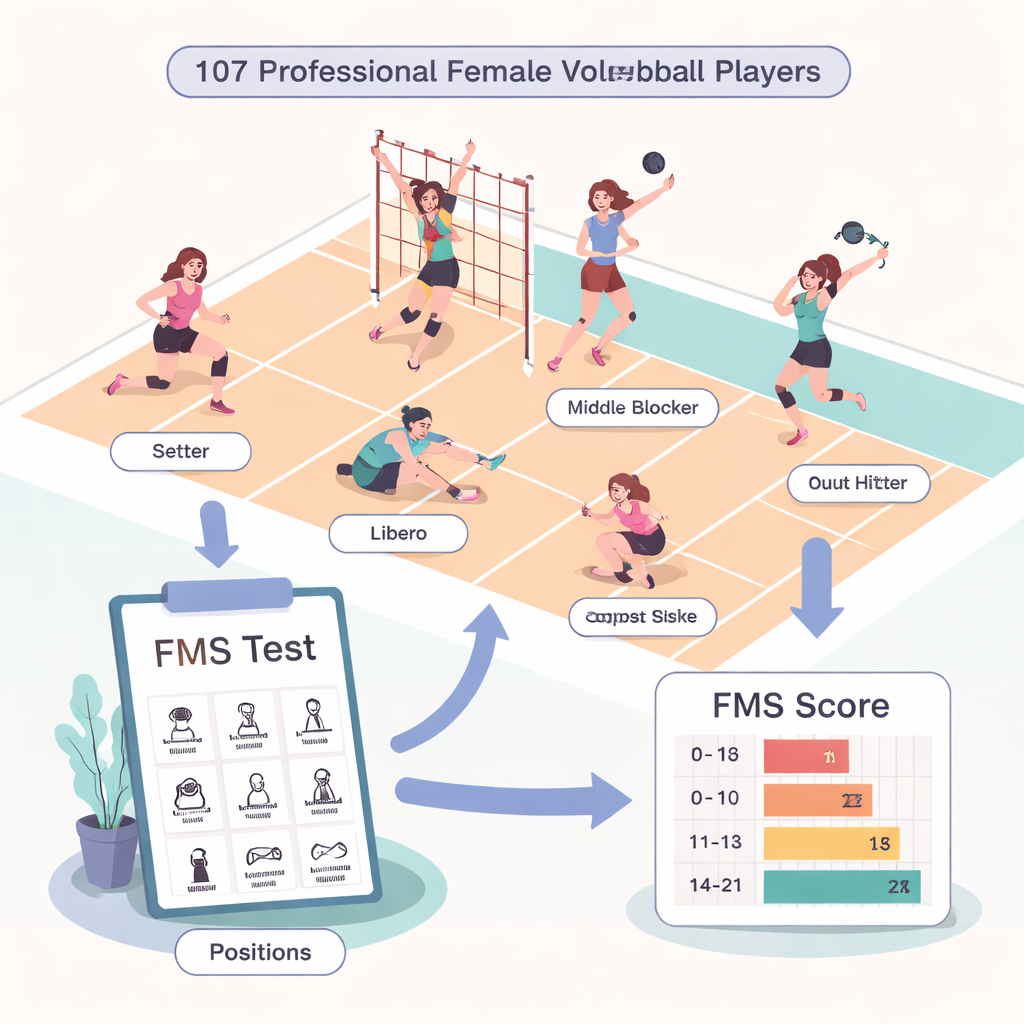
The researchers worked with 107 professional female volleyball players from clubs in two Turkish cities. All were actively competing in the country’s top two leagues and trained at least three times a week. After measuring height, weight, and body mass index, the team put each athlete through the FMS, a short series of seven movements such as deep squats, lunges, stepping over a hurdle, lifting a straight leg while lying down, a push-up that tests core control, and reaching behind the back to check shoulder mobility. Each movement was scored from 0 to 3, with higher scores reflecting smoother, pain-free movement and a total possible score of 21. Traditionally, a total score of 14 or less has been viewed as a warning sign for higher injury risk.
Different roles, similar movement patterns
Volleyball positions place different physical demands on the body: middle blockers tend to be tallest and jump frequently at the net, liberos stay closer to the floor for defense, and setters must move quickly in all directions. The study compared FMS scores across setters, opposite hitters, middle blockers, outside hitters, and liberos to see whether these roles shape basic movement patterns. Despite clear differences in body size between positions—middle blockers being the tallest and leanest and liberos the shortest and lightest—their movement scores on all seven FMS tasks were remarkably similar. In other words, at this professional level, players in different positions seemed to have comparable overall movement quality.
What the tests say about injury risk
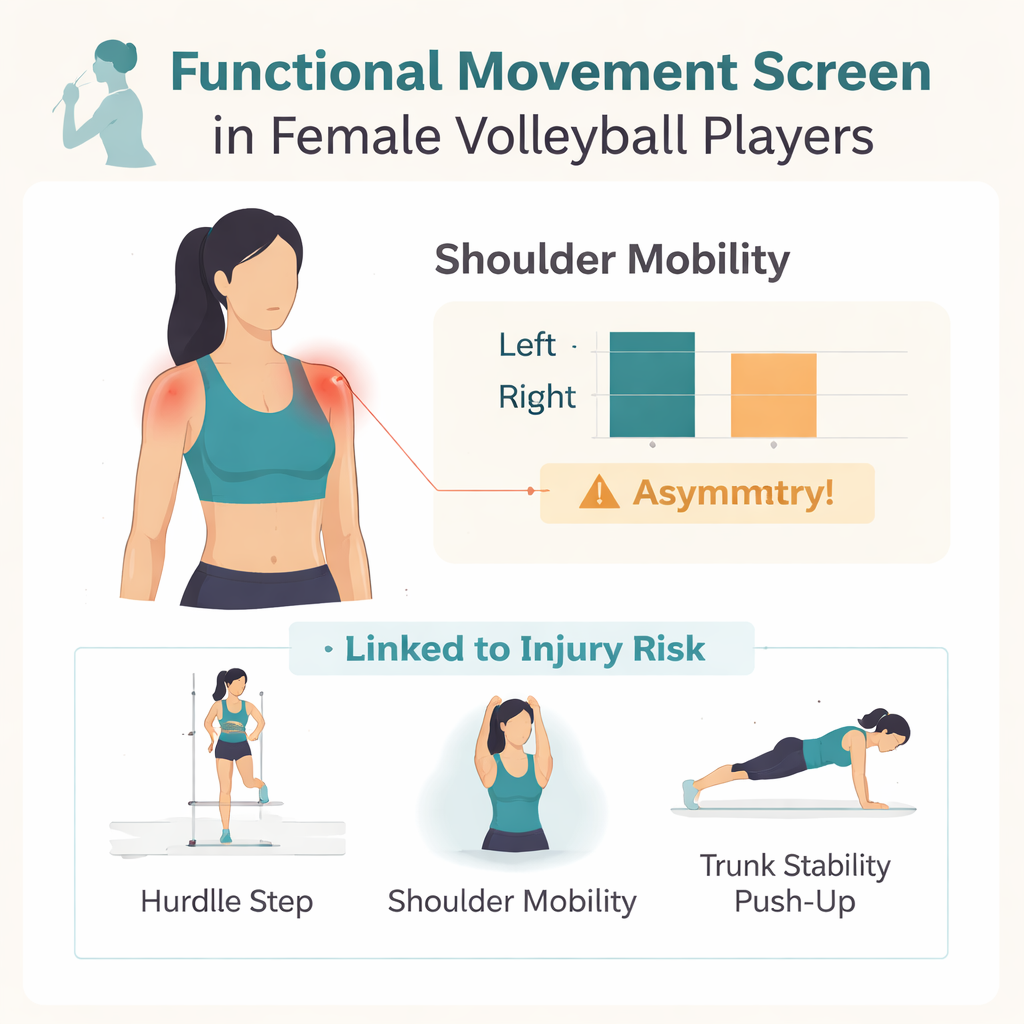
The team also grouped players according to performance levels on each FMS task to explore how low scores might connect to injury risk. They did not track actual injuries during the season, so they could only look for statistical links, not prove cause and effect. For most movements—deep squats, lunges, straight-leg raises, and rotational stability—there was no meaningful connection between lower scores and higher risk categories. However, three tests stood out: the hurdle step, shoulder mobility, and trunk stability push-up. In these, lower-quality movement was significantly associated with a category traditionally viewed as higher injury risk. This pattern suggests that difficulty stepping and balancing, limited shoulder reach, and weak core control may flag athletes who deserve closer attention and targeted training.
Hidden left–right differences in the shoulders
An important part of the analysis focused on asymmetry—differences between the right and left sides of the body. For movements involving the legs and trunk, such as the hurdle step, lunge, straight-leg raise, and rotational stability, the players showed no meaningful side-to-side gaps. The one clear exception was shoulder mobility. On average, the athletes’ dominant shoulders moved better than their non-dominant ones, and the size of this difference passed a commonly used threshold for clinical concern. This fits with the repetitive nature of spiking and serving in volleyball, which can strengthen and loosen the hitting arm differently from the other side, potentially increasing stress on the shoulder over time.
What this means for players and coaches
For players and coaches, the study offers two key takeaways. First, basic movement quality, as captured by the FMS, appears broadly similar across volleyball positions among professional women. Training programs can therefore start from a shared foundation rather than assuming large position-based differences in movement ability. Second, the FMS is less a crystal ball for predicting who will get hurt and more a spotlight on where movement is restricted or unbalanced—especially in the shoulders and trunk. Used alongside other fitness and medical tests, it can guide preseason screening and individualized exercise plans to improve mobility, shore up the core, and address side-to-side differences before they evolve into pain or injury.
Citation: Uysal, G.E., Baydemir, B. Functional movement screen and asymmetries in female volleyball players across playing positions. Sci Rep 16, 4979 (2026). https://doi.org/10.1038/s41598-026-35725-w
Keywords: volleyball, female athletes, functional movement screen, shoulder asymmetry, injury prevention