Clear Sky Science · en
Understanding the effects of aging on whole-body dynamic balance, trunk stability, functional mobility, and hip strength
Why balance matters as we get older
Staying steady on your feet is one of the quiet skills that lets people live independently as they age. A stumble in the kitchen or a misstep on the stairs can have serious consequences, from broken bones to a loss of confidence that keeps someone homebound. This study explored how key physical abilities behind balance and everyday movement change between ages 30 and 80, and which of them most strongly protect older adults from losing their independence.
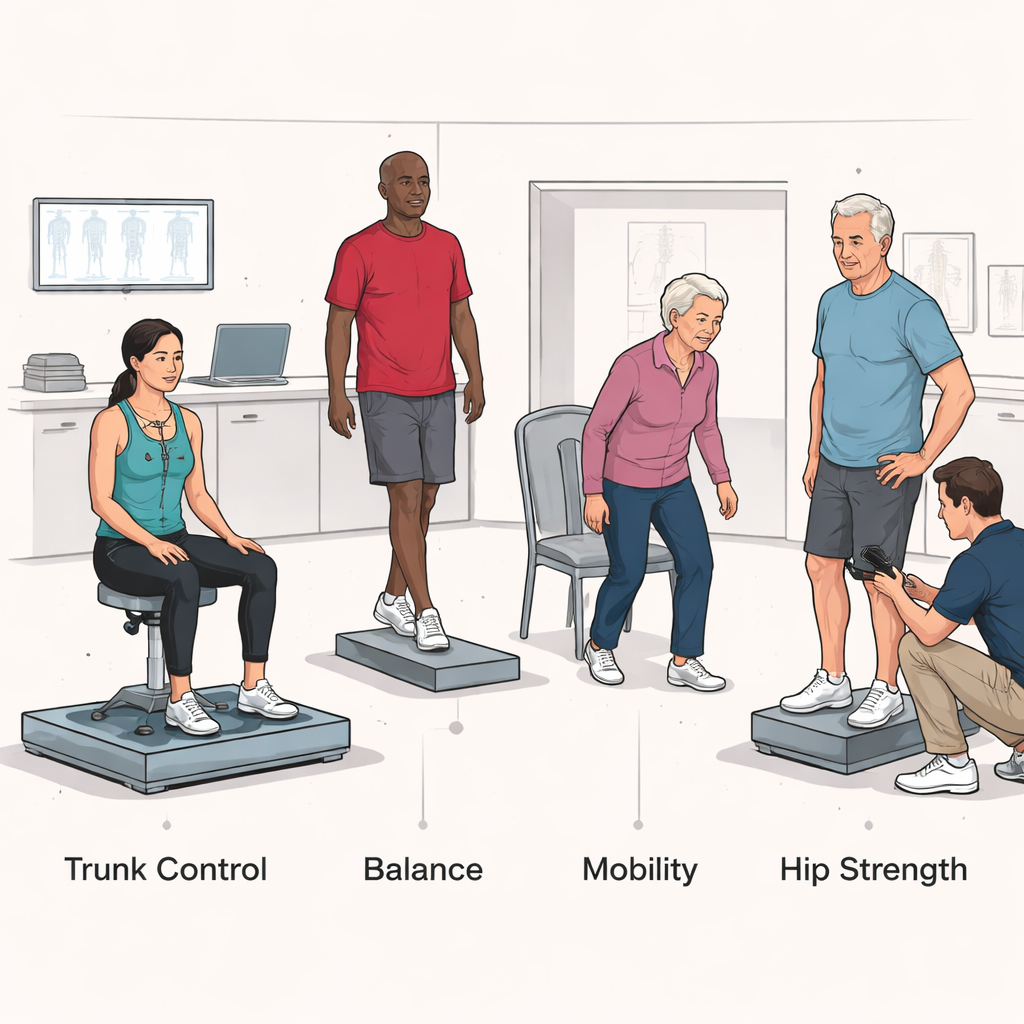
The body’s central stabilizer
The researchers focused on the "trunk"—the muscles around the torso and spine that keep the upper body steady—along with overall balance, hip strength, and basic mobility. They tested 127 healthy, physically active adults who exercised several times a week. To measure trunk stability, volunteers sat on an unstable chair placed on a force platform and tried to keep a moving target centered. Whole-body balance was tested by having them stand heel-to-toe on a force platform while tracking a target. Mobility was measured with a fast version of the Timed Up & Go test, in which participants stood up from a chair, walked three meters, turned around, and sat back down as quickly as possible. Finally, hip strength was assessed with a handheld device that measured how strongly people could push their legs outward and inward.
How aging affects balance, strength, and mobility
All four abilities worsened with age, but not to the same degree. Trunk stability and standing balance showed the steepest and most consistent declines in both men and women. For example, men’s trunk control worsened by about 4.5% per year, and women’s by about 2.7% per year. This means that by later life, errors in the unstable sitting task were many times higher than at age 30, even though everyone in the study was relatively fit. Hip strength and mobility also declined but more gradually. Hip strength dropped by around 1.6–1.8% per year, while the time needed to complete the Timed Up & Go test increased by only about 0.6% per year. The authors suggest that regular exercise may help preserve leg strength and everyday mobility more effectively than it preserves the fine control needed to stabilize the trunk and maintain precise balance.
Differences between men and women
When the researchers compared men and women, they found that the pattern of decline with age was broadly similar for most measures. However, trunk stability in men deteriorated faster than in women, even though performance after age 60 ended up looking similar between the sexes. In contrast, older men had clearly higher hip strength than older women, despite both groups being physically active. The authors argue that this gap likely reflects natural differences in muscle mass rather than lifestyle. These findings highlight that men and women may reach old age with different physical strengths and weaknesses, even when they share similar activity levels.
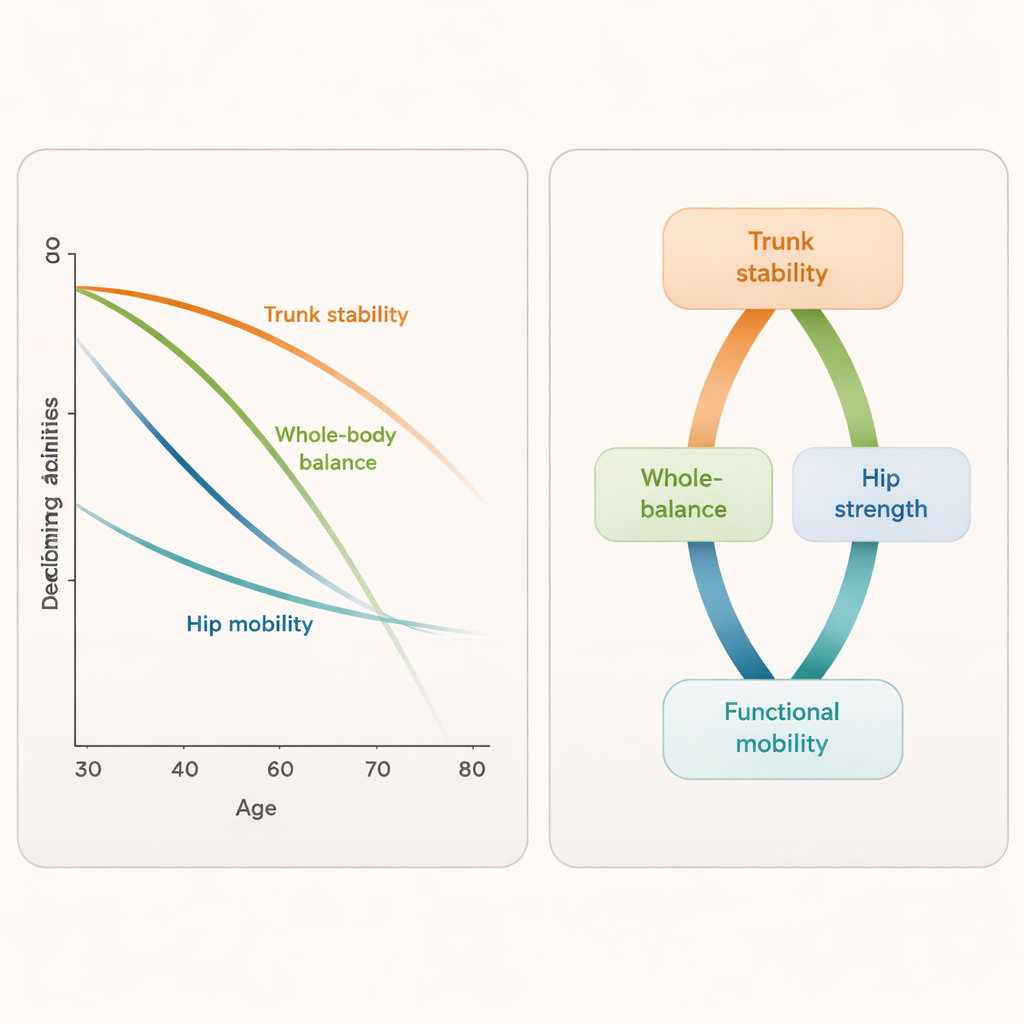
Which abilities matter most in later life
The team then looked only at participants over 60 to see which physical abilities best predicted balance and mobility. They found that better trunk stability during the unstable sitting task was strongly linked to better performance in the standing balance test for both men and women. In other words, people who could keep their torso steady while seated on an unstable surface also tended to stand more steadily. By contrast, mobility—the ability to stand up, walk, turn, and sit down quickly—was more closely tied to hip strength, especially in men. Stronger hips were associated with faster Timed Up & Go times, while trunk stability showed little direct connection to this mobility test in this relatively fit group.
What this means for staying independent
For everyday life, the message is straightforward: different abilities protect different aspects of independence. Good trunk control appears crucial for staying upright and avoiding falls when the body is disturbed, while strong hip muscles help older adults move quickly and confidently through tasks like standing up from a chair or changing direction while walking. The authors suggest that exercise programs for aging adults should not rely only on general activity, but should include specific unstable sitting or other core-challenging exercises to train trunk stability, alongside targeted hip strengthening. Monitoring these abilities from early older age may help people and their clinicians act sooner to slow physical decline and support safe, independent living for longer.
Citation: Hernández-Sánchez, S., De Los Ríos-Calonge, J., Juan-Recio, C. et al. Understanding the effects of aging on whole-body dynamic balance, trunk stability, functional mobility, and hip strength. Sci Rep 16, 5828 (2026). https://doi.org/10.1038/s41598-026-35724-x
Keywords: aging and balance, trunk stability, hip strength, fall prevention, older adults mobility