Clear Sky Science · en
Fusion yield enhancement via secondary beam-target reactions in laser-cluster experiments
Lighting Tiny Suns in the Lab
Fusion, the process that powers the sun, usually demands enormous machines or stellar interiors. This study explores a very different path: using tabletop, ultra‑fast lasers and tiny gas clusters to spark fusion reactions in a compact setup. The researchers show how adding a simple solid “shell” around a laser‑driven fusion source can dramatically boost the number of fusion neutrons produced, opening the door to small laboratory experiments that probe conditions similar to those in stars.
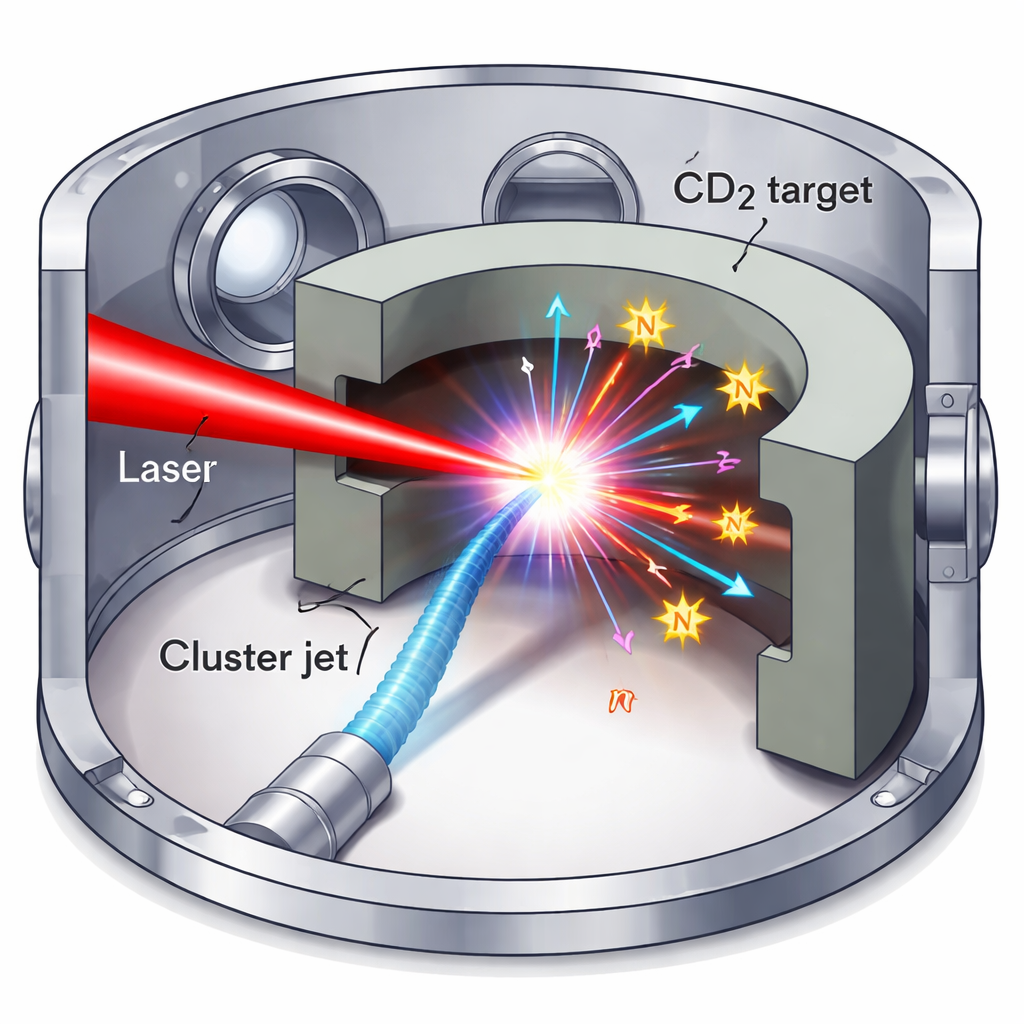
How Lasers Turn Clusters into Fusion Fuel
In laser‑cluster fusion, a powerful, ultra‑short laser pulse strikes a jet of microscopic clusters made from deuterated methane gas, a form of methane where hydrogen is replaced by deuterium, a heavier cousin of hydrogen. The intense light strips electrons from the clusters, leaving behind positively charged ions that violently repel each other and “Coulomb explode.” This explosion flings deuterium ions to tens of thousands of electron volts of energy—enough for pairs of deuterium nuclei to fuse and emit 2.45 MeV neutrons. Some fusion happens where the clusters explode, as energetic ions collide with one another or with slower atoms in the gas jet.
Adding a Surrounding Target for Extra Fusion
The key idea in this work is to catch and reuse the fast ions that escape the initial fusion region. The team surrounded the cluster jet with a C‑shaped block made of deuterated plastic (CD2). As the hot deuterium ions stream outward from the exploding clusters, many of them plunge into this solid target. There, they encounter large numbers of deuterium atoms packed at much higher density than in the gas jet. Each ion can trigger additional fusion reactions as it slows down inside the solid, turning what would have been “wasted” particles into a second stage of neutron production.
Measuring Neutrons with a Race Against Time
To see how much this secondary target helps, the researchers carefully measured when and how many neutrons arrived at detectors placed several meters away. Because fusion neutrons travel at known speeds, their time of flight reveals when and where they were created. By subtracting early signals from X‑rays and accounting for slight energy spreads, the team isolated neutrons from the cluster region and from the added CD2 block. They also used a separate detector to measure the energies of the deuterium ions, finding ion “temperatures” between about 60 and 100 kiloelectron volts—an indicator of how energetic the ions are.
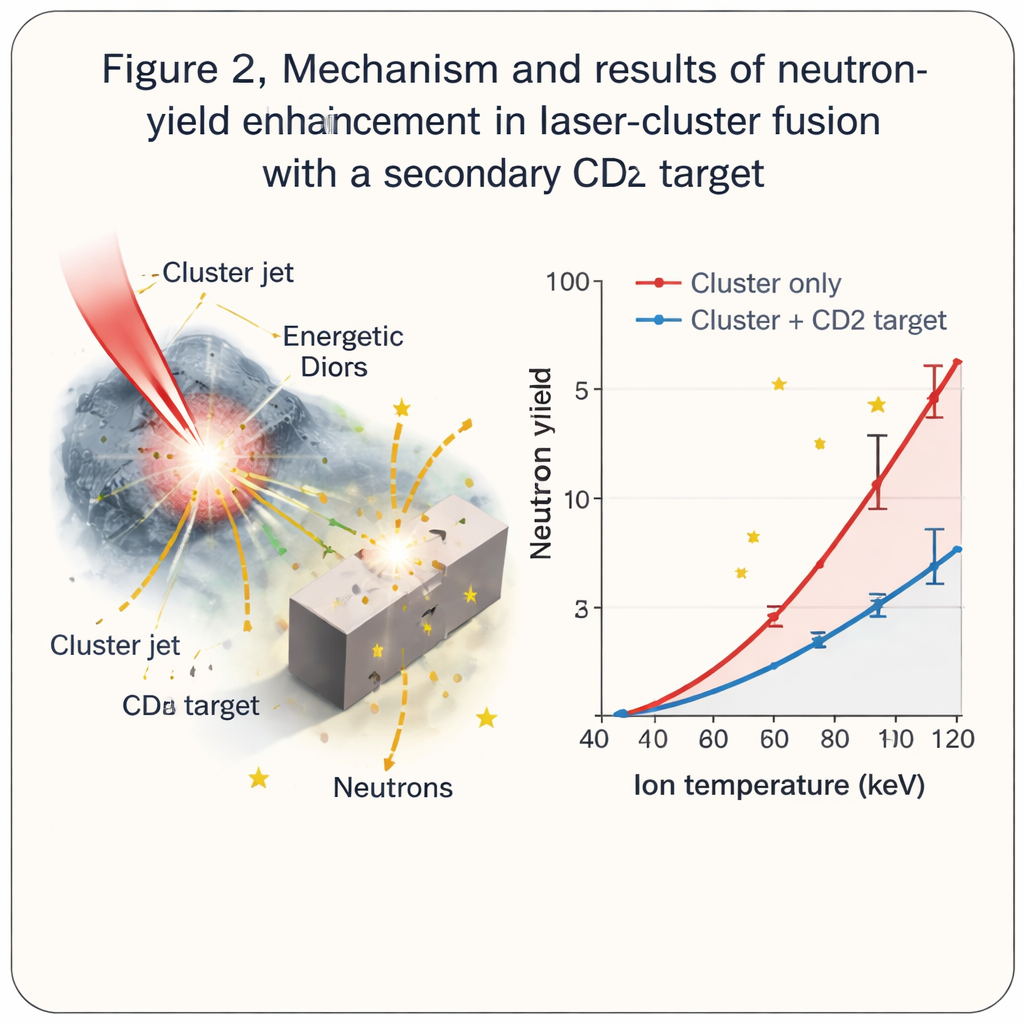
Turning Up the Heat to Boost Yields
With the CD2 target in place, the neutron yield per laser shot rose sharply. At the lowest ion energies tested, the number of neutrons roughly doubled compared with the cluster‑only case; at the highest energies near 100 keV, the yield increased by about three and a half times. A time‑resolved model that tracks how the hot plasma expands, how ions slow down, and how many reactions occur in gas and solid matched these measurements well. The analysis shows that as ion energy rises, each ion becomes more likely to fuse in the solid target, so the relative benefit of the added CD2 block grows nearly linearly within the tested range.
What This Means for Fusion and the Cosmos
This experiment demonstrates a practical way to significantly amplify neutron production in compact laser‑driven fusion setups by surrounding the main fusion region with a suitable solid target. Beyond simply making more neutrons, the concept is flexible: by swapping the CD2 block for other materials, future experiments could study many different nuclear reactions under well‑controlled, low‑energy conditions similar to those inside stars. In effect, laser‑cluster fusion combined with secondary targets offers a small‑scale, tunable platform for exploring how nuclei react and how often they fuse—information that is crucial for understanding both potential fusion technologies and the inner workings of astrophysical objects.
Citation: Sim, J., Lee, S., Kim, Hi. et al. Fusion yield enhancement via secondary beam-target reactions in laser-cluster experiments. Sci Rep 16, 5633 (2026). https://doi.org/10.1038/s41598-026-35722-z
Keywords: laser-cluster fusion, deuterium fusion, neutron yield, secondary targets, astrophysical nuclear reactions