Clear Sky Science · en
Shear behavior and predictive modeling of loess stabilized with rice husk ash
Turning Farm Waste into Safer Hillsides
Across northern China, wind-blown yellow soils called loess form steep hills and road cuts that can suddenly collapse during heavy rain, threatening homes, highways, and farmland. At the same time, rice mills and power plants generate huge volumes of rice husk ash, a dusty waste that often ends up in landfills. This study asks a simple but powerful question: can this agricultural waste be turned into a low‑carbon ingredient that makes fragile loess slopes stronger and safer?
Fragile Soil in a Tough Climate
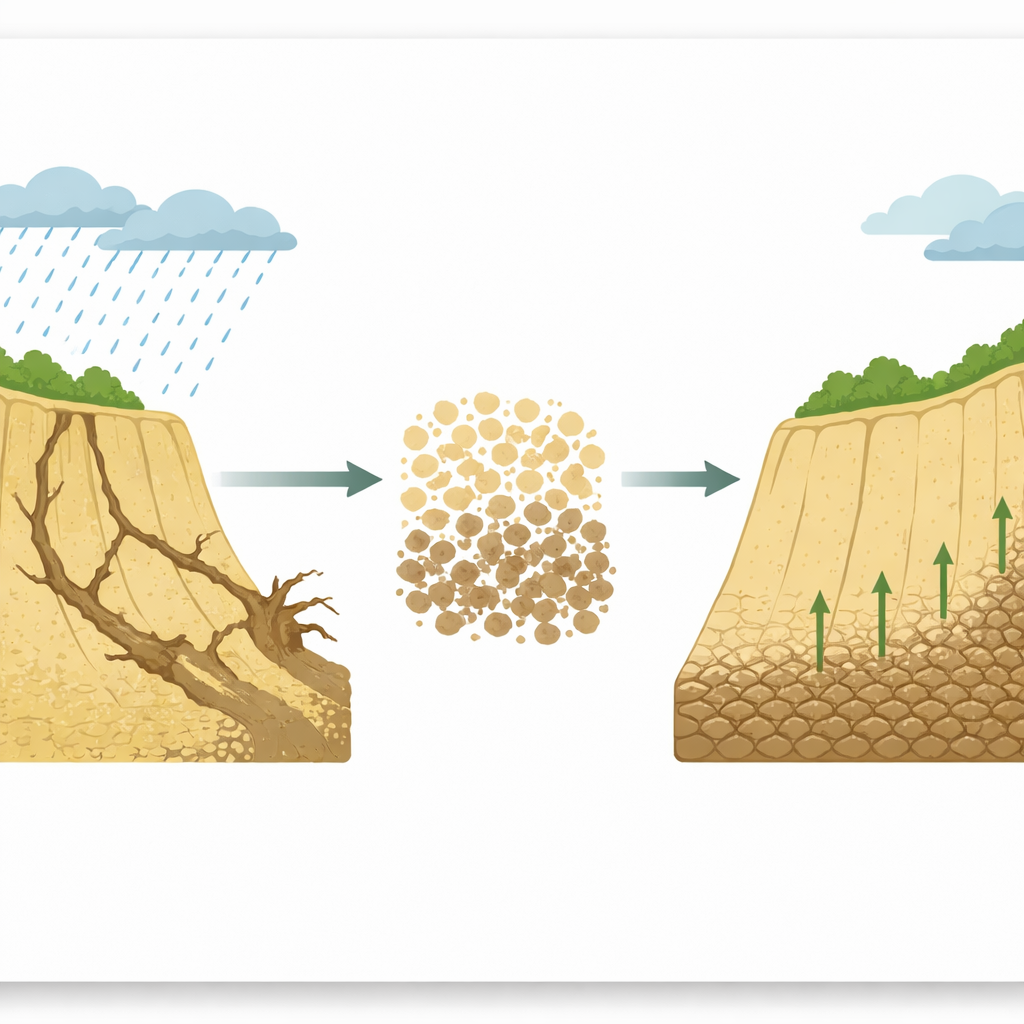
Loess covers vast areas of China’s dry and semi‑dry regions. It looks solid, but it is riddled with pores and weak natural bonds. Years of wind, water, and temperature swings leave the soil under-compacted and easily softened by rain. When storms arrive, water seeps in, the structure collapses, and slopes can crack or slide. Traditional ways to strengthen loess rely on cement or lime, which work well but are energy‑intensive and add to carbon emissions. The researchers explored rice husk ash as an alternative stabilizer that might improve the soil while making use of an abundant waste product from rice-based power generation.
How Rice Husk Ash Changes the Soil
Rice husk ash is unusually rich in reactive silica and other oxides and has a very large surface area. When mixed with loess and water, it can form glue‑like compounds that bind soil grains together. The team collected loess from highway slopes in Shanxi Province and blended it with different amounts of ash, from 0 to 20 percent by dry weight. They then compacted these mixtures, cured them, and tested how much force they could withstand before shearing, under a range of confining pressures that mimic real ground stresses. They also varied water content from the soil’s optimum level up to 1.6 times wetter to reflect how slopes become saturated during rainfall and rising groundwater.
Finding the Sweet Spot for Strength
The experiments revealed that adding some ash makes a big difference, but too much can be harmful. As ash content increased, the compacted soil became lighter and needed more water to pack well, reflecting the ash’s low density and strong water absorption. Shear strength, cohesion, and internal friction all climbed as ash was added up to about 10 percent, where the soil became roughly half again as strong as untreated loess and its resistance to sliding improved markedly. Beyond this point, strength began to fall, likely because excess ash and extra water created a mix that was too wet and porous. When the researchers raised the water content above the optimum, even the best mixture weakened sharply: at 1.6 times the optimum moisture, peak strength dropped by around 80 percent, especially under higher confining pressures, showing that water remains the dominant trigger for failure.
Seeing Inside the Strengthened Soil
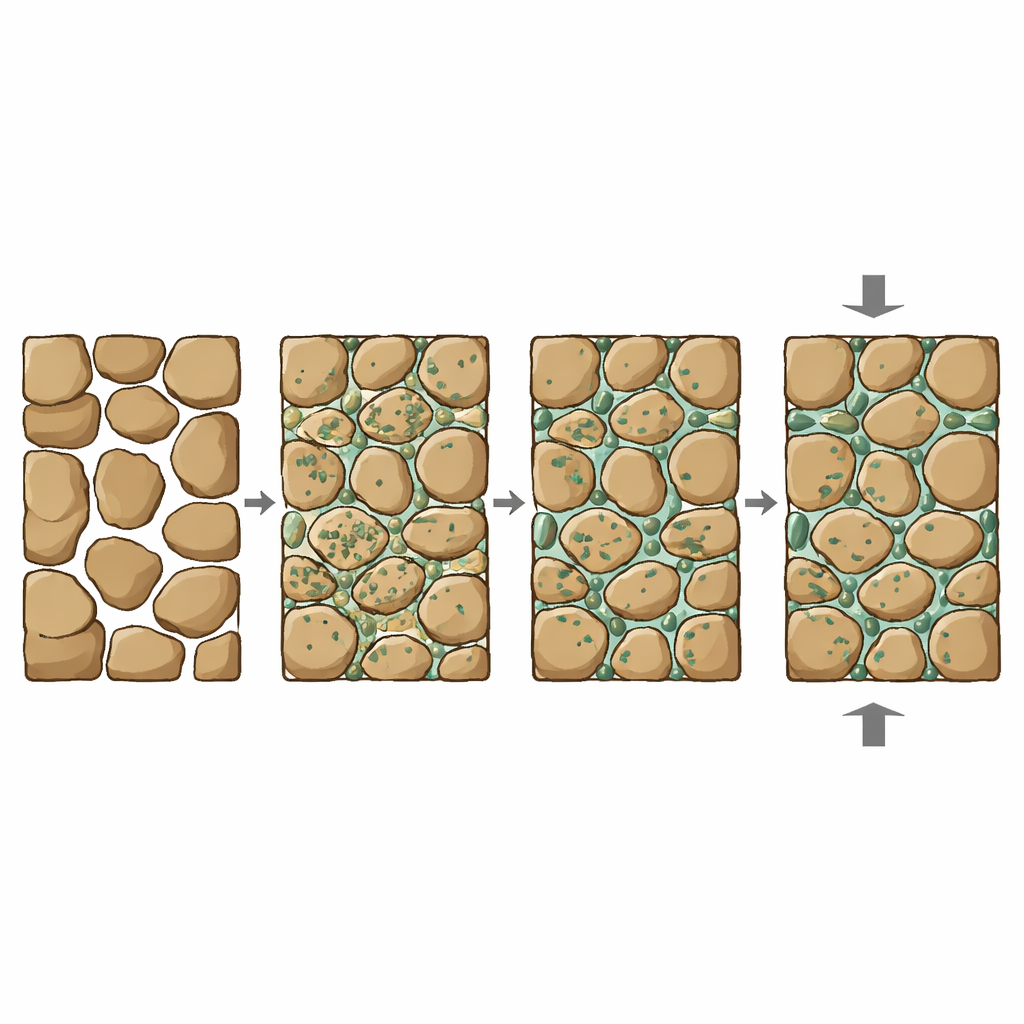
To understand why the ash worked, the team used electron microscopes and X‑ray scans to peer into the soil’s tiny pore spaces. Untreated loess appeared as loosely packed grains with large voids in between. With 10 percent ash, the pictures changed: new gel‑like material bridged neighbouring particles and filled gaps, and the overall pore volume fell by about 22 percent. This denser, better‑connected fabric helps the soil resist the rearrangement of grains that leads to shear failure. Building on these observations, the researchers developed a mathematical model that links shear strength to both water content and confining pressure, and then checked it against dozens of laboratory tests. The model’s predictions closely matched the measurements, outperforming earlier formulas taken from the literature.
What This Means for Roads and Slopes
In everyday terms, the study shows that a modest dose of rice husk ash—about one part in ten by weight—can turn weak, collapse‑prone loess into a much more robust material, thanks to new mineral “glues” that tighten its internal structure. However, the treated soil still becomes far weaker when it gets too wet, so drainage and moisture control remain essential. The new strength‑prediction equations give engineers a practical tool to estimate how stabilized loess will behave under different water and load conditions, helping them design safer roadbeds and slopes. By pairing waste recycling with better geotechnical performance, this work points toward more sustainable ways to build on and through loess landscapes.
Citation: Peng, D., Wang, G. & Guan, X. Shear behavior and predictive modeling of loess stabilized with rice husk ash. Sci Rep 16, 7964 (2026). https://doi.org/10.1038/s41598-026-35717-w
Keywords: rice husk ash, loess slope stability, soil stabilization, sustainable geotechnics, shear strength modeling