Clear Sky Science · en
Effect of ceramic reinforcements in TIG-welded Al/SiCp and Al/TiB2 composites for enhanced mechanical properties
Making Stronger, Lighter Metal for Everyday Technology
From airplanes and cars to laptops and sports gear, engineers are constantly hunting for metals that are both strong and light. Aluminum is already a favorite, but it can be pushed further by mixing in tiny, hard ceramic particles to form what are called metal–matrix composites. This study explores how to reliably weld such advanced aluminum composites without ruining their strength, opening the door to tougher, lighter structures in real-world products.
Blending Metal with Tiny Ceramic Grains
The researchers began with a common casting alloy, A356 aluminum, and blended it with small amounts of two different ceramic materials: silicon carbide (SiC) and titanium diboride (TiB₂). These particles act like microscopic gravel in concrete, helping the metal resist wear and deformation. The team prepared a series of samples with 2%, 4%, and 6% of each ceramic, producing two families of materials: aluminum–SiC and aluminum–TiB₂ composites. They then joined these materials using a process called Tungsten Inert Gas (TIG) welding, a widely used industrial technique, and examined how the ceramic content affected the internal structure and strength of the welded joints. 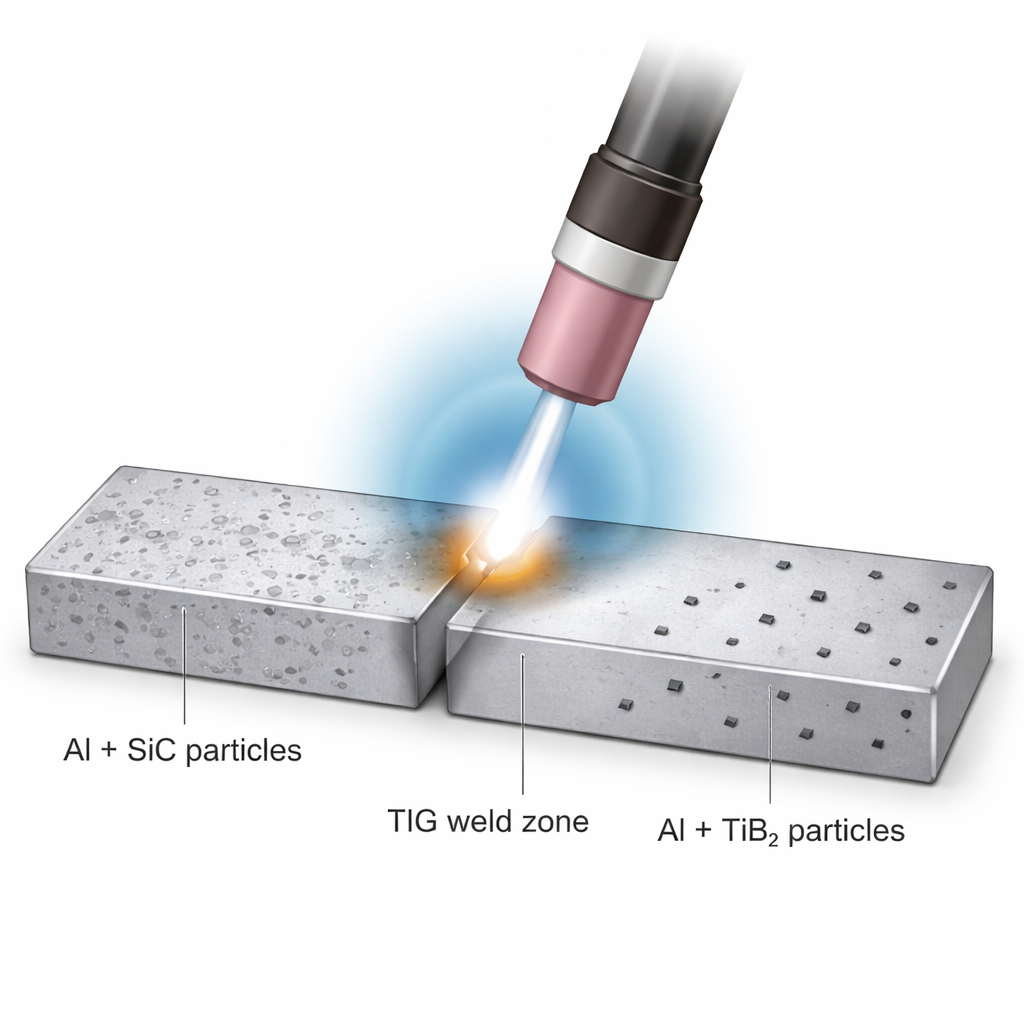
What Happens Inside the Weld
To see what was going on at the microscopic level, the authors used powerful imaging tools, including scanning electron microscopy and X-ray diffraction. These showed that the ceramic particles survived the high heat of welding and stayed chemically stable; importantly, no unwanted or brittle reaction phases were detected. At low particle content (2%), the ceramics were present but not numerous enough to fully control solidification, leading to uneven regions and occasional clusters. At very high content (6%), the particles tended to clump together and create tiny pores—potential weak spots in the joint. The sweet spot was around 4%, where both SiC and TiB₂ particles were spread relatively uniformly, refining the grain structure of the aluminum and creating clean, well-bonded interfaces between metal and ceramic.
Strength and Hardness: The 4% Advantage
The team then measured how much force the welded joints could withstand before breaking (tensile strength) and how resistant they were to local indentation (hardness). In both aluminum–SiC and aluminum–TiB₂ systems, adding ceramic particles clearly made the welds harder and stronger than plain aluminum. The best overall results came from the 4% composites: the aluminum–SiC joint with 4% SiC reached a tensile strength of about 227 megapascals, while the 4% TiB₂ version reached about 229 megapascals—both higher than the base metal and their 2% and 6% counterparts. Hardness followed the same pattern: 4% SiC gave the highest value of about 173 on the Vickers scale, and 4% TiB₂ also outperformed the lower and higher contents. 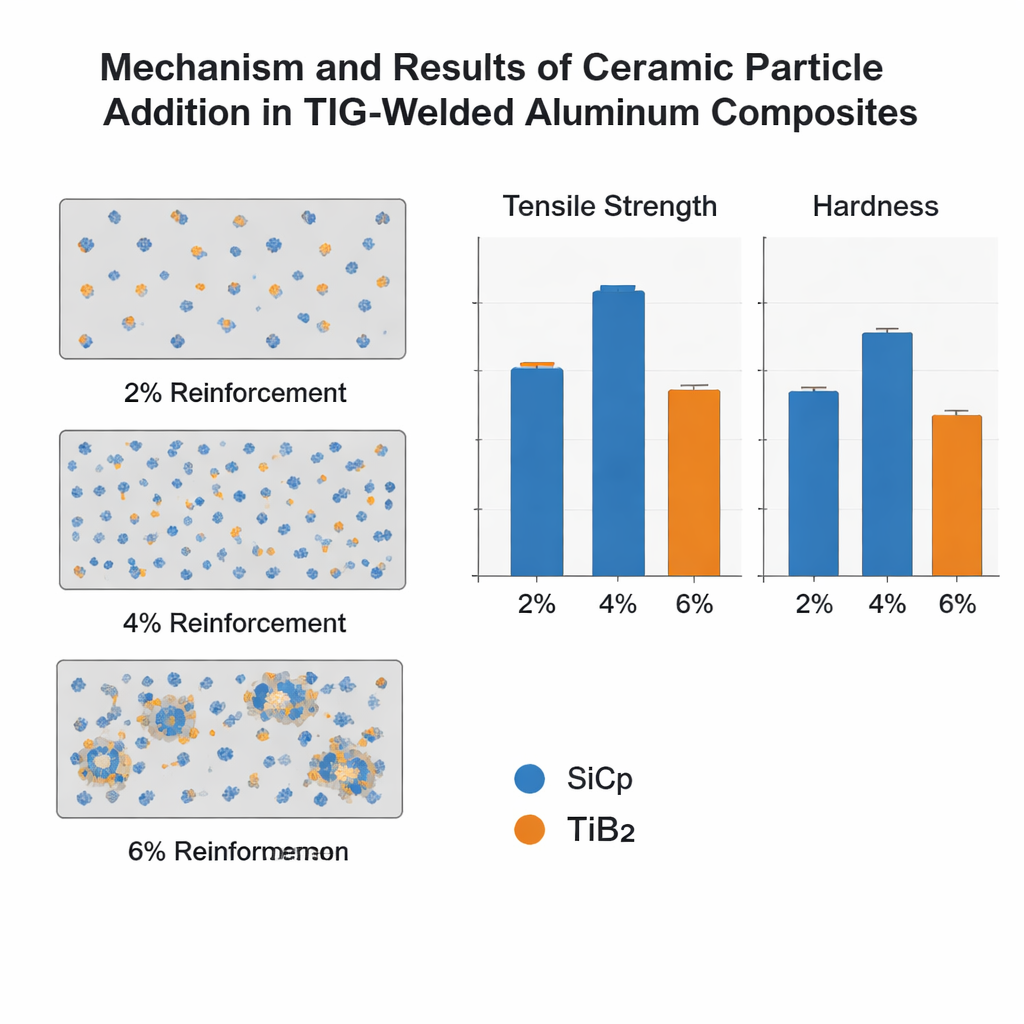
The Trade-Off: Stronger but Less Stretchy
Greater strength and hardness came with a cost: the welded joints became less ductile, meaning they stretched less before breaking. Microscopic images of fracture surfaces showed that the base aluminum failed in a more “stretchy” or ductile manner, while heavily reinforced joints showed signs of more brittle behavior, especially at 6% particle content where clustering created stress hot spots. The 4% composites again offered a compromise: notably higher strength and hardness, with only a moderate loss of stretch compared with the unreinforced alloy, making them attractive for parts where stiffness and strength matter more than extreme flexibility.
Why This Matters for Future Designs
For engineers designing aircraft panels, automotive suspension arms, or high-performance housings, this work highlights a practical recipe: modest ceramic additions—around 4% of either SiC or TiB₂—can significantly improve the performance of TIG-welded aluminum parts without introducing dangerous welding defects. The study shows that it is possible to weld advanced aluminum composites while preserving their carefully engineered microstructure, provided the ceramic content is chosen wisely. In plain terms, it offers a roadmap for building lighter, tougher, and more reliable components using manufacturing methods that industry already knows well.
Citation: Srinivasan, R.G., Bakkiyaraj, M., Rajaravi, C. et al. Effect of ceramic reinforcements in TIG-welded Al/SiCp and Al/TiB2 composites for enhanced mechanical properties. Sci Rep 16, 5570 (2026). https://doi.org/10.1038/s41598-026-35715-y
Keywords: aluminum composites, TIG welding, ceramic reinforcement, mechanical properties, lightweight structures