Clear Sky Science · en
A novel chronostratigraphic framework for the Aptian–Albian paleoclimate events
When Ancient Rocks Tell Time
Imagine being able to read Earth’s ancient climate history as clearly as the seconds on a clock. This study does just that for a 20‑million‑year slice of the Early Cretaceous, about 120 to 100 million years ago, when dinosaurs roamed and the planet was largely ice‑free. By turning a single Italian drill core into a kind of geological timepiece, the authors pin down when dramatic global events—from oxygen‑starved oceans to bursts of volcanism and shifting sea levels—actually happened, and how long they lasted. That sharper timing helps scientists understand how fast Earth’s climate system can change, and why.
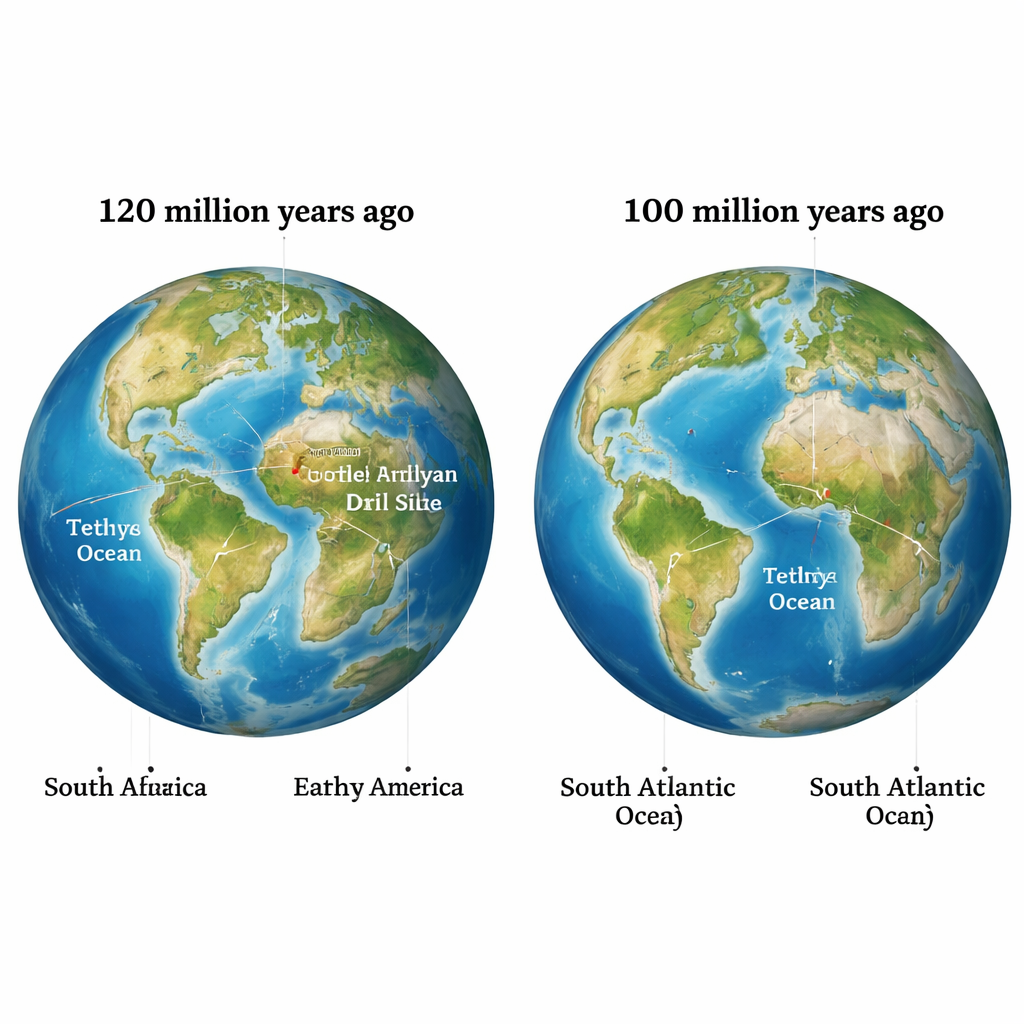
A World of Rising Seas and Restless Oceans
The Aptian–Albian interval was a time of high seas, active volcanoes, and changing ocean gateways. As continents broke apart and new seafloor formed, the South Atlantic and Southern Ocean opened, raising global sea level and reshaping ocean currents. Superimposed on this slow tectonic background were shorter climate swings driven by changes in Earth’s orbit around the Sun. The oceans alternated between well‑oxygenated conditions and episodes when deep waters turned starved of oxygen, leaving behind dark, organic‑rich “black shales.” These so‑called Oceanic Anoxic Events (OAE 1a through 1d) coincided with bursts of volcanic activity, shifts in rainfall and runoff, and turnovers in tiny plankton that built much of the seafloor mud.
A Natural Archive in the Heart of Italy
The researchers focused on the Poggio le Guaine (PLG) core from the Umbria–Marche Basin of central Italy, once part of the Tethys Ocean. This core preserves a nearly continuous record from the latest Barremian into the early Cenomanian, capturing all four major anoxic events plus seven intervals of unusual reddish sediments known as Cretaceous Oceanic Red Beds. Layer by layer, the PLG sequence records shifts from white, oxygen‑rich limestones, to dark black shales laid down under low‑oxygen conditions, to rust‑colored beds formed in more oxidizing waters. Fossil plankton and calcareous algae in these layers allow the section to be divided into detailed biological zones, which are widely used worldwide to date Cretaceous rocks.
Using Earth’s Orbit as a Cosmic Metronome
To turn the PLG stack of sediments into a high‑precision clock, the team measured two magnetic properties—magnetic susceptibility and anhysteretic remanent magnetization—every few centimeters. These signals track how much fine magnetic mineral was delivered to the seafloor and how it changed through time. When analyzed with advanced spectral tools, both records show clear rhythmic patterns that match the known cycles of Earth’s orbit, especially a very stable 405,000‑year “long eccentricity” cycle. By aligning these cycles with a well‑calculated orbital solution and anchoring them to a few precisely dated ash layers and a key magnetic reversal (Chron M0r), the authors built an astronomically tuned age model spanning about 20 million years with uncertainties of roughly 200,000 years.
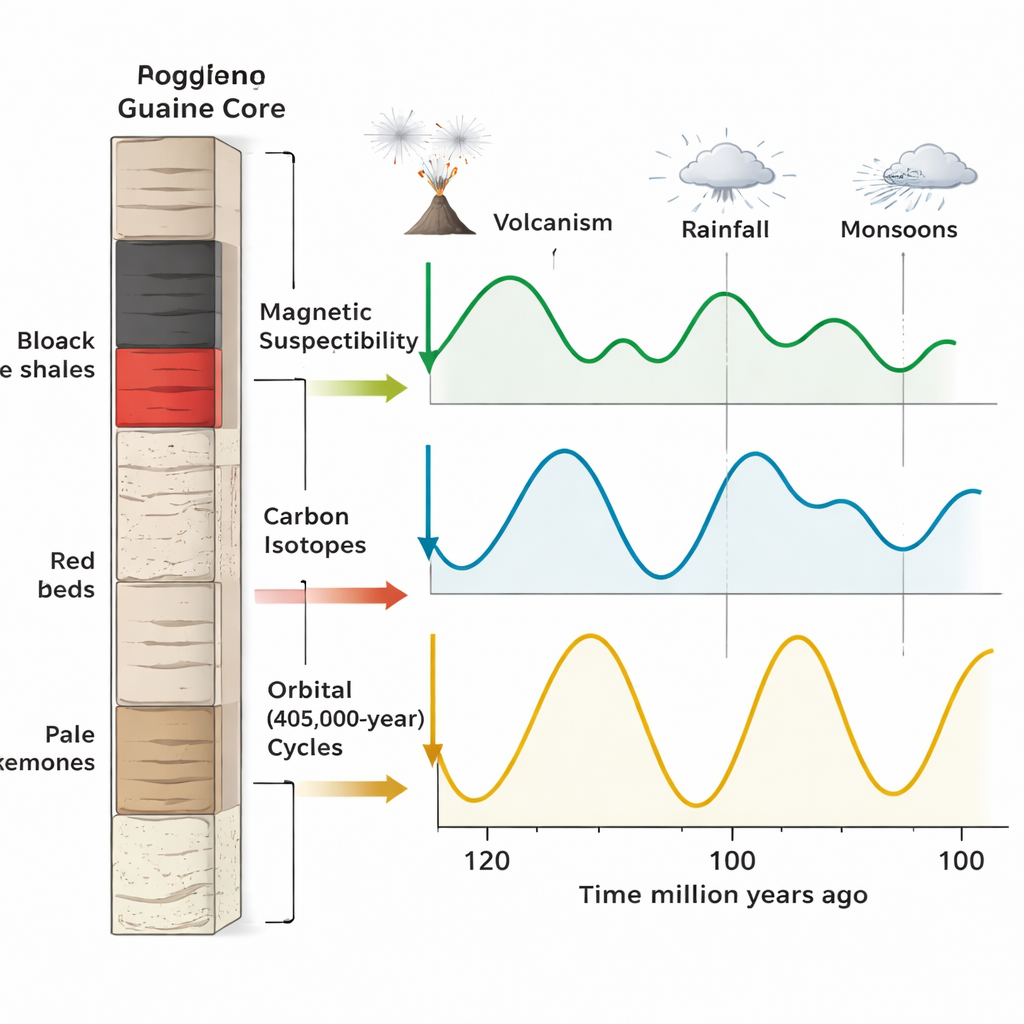
Pinning Down Black Shales, Red Beds, and Climate Swings
With this orbital clock in hand, the study re‑dates and refines many hallmark events of the Early Cretaceous. OAE 1a, the most prominent anoxic event, is found to last about 1.13 million years, starting near 119.5 million years ago and coinciding with a long volcanic pulse recorded by osmium isotopes. OAE 1b extends for roughly 2.7 million years, with five shorter sub‑events whose individual durations range from only tens to a few hundred thousand years; some are closely tied to volcanic signals, others to stronger monsoons and runoff. OAE 1c and 1d are shown to be longer, multi‑million‑year episodes of more regional anoxia. Between and around these dark intervals, the core contains red beds that record more oxygenated bottom waters. Their timing suggests they were modulated by orbital cycles and longer‑term changes in ocean circulation rather than directly by temperature alone.
Rewriting the Geological Calendar
The new framework also sharpens the ages and lifespans of numerous fossil marker zones used to date Cretaceous rocks. The Aptian stage is found to last about 7 million years and the Albian about 12.8 million years, in good overall agreement with the current Geological Time Scale but with important shifts for individual biozones. The magnetic reversal known as Chron M0r, which helps define the Barremian–Aptian boundary, is now estimated to have persisted for about 430,000 years. By tying volcanic pulses, monsoon‑driven changes, black shale deposition, and red‑bed intervals to the same precise timeline, the study reveals a tight coupling between deep‑Earth processes, orbital pacing, and ocean chemistry.
What This Means for Understanding Climate Change
For non‑specialists, the key message is that Earth’s climate and oceans can respond quickly—and sometimes repeatedly—to relatively slow background changes such as continental breakup and variations in orbit. Volcanic outgassing, shifts in rainfall, and evolving ocean gateways pushed the Early Cretaceous climate toward greenhouse warmth, yet also produced cooler intervals and dramatic swings in oxygen levels in the sea. By building the most detailed time framework so far for the Aptian–Albian, this work turns a once blurry picture into a high‑definition timeline. That, in turn, lets scientists better compare cause and effect in past warm worlds, improving our ability to judge how today’s rapid climate changes might ripple through the oceans and biosphere.
Citation: Ramos, J.M.F., Savian, J.F., Franco, D.R. et al. A novel chronostratigraphic framework for the Aptian–Albian paleoclimate events. Sci Rep 16, 5862 (2026). https://doi.org/10.1038/s41598-026-35714-z
Keywords: Early Cretaceous climate, oceanic anoxic events, astrochronology, Cretaceous red beds, Poggio le Guaine core