Clear Sky Science · en
Novel DCAT plans in stereotactic body radiotherapy for stage I/II centrally located non-small-cell lung cancer
Why this matters for lung cancer patients
Stereotactic body radiotherapy (SBRT) has become a powerful option for people with early-stage lung cancer who cannot have surgery. But when tumors sit close to vital structures in the center of the chest, doctors must walk a tightrope: give enough radiation to cure the cancer while protecting the airways, heart, and major blood vessels. This study asks whether a newer way of delivering radiation, called dynamic conformal arc therapy (DCAT), can safely and efficiently replace today’s workhorse technique, volumetric modulated arc therapy (VMAT), for these high‑risk central lung tumors.
Two different ways to aim radiation
Both DCAT and VMAT use a rotating radiation beam that sweeps in arcs around the patient, but they shape and modulate the beam differently. VMAT is highly flexible: as the machine spins, it constantly adjusts the speed of rotation, the opening of tiny metal leaves that shape the beam, and the dose rate. This can sculpt the dose very precisely but also creates many small, complex beam segments that are harder to measure and deliver. The newer DCAT approach used in this study adds smart tools to a simpler arc technique. It lets the leaves move only a short distance in and out around the tumor (segment shape optimization) and varies the dose rate. The goal is to keep the plan simple and robust while still hugging the tumor closely. 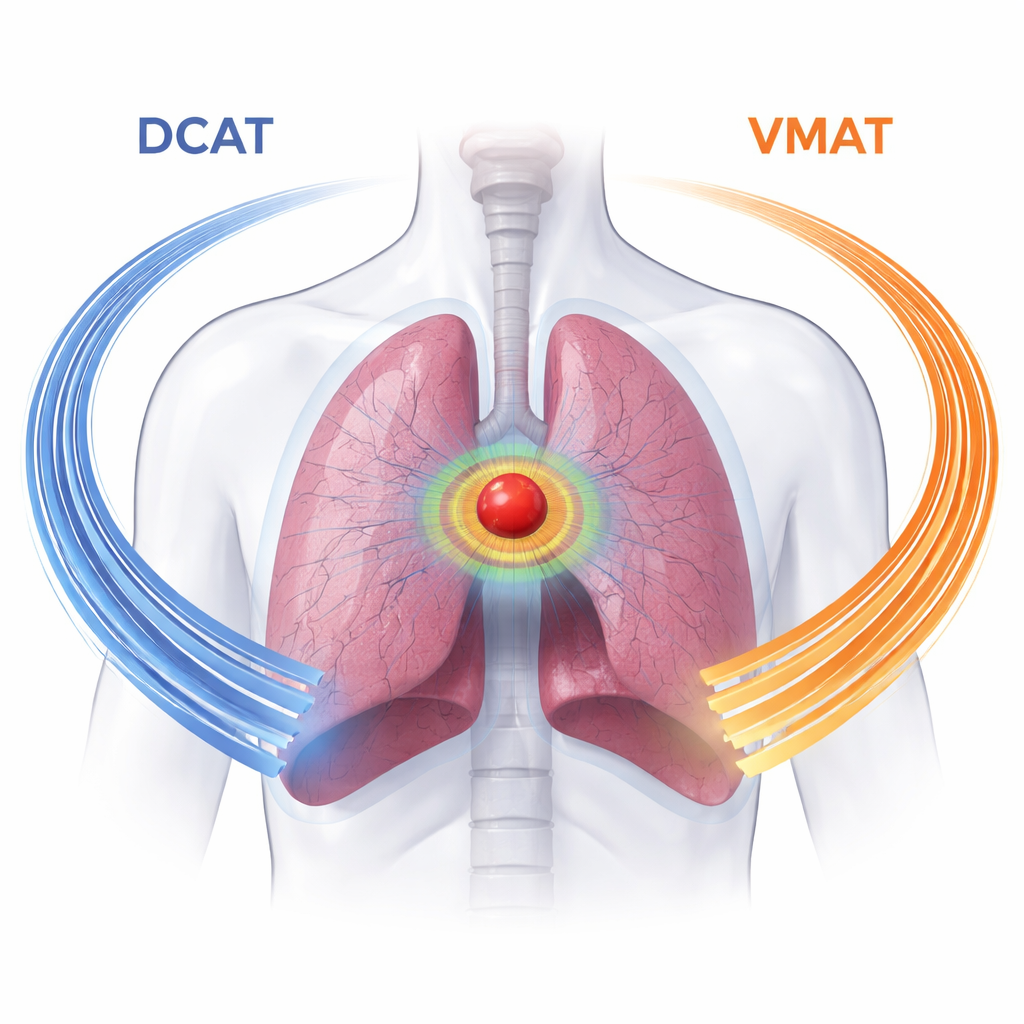
Who was studied and how plans were built
The team looked back at 25 patients with stage I or II non‑small‑cell lung cancer whose tumors were centrally located but not directly touching the main airways. All tumors were relatively small, with planning target volumes under 70 cubic centimeters. For each patient, the researchers created two SBRT treatment plans using the same planning system and the same overall prescription: 50 gray in five treatments over about two weeks, delivered with modern high‑rate “flattening‑filter‑free” beams. One plan used the novel DCAT method and the other used VMAT, with identical arc arrangements and machine settings wherever possible. They then compared how well each plan covered the tumor, how quickly the dose fell off in nearby tissue, the doses to critical organs, and how complex and accurate deliveries were.
Balancing tumor coverage and organ protection
Both types of plans met national trial standards (RTOG 0813) for safely treating central lung tumors. DCAT produced slightly larger “spillover” of intermediate dose around the tumor than VMAT, as seen in measures like conformity and the size of the 50% dose cloud, but the differences were small and still within recommended limits. Inside the tumor, DCAT actually gave a more even dose distribution, with fewer very hot spots and better minimum coverage. For most organs at risk—including the spinal cord, esophagus, heart, major vessels, and brachial plexus—the two techniques were essentially comparable. VMAT had an edge in reducing low‑to‑moderate dose to the lungs and the nearby bronchial tree, but even the somewhat higher lung doses with DCAT remained well below safety thresholds, suggesting they are unlikely to translate into extra side effects.
Speed, simplicity, and accuracy in the treatment room
Where DCAT clearly stood out was in how simple and efficient the plans were. Compared with VMAT, DCAT used about 19% fewer beam segments and about 23% fewer monitor units—the basic “currency” of delivered radiation. This streamlined delivery shaved a median of almost 9 seconds off the beam‑on time per session, modest in absolute terms but meaningful for patient comfort and for reducing the impact of breathing motion. When the team checked how closely delivered doses matched the plans using a sensitive gamma analysis, DCAT achieved slightly higher passing rates under the strictest test (2% dose difference and 1 mm distance), indicating more reliable delivery. 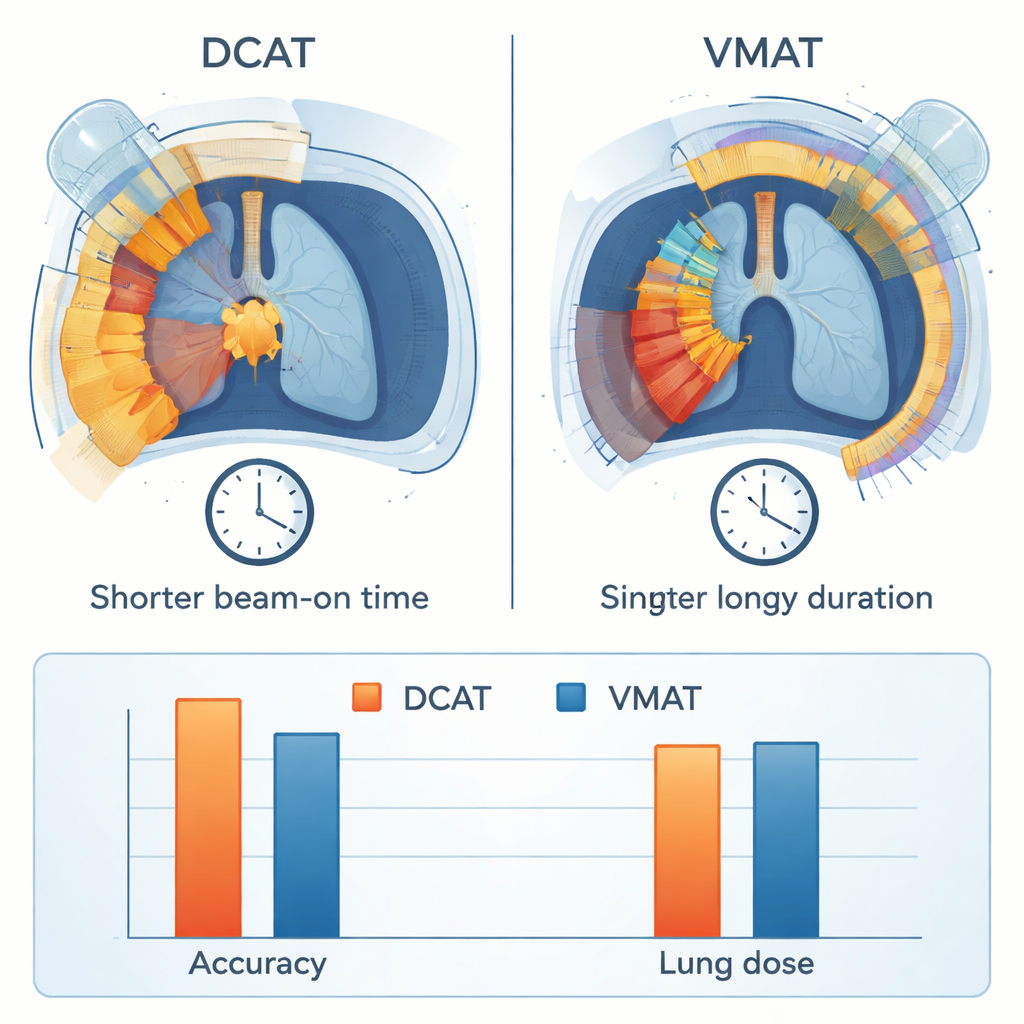
Which patients benefit most from DCAT
The researchers also asked whether tumor size changes the balance between the two techniques. By looking at ratios of key metrics between DCAT and VMAT across different target volumes, they found that for larger targets, DCAT gained a modest advantage in dose uniformity and in keeping the number of segments low. For very small targets, DCAT’s fall‑off outside the tumor became more comparable to VMAT’s. Taken together, this suggests that, within the studied size range, DCAT is particularly attractive when targets are small to moderate and a fast, robust delivery is desired.
What this means for patients and clinics
The study concludes that this refined form of DCAT is a feasible and attractive alternative to VMAT for SBRT in patients with centrally located early‑stage lung cancer, as long as the tumor volume stays below about 70 cubic centimeters. VMAT can still provide slightly better sparing of some normal tissues, especially the lungs, but DCAT offers faster treatments and slightly higher delivery accuracy without sacrificing tumor coverage or violating safety limits. For patients, that combination may translate into comfortable, reliable sessions with a very low risk of serious radiation injury to nearby organs. For clinics, DCAT provides a simpler, more stable way to treat challenging central lung tumors while maintaining the high cure rates associated with modern SBRT.
Citation: Huang, Y., Yang, J., Wang, C. et al. Novel DCAT plans in stereotactic body radiotherapy for stage I/II centrally located non-small-cell lung cancer. Sci Rep 16, 5197 (2026). https://doi.org/10.1038/s41598-026-35713-0
Keywords: lung cancer, stereotactic body radiotherapy, radiation therapy planning, DCAT vs VMAT, central lung tumors