Clear Sky Science · en
Harmonic distortion reduction and dynamic stability in PMSG-CHBI wind energy systems via a dual optimization–prediction approach
Why smoother wind power matters
As wind farms grow, keeping their electricity clean and stable becomes a hidden but crucial challenge. Homes, factories, and data centers all depend on power that looks like a smooth sine wave. In reality, wind changes from second to second, and the electronics that turn spinning blades into grid power can introduce unwanted ripples and spikes. This paper presents a new smart control approach that makes wind-turbine electricity cleaner, more efficient, and quicker to respond to sudden gusts, helping future grids absorb more renewable energy without sacrificing reliability.
The journey from wind to wall socket
In the system studied here, the wind first turns a turbine, which drives a permanent magnet generator to produce three-phase AC power. That power is then straightened into DC by a rectifier, boosted to a higher voltage, and finally reshaped into grid-quality AC by a special device called a five-level cascaded H-bridge inverter. Each of these stages can add its own irregularities, especially the inverter, which switches on and off rapidly to build up a staircase-like approximation of a sine wave. Under changing wind and load conditions, this process can introduce “harmonics”—extra frequency components that waste energy, stress equipment, and lower overall power quality.

A nature-inspired search for better switching
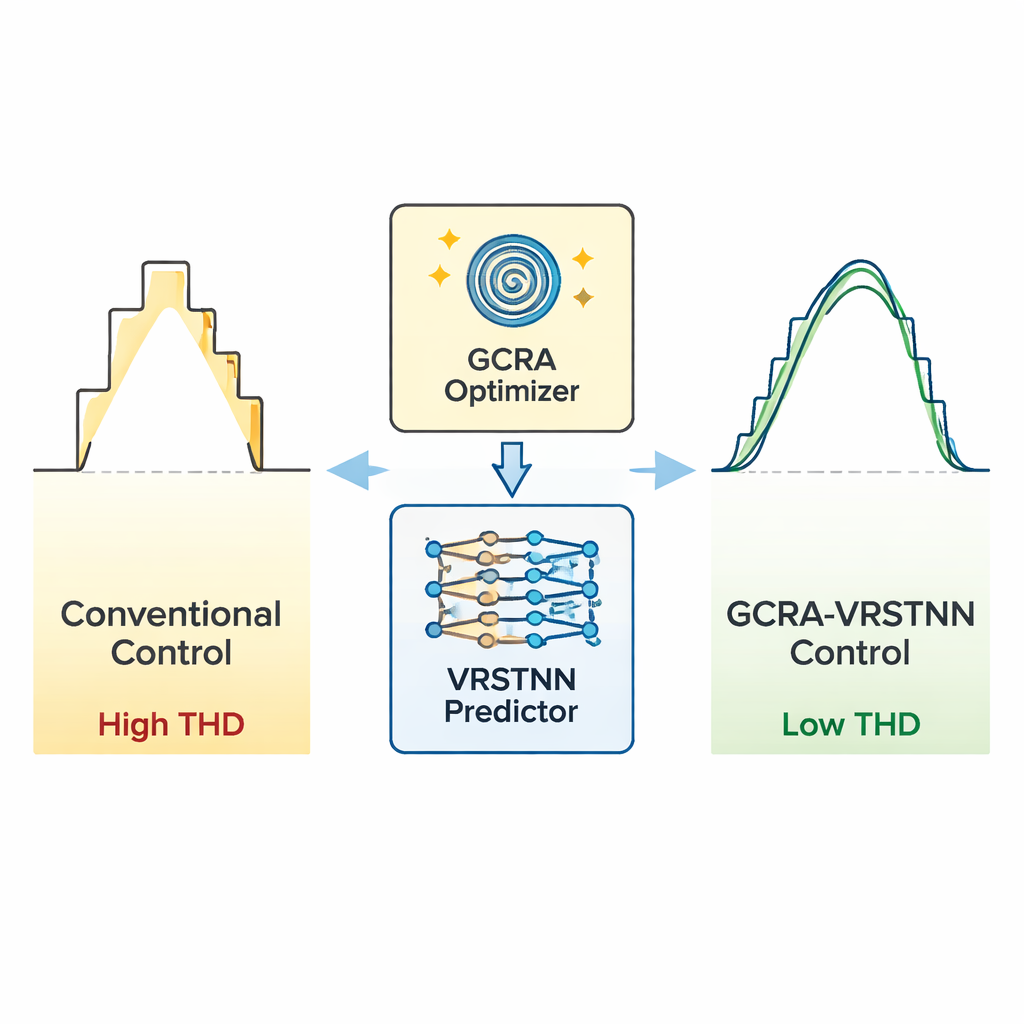
To tackle these distortions, the authors introduce a two-part strategy that combines an optimization algorithm with a predictive neural network. The first part, called the Greater Cane Rat Algorithm, is inspired by how groups of cane rats forage and move between shelters. Translated into mathematics, each “rat” represents a candidate pattern of switching angles for the inverter. By exploring and refining many options, the algorithm hunts for angle combinations that keep the useful fundamental voltage high while sharply reducing unwanted harmonics. Unlike older optimization methods that can get stuck in local ruts or require delicate tuning, this approach is designed to keep exploring broadly while still homing in on promising solutions.
A learning brain watching the system evolve
The second part of the method is a Visual Relational Spatio-Temporal Neural Network, essentially a specialized deep-learning model trained to predict how the wind-energy system will behave over time. Instead of looking at pictures, it treats key electrical signals—voltages, currents, wind speed, generator speed, and inverter settings—as a dynamic two-dimensional map. It learns how changes in one part of the system ripple through to others, and it uses this knowledge to forecast near-future conditions such as DC voltage fluctuations, current ripples, and likely harmonic growth. During operation, it provides rapid correction signals to the power electronics, allowing the inverter to adapt smoothly to gusts and load changes without waiting for large errors to appear.
Cleaner waves, lower losses, faster reactions
Using detailed computer simulations of a 2.5 kW wind-turbine setup, the authors compared their dual approach against several advanced controllers based on neural networks and hybrid optimization methods. The new framework cut total harmonic distortion in the inverter’s output voltage to about 2.1%, roughly halving the prominent low-order harmonics seen with a baseline controller. Voltage ripple on the DC link dropped from 4.8% to 1.6%, while power losses shrank by more than 80%, boosting inverter efficiency to nearly 99%. Just as importantly, the system settled into a new steady state after wind changes in about 12 milliseconds, nearly three times faster than before. The output currents and voltages approached ideal sine waves, and the power factor—the measure of how effectively power is used—rose close to unity.
What this means for future wind power
To a non-specialist, the key message is that this combined “optimize and predict” strategy helps wind turbines send out electricity that is both cleaner and more stable, even when the weather is not. By carefully choosing how the inverter switches and by anticipating how the system will respond a few moments ahead, the method squeezes more useful energy out of the same wind, reduces waste heat in the hardware, and eases the burden on the grid. Approaches like this could make it easier to expand wind power while keeping lights steady and sensitive electronics safe, pointing toward smarter, more resilient renewable energy systems.
Citation: Varghese, L.J., Venkatesan, G., Flah, A. et al. Harmonic distortion reduction and dynamic stability in PMSG-CHBI wind energy systems via a dual optimization–prediction approach. Sci Rep 16, 6234 (2026). https://doi.org/10.1038/s41598-026-35707-y
Keywords: wind energy, power quality, multilevel inverter, harmonic distortion, intelligent control