Clear Sky Science · en
Predicting energy prices and renewable energy adoption through an optimized tree-based learning framework with explainable artificial intelligence
Why the future cost of power matters to you
Electricity bills, fuel prices, and the pace at which solar and wind replace coal and oil shape daily life and national economies alike. This study asks a deceptively simple question: can we use modern data tools to see where energy prices and clean power adoption are headed, and understand what really drives those changes? By mining two decades of global energy data with advanced machine learning, the author builds a forecasting system that not only predicts future trends, but also explains which factors—like fossil fuel dependence or carbon emissions—matter most.
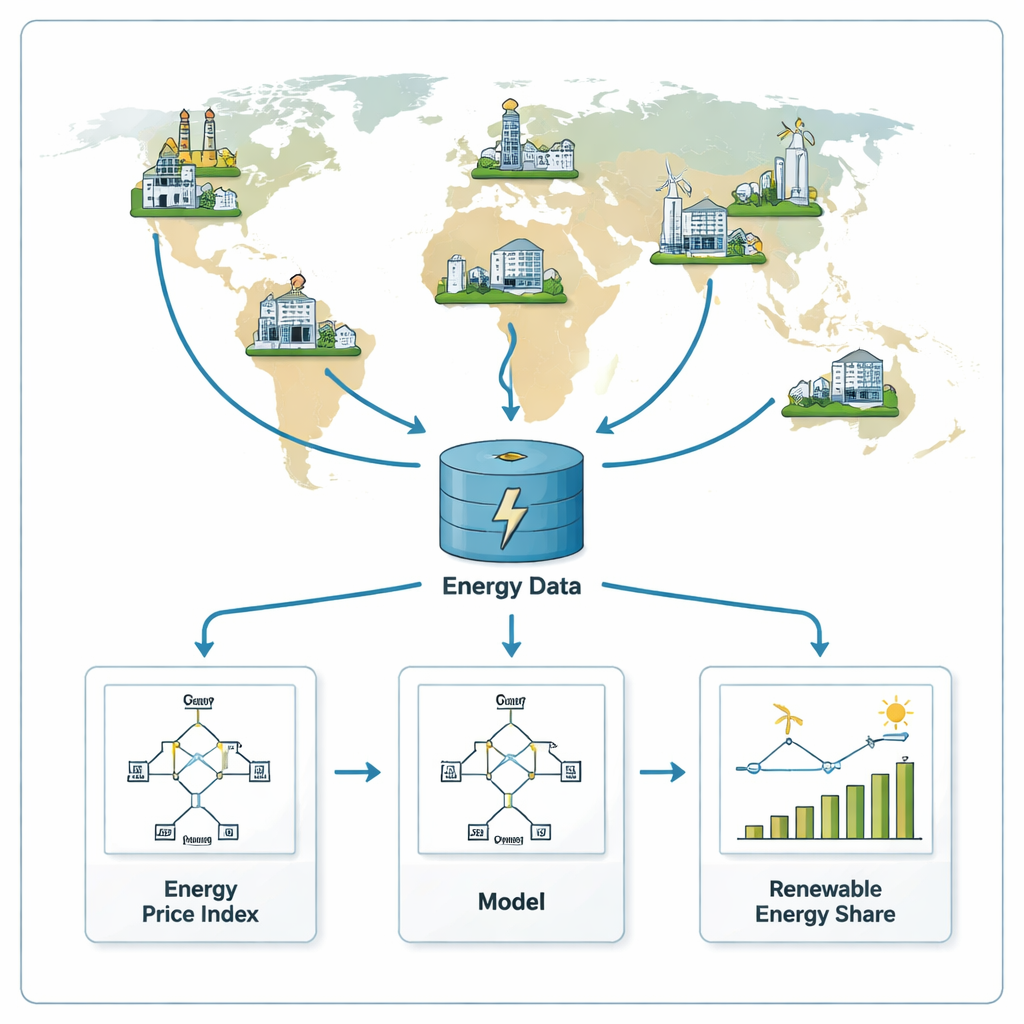
Following the world’s changing energy habits
The research starts from a large dataset covering more than 50 countries from 2000 to 2024. For each country and year, it tracks how much energy people use on average, how dependent the country is on fossil fuels, how energy is split between industry and households, the total amount of energy consumed, and the level of carbon emissions. Two key outcomes are then recorded: an Energy Price Index, which reflects how expensive power is, and the share of energy coming from renewable sources such as wind, solar, and hydropower. Because the data span many regions and years, they capture both local differences and long-term global trends, making them well suited for forecasting.
Teaching digital “trees” to learn from energy data
To turn this historical information into forecasts, the study relies on a family of techniques known as tree-based machine learning models. These models split data into branches based on simple questions, such as whether fossil fuel use is above or below a certain level, eventually arriving at predictions for price or renewable share. Instead of using a single tree, the author builds forests of trees and boosts their performance with so‑called metaheuristic optimization algorithms, inspired by animal behavior, that search for the best settings of each model. This tuning process improves both accuracy and stability when dealing with complex, noisy, real‑world data.
Checking reliability and opening the “black box”
Accurate predictions are useful only if they hold up under scrutiny. The study tests its models by repeatedly training and evaluating them on different slices of the time‑ordered data, mimicking how they would perform on future years they have never seen. Across these tests, the best hybrid models explain well over 90 percent of the variation in both energy prices and renewable energy share, with relatively small typical errors. To avoid the common criticism that machine learning is a black box, the author then applies explainable‑AI tools. One, called SHAP, distributes each prediction back to the input factors, showing how much each one pushed the forecast up or down. Another, a sensitivity method called the Cosine Amplitude Method, examines how changes and combinations of inputs ripple through to the outputs.
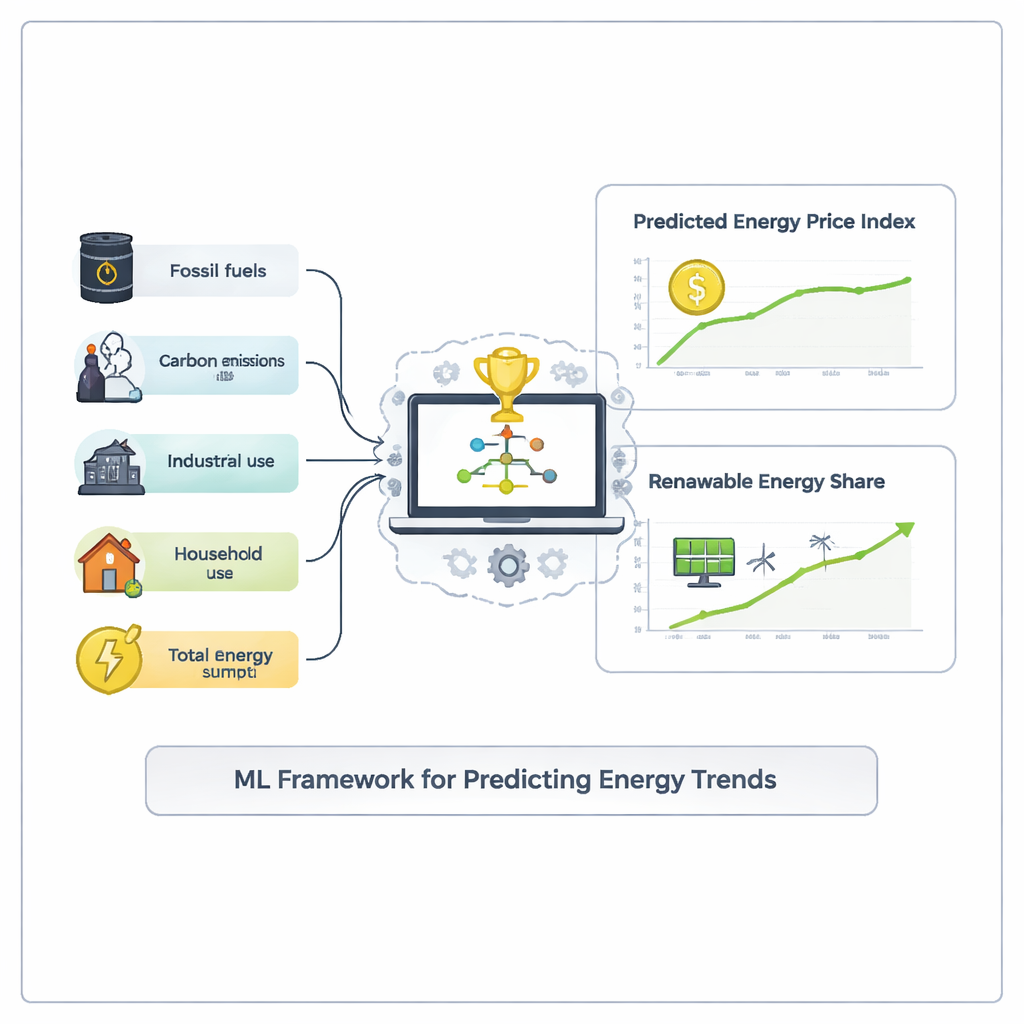
What really drives prices and clean energy growth
These interpretability tools reveal a clear story. For predicting the share of renewables, two variables stand out: how dependent a country is on fossil fuels and how much carbon it emits. High fossil fuel reliance and high emissions tend to suppress renewable growth, while shifts away from fossil fuels are strongly tied to larger clean‑energy shares. For energy prices, overall energy consumption—how much power a country uses across factories, offices, and homes—plays a leading role. Regions that use a lot of energy per person, or that lean heavily on fossil fuels, are more exposed to price swings when supply is tight. The analysis also shows that interactions matter: for example, the combined effect of industrial energy use and total consumption can be more important than either alone.
From smarter forecasts to smarter policy
For non‑specialists, the takeaway is straightforward. By pairing advanced learning algorithms with tools that clarify how they think, this research builds a forecasting framework that is both accurate and understandable. It shows that cutting fossil fuel dependence and carbon emissions is not just good for the climate; it is also closely linked to how fast renewables can grow and how stable energy prices can be. Policymakers, utilities, and investors can use such models to test how different choices—like carbon pricing, efficiency programs, or renewable incentives—might reshape future bills and emissions. In essence, the study offers a data‑driven compass to navigate the transition toward a more affordable and sustainable global energy system.
Citation: Tang, T. Predicting energy prices and renewable energy adoption through an optimized tree-based learning framework with explainable artificial intelligence. Sci Rep 16, 6771 (2026). https://doi.org/10.1038/s41598-026-35706-z
Keywords: energy prices, renewable energy, machine learning, carbon emissions, fossil fuels