Clear Sky Science · en
Analysis of air temperature reduction and indirect carbon savings by strategies of urban green space creation
Why Cooler Campuses Matter for City Life
As heat waves become more frequent, many cities are searching for ways to stay cool without simply cranking up the air conditioning. This study shows how turning a university campus into a carefully planned network of trees, green roofs, and planted walls can lower air temperatures and indirectly cut carbon emissions from electricity use. Instead of treating green space as just decoration, the researchers treat it like a piece of urban climate infrastructure that can measurably shrink a city’s carbon footprint.
A City That Overheats
The research focuses on Kyungpook National University in Daegu, South Korea, a dense inland city that regularly experiences more hot nights and heat wave days than the national average. The campus sits in the middle of residential, commercial, and industrial districts and already has more trees and parks than the surrounding neighborhoods. That makes it an ideal “green hub” for testing how different types of planting might cool not only the campus itself but also the nearby city blocks. The question is not just whether green spaces are helpful, but which specific strategies give the best cooling and carbon benefits in a tight urban setting.
Nine Ways to Add Green to the Same Campus
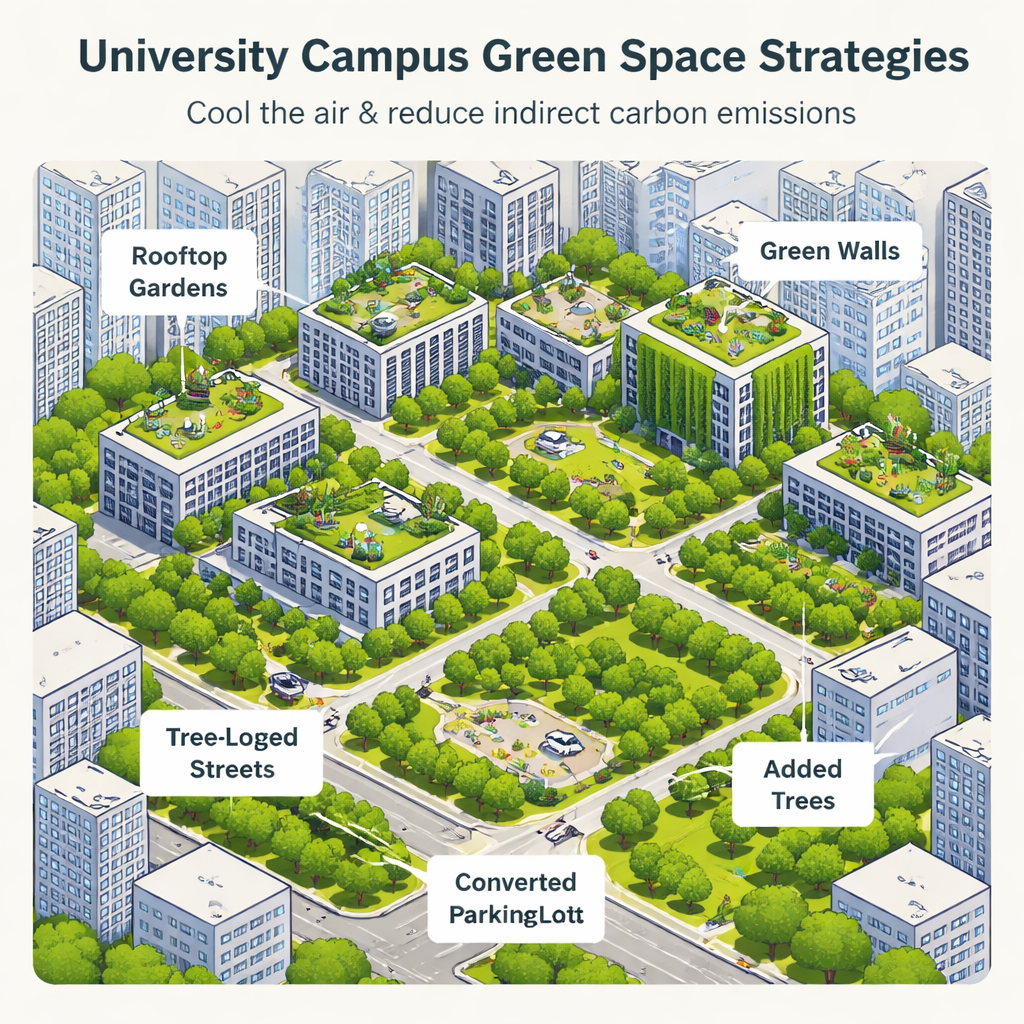
To answer this, the team designed nine detailed scenarios for changing the campus landscape. Two were reference cases: the current layout and a hypothetical version with no green space at all. The others reflected real policies already used on Korean campuses: covering roofs with vegetation, adding climbing plants on building walls, moving surface parking underground and planting over it, greening idle paved areas, adding more trees to existing lawns, lining major walkways with street trees, and finally a combined scenario that applied all these strategies together. Using a specialized 3D microclimate model called ENVI-met, they simulated how air temperature would change across the whole campus block from ground level up to 54 meters, roughly twice the height of the tallest buildings.
How Much Can Greenery Cool the Air?
Even small temperature changes can matter when they are spread through a large volume of air. At about head height, the most effective single strategy was adding street trees along roads and paths, which cooled the air by roughly three times more than simple rooftop greening. These trees cast shade on heat‑absorbing surfaces like asphalt, reducing the build‑up of radiant heat. Adding trees to existing green spaces also helped, but the street trees were more efficient because they targeted the hottest materials. Vertical greening on roofs and facades produced smaller reductions at ground level, yet they continued to cool the air higher up, around typical building heights, which is important for tall, compact cities.
Turning Cooler Air into Carbon Savings
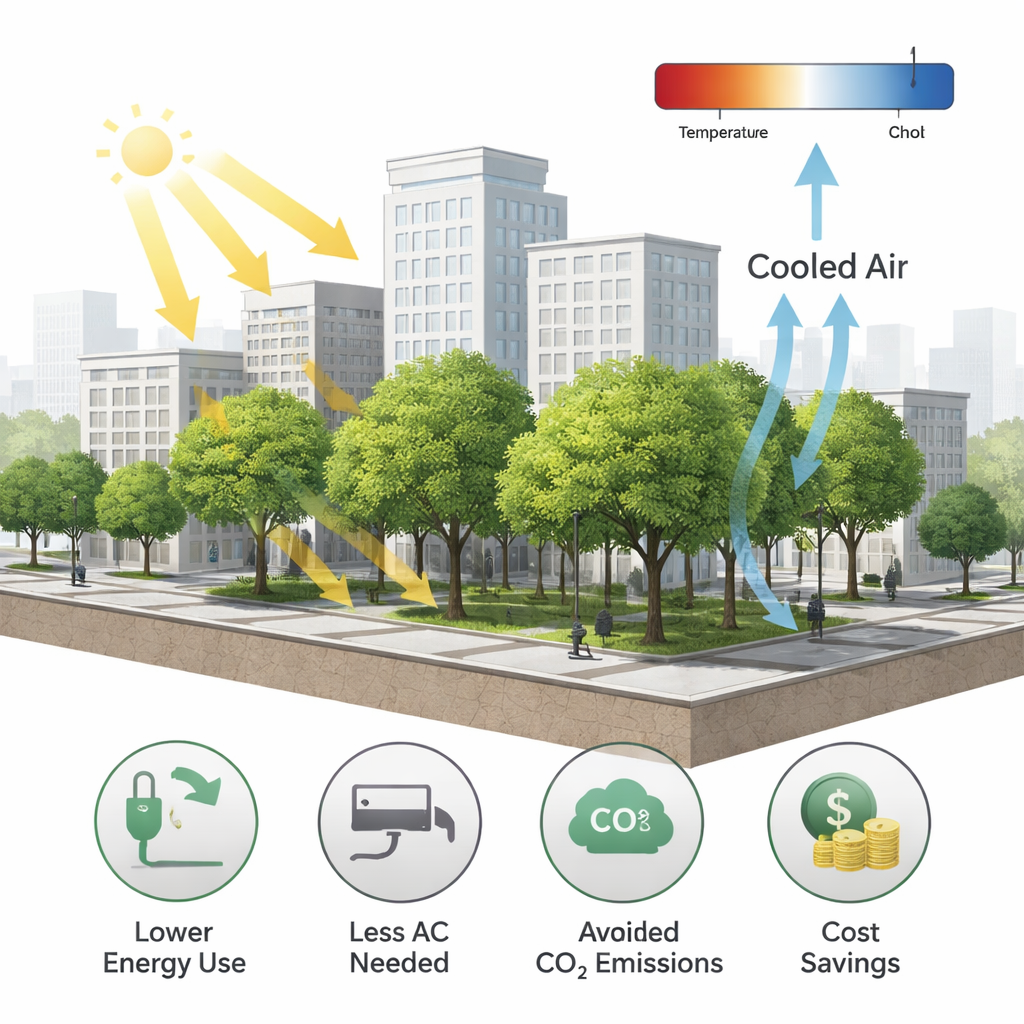
The researchers then converted these temperature drops into potential energy and carbon savings. Using well‑established physical formulas, they estimated how much cooling energy the lower air temperatures represent and compared that to the campus’s real hourly electricity use in summer. The standout strategy again was street trees: at 4 p.m., when electricity demand peaks, the added shade could offset the equivalent of running about 190 standard air conditioners and avoid around 143 kilograms of CO2 in a single hour. When all six greening strategies were combined, the maximum hourly benefit rose to 903 kilowatt‑hours of cooling, representing about 8.55% of the campus’s electricity consumption at that time and roughly 361 kilograms of CO2 in avoided emissions.
Choosing Smarter Green, Not Just More Green
One of the study’s key findings is that more plants do not automatically mean more climate benefit. For example, converting a fully paved parking lot into a planted surface delivered similar carbon savings to adding almost twice as many trees in partly green areas. This is because replacing hard, sun‑soaked surfaces with greenery cuts heat at its source. When the team examined savings per unit of greened area or volume, street trees shading roads and walkways and the greening of former parking lots emerged as especially efficient strategies. The authors argue that future urban plans should use tools like ENVI-met to test different layouts before planting, so that limited space and budgets are spent on the kinds of greenery that cool the most and save the most energy.
What This Means for Everyday City Planning
For non‑specialists, the bottom line is clear: trees and planted buildings do more than make campuses look pleasant. When placed strategically—along streets, over parking lots, and on vertical surfaces—they create measurable cooling that reduces the need for air conditioning and indirectly cuts carbon emissions. University campuses, often large and centrally located, can act as experimental green hubs that show nearby districts what works best. By treating green space as a climate tool and planning it with data rather than guesswork, cities can make meaningful progress toward carbon neutrality while also creating cooler, more comfortable places to live, work, and study.
Citation: Kim, JE., Eum, JH. & Son, JM. Analysis of air temperature reduction and indirect carbon savings by strategies of urban green space creation. Sci Rep 16, 5110 (2026). https://doi.org/10.1038/s41598-026-35702-3
Keywords: urban green space, campus greening, heat mitigation, energy savings, carbon neutrality