Clear Sky Science · en
A linear programming model for power system planning with hydrogen integration
Why turning sunshine into hydrogen matters
Many countries are searching for ways to keep the lights on, cut carbon emissions, and still support energy-hungry industries. The United Arab Emirates (UAE) has abundant sunshine, growing electricity use, and big ambitions to become a global hub for clean hydrogen. This study asks a simple but crucial question: if the UAE redesigned its power system for the year 2030 from the ground up, how much solar, gas, nuclear power, batteries, and hydrogen storage would make both economic and environmental sense?
Designing a future energy puzzle
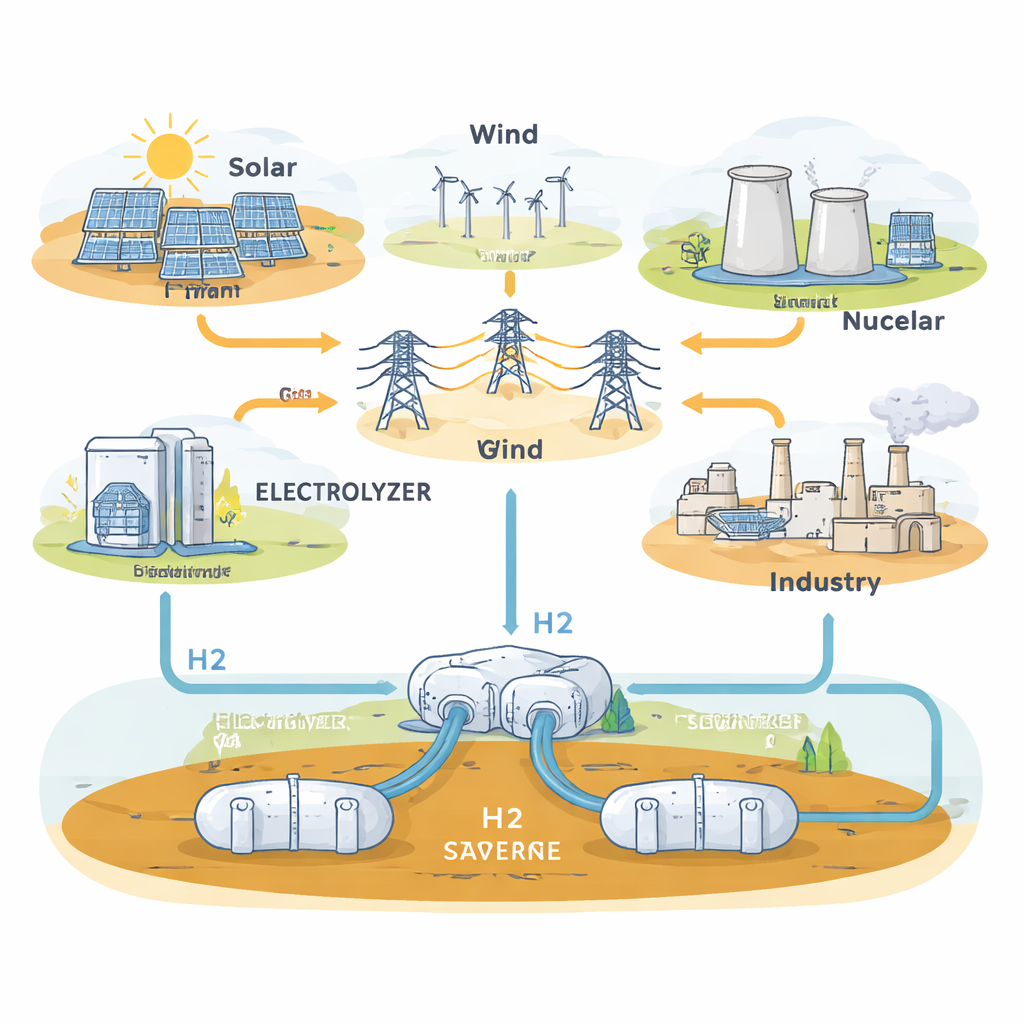
The researchers built a detailed computer model that represents the UAE’s entire power and hydrogen system hour by hour over a full year. Instead of tweaking today’s infrastructure, they used a “greenfield” approach: the model is free to choose whatever mix of technologies is cheapest while still meeting two targets for 2030—about 203 terawatt-hours of electricity and 1.4 million tons of hydrogen per year. The model can invest in four ways of making electricity (solar panels, wind turbines, nuclear reactors, and efficient natural gas plants) and two ways of storing energy (lithium-ion batteries and underground hydrogen storage). It also includes the core pieces of a hydrogen chain: electrolyzers that use electricity to split water, underground caverns to store hydrogen, and fuel cells that can turn stored hydrogen back into power.
How the digital power system makes choices
To decide what to build and how to operate it, the model uses linear programming, a mathematical method often applied in logistics and finance. It minimizes the total annual cost, including construction, operation, fuel, and even a price on carbon emissions. At every hour of the year, the model must balance electricity supply and demand, and also keep track of where hydrogen is produced, stored, and consumed. It uses real weather data for solar and wind, a realistic hourly shape for electricity demand dominated by air-conditioning, and a synthetic but consistent pattern for hydrogen demand across industries such as steel, shipping, and refineries. On top of costs, the model tracks life‑cycle emissions from each technology, from building equipment to burning gas.
What the cheapest low‑carbon system looks like
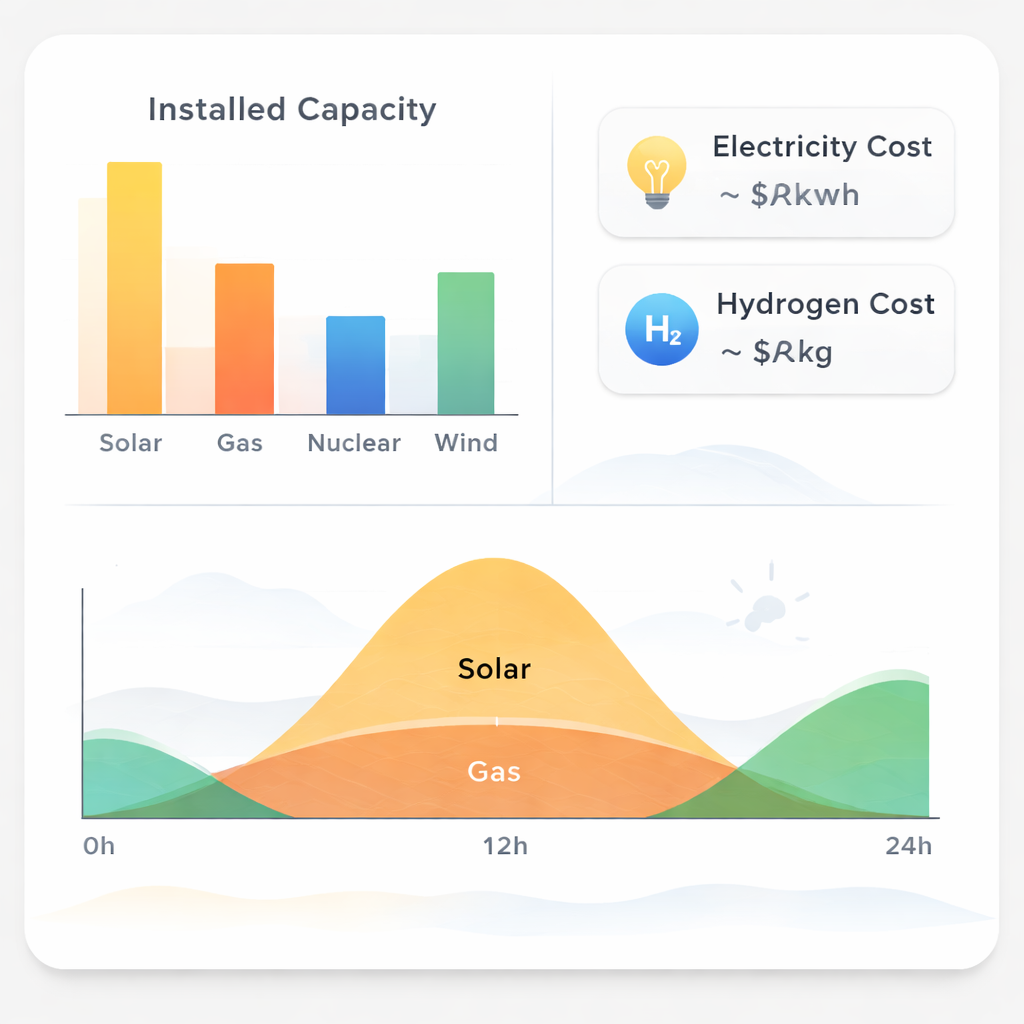
The cost‑optimal solution for 2030 has a clear structure. Solar power is pushed up to the national planning limit, reaching 19.8 gigawatts of capacity. Nuclear energy operates mainly as a steady baseload source, close to the existing Barakah plant’s full capacity. Natural gas plants still play a major role, providing more than 50 gigawatts of flexible capacity that ramps up when the sun goes down or when demand peaks. On the hydrogen side, the model installs large electrolyzers—about 10.4 gigawatts—to turn surplus electricity into hydrogen, and very large underground hydrogen storage, equivalent to roughly 1.3 terawatt‑hours of energy. This setup allows the system to use every unit of generated electricity either directly or indirectly via hydrogen, with essentially no wasted energy. Under current cost assumptions, however, it is not economical to build additional batteries or fuel cells at the national scale.
Costs, carbon, and what really drives the outcome
With this configuration, the model finds that electricity could be supplied at an average cost of about 6.5 cents per kilowatt-hour, and hydrogen at around $2.56 per kilogram—competitive figures in the global green hydrogen race. Yet the system still emits around 124 million tons of carbon dioxide equivalent per year, mostly from natural gas power plants. A sensitivity analysis shows that policy and fuel prices matter much more than the sticker price of solar panels or electrolyzers. A carbon tax of $100 per ton would raise total system costs by nearly three‑quarters, while a 50% swing in gas prices shifts costs by roughly plus or minus one‑quarter. By contrast, cutting the capital cost of solar or electrolyzers in half barely changes total system cost, because the model already uses as much of these technologies as practical limits allow.
What this means for people and policymakers
For readers outside the energy‑modeling world, the message is straightforward. In a sun‑rich, water‑scarce country like the UAE, large solar farms, steady nuclear power, and flexible gas plants form the backbone of an affordable system. Hydrogen plays a double role: it acts as a long‑term energy store that smooths out swings in solar output, and it supplies cleaner fuel for heavy industries and transport. The study suggests that, at current prices, big hydrogen facilities and underground storage beat batteries for large‑scale balancing, while policy tools like carbon pricing and gas‑price risk will ultimately decide how “green” and how costly the system becomes. In practical terms, accelerating solar and nuclear build‑out, maintaining—but cleaning up—gas plants, and investing early in hydrogen infrastructure could let the UAE cut emissions and create new export industries without sacrificing energy reliability.
Citation: Zaiter, I., Sleptchenko, A., Mayyas, A. et al. A linear programming model for power system planning with hydrogen integration. Sci Rep 16, 7120 (2026). https://doi.org/10.1038/s41598-026-35701-4
Keywords: green hydrogen, energy storage, solar power, natural gas, UAE energy transition