Clear Sky Science · en
Neuromechanical gait signatures reveal holistic biomechanical responses to walking speed modulation in stroke survivors
Why Walking Patterns After Stroke Matter
After a stroke, many people struggle to walk at comfortable speeds, limiting their independence and ability to get around their community. Therapists often try to help patients walk faster, but speeding up can sometimes make a person’s movement less balanced or less efficient. This study introduces a new way to look at walking called “gait signatures,” which blend information from the joints and nervous system into a single picture. The goal is to understand, in a holistic way, how changing walking speed affects overall walking quality, and how this knowledge might help personalize rehabilitation.
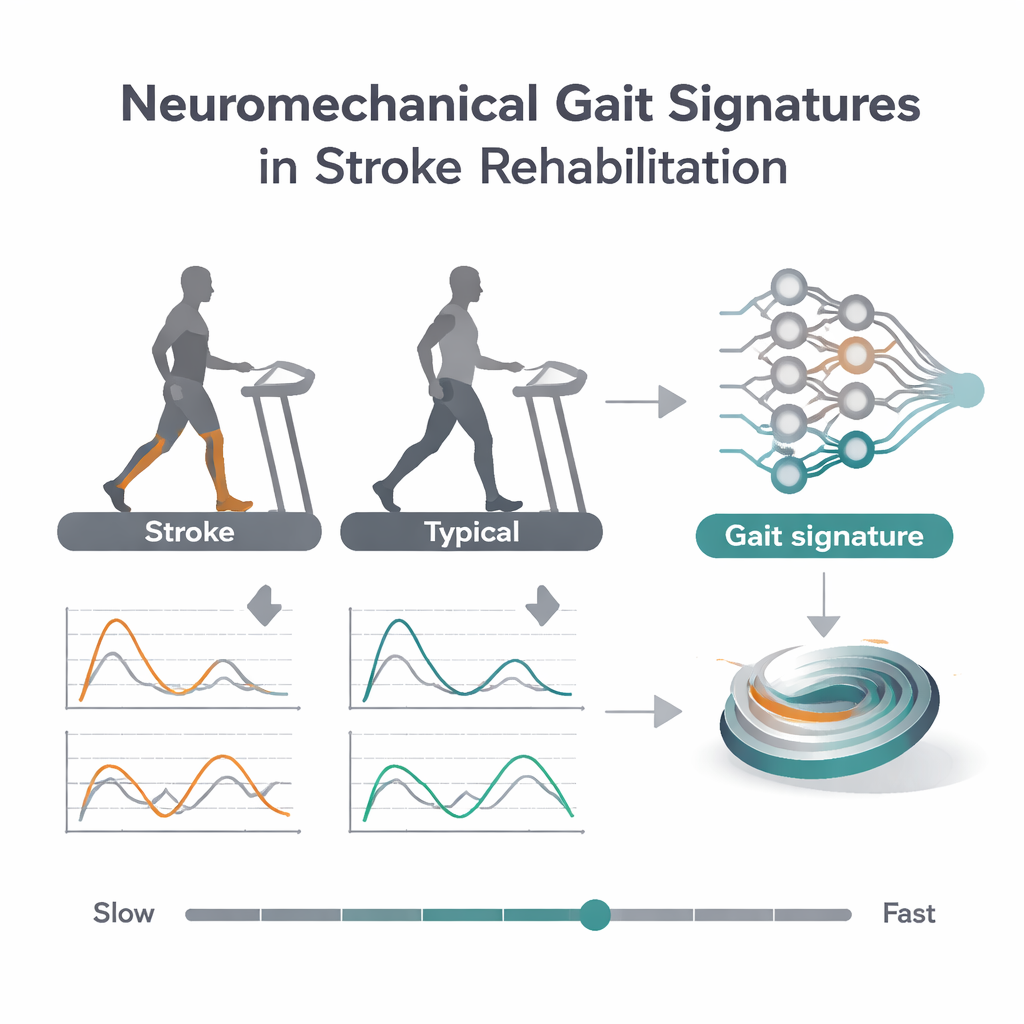
A New "Fingerprint" of How You Walk
Traditional gait analysis focuses on separate measurements such as how hard the leg pushes off, how far behind the body the foot trails, or how uneven the two legs are. These individual numbers can give mixed messages: one might improve with speed while another gets worse. The researchers instead trained a recurrent neural network—a type of artificial intelligence that works well with time-based data—to follow how the hip, knee, and ankle move during walking in both stroke survivors and adults without neurological problems. From this network, they extracted compact patterns called gait signatures, which act like a movement fingerprint summarizing the combined effects of muscles, nerves, and mechanics over each step.
Comparing Stroke and Typical Walking
Nineteen people who had experienced a stroke and five people without neurological impairments walked on a treadmill at six speeds, from self-selected to their fastest safe pace. The team compared each person’s gait signature with a reference signature built from the able-bodied group. Stroke survivors started out with gait signatures that were clearly different from this reference, reflecting their impaired movement. As walking speed increased, however, their signatures generally shifted to become more similar to the able-bodied pattern, suggesting that walking faster often nudged their overall movement toward a more typical style—even when some individual measures, like asymmetry between legs, did not fully normalize.
Speed Changes Reveal Hidden Movement Limits
The study found that the direction in which a person’s gait signature moved as they sped up carried particularly important information. Stroke survivors whose signatures changed in a direction more similar to the able-bodied group tended to walk faster overall, cover a wider range of speeds, and generate stronger push-off forces and ankle power in the affected leg. In contrast, simply asking how close someone’s baseline signature was to the able-bodied reference—without considering how it changed with speed—was only weakly related to clinical walking scores. This suggests that how a person adapts their movement when challenged with higher speeds may reveal underlying neuromechanical constraints that matter for recovery more than their starting pattern alone.
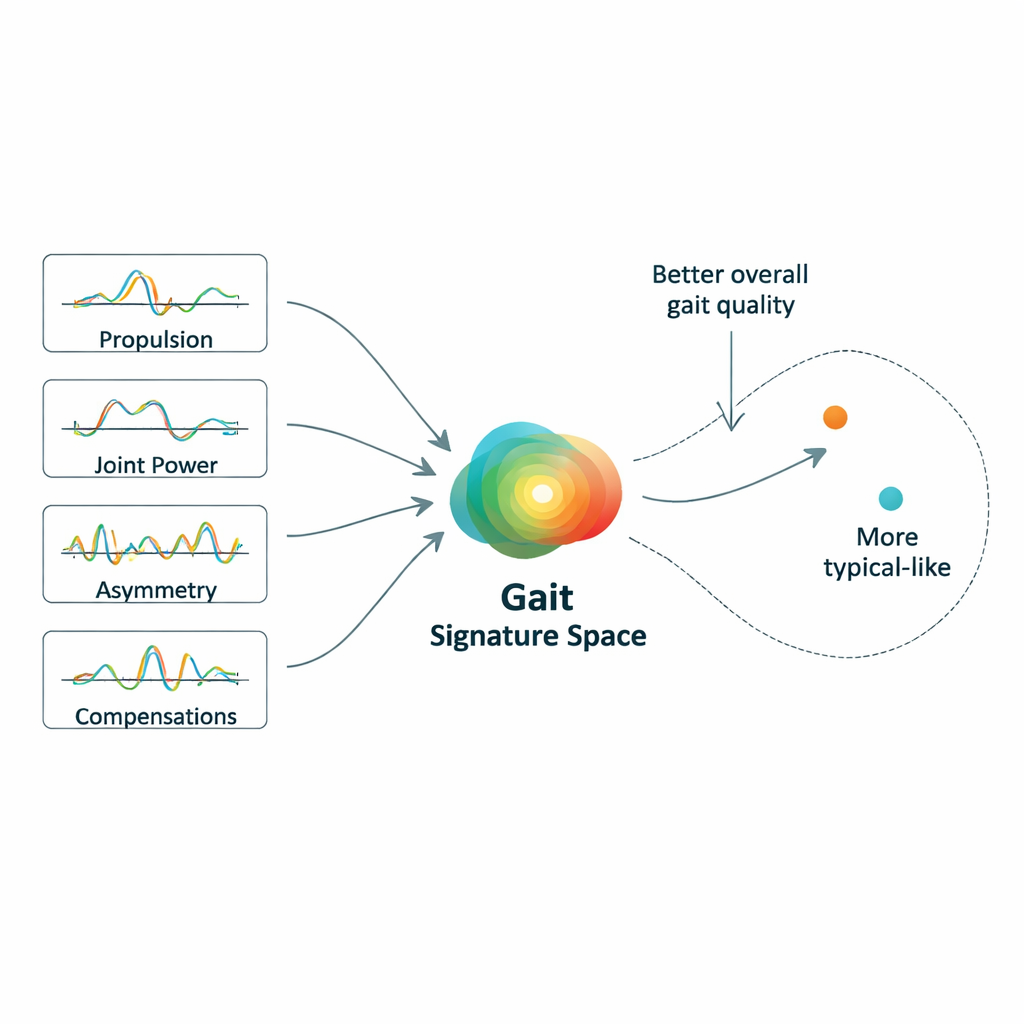
Capturing the Whole Picture of Walking Quality
Beyond single measurements, the researchers asked whether gait signatures could stand in for many biomechanical variables at once. Using a statistical method that links patterns across large sets of numbers, they showed that specific features of the gait signatures predicted a broad combination of desirable traits: stronger work from the paretic leg, smaller differences between legs, and fewer compensatory movements like swinging the leg outward or hiking the hip. Gait signatures captured these tradeoffs more completely than walking speed alone, which mainly reflected how hard the affected leg pushed but not how symmetric or compensatory the gait was.
What This Means for Rehabilitation
For people recovering from stroke and the clinicians who treat them, this work suggests that a single, AI-derived gait signature can summarize the complex ways walking changes with speed. Instead of tuning therapy based only on how fast someone can go or on a handful of separate measurements, therapists might eventually use gait signatures to find the speed range that best balances stronger use of the paretic leg with acceptable symmetry and minimal compensations. In the future, similar tools could help track how new treatments or training programs influence the overall quality of movement, leading to more personalized and effective rehabilitation.
Citation: Rosenberg, M.C., Winner, T.S., Berman, G.J. et al. Neuromechanical gait signatures reveal holistic biomechanical responses to walking speed modulation in stroke survivors. Sci Rep 16, 5040 (2026). https://doi.org/10.1038/s41598-026-35700-5
Keywords: stroke gait, walking speed, gait rehabilitation, biomechanics, neural networks