Clear Sky Science · en
Perioperative outcomes in primary neonatal pullthrough versus pullthrough in older children with Hirschsprung disease: a systematic review and meta-analysis
When Timing Matters for Tiny Tummies
Parents whose babies are diagnosed with Hirschsprung disease face an urgent and emotional question: when is the safest time to operate? This condition, in which part of the large intestine lacks the nerve cells needed to move stool along, is treated with a surgery called a pullthrough. Surgeons can perform it in the first weeks of life or wait until the baby is a bit older. This article looks across decades of studies to ask a simple but crucial question: does waiting past the first month of life actually give children a smoother recovery?
A Birth Defect That Blocks the Bowels
Hirschsprung disease affects about one in every 5,000 newborns. Because a segment of the bowel has no working nerve cells, stool cannot pass normally, leading to severe constipation, swelling of the belly, vomiting, and sometimes a dangerous gut infection called enterocolitis. The standard treatment is to remove the diseased bowel and connect the healthy intestine to the anus in a single operation, known as a primary pullthrough. Thanks to better diagnosis and improved surgical techniques, many centers now offer this repair in the newborn period, often through a minimally invasive, trans-anal approach.
Pulling Together Evidence from Around the World
The authors carried out a systematic review and meta-analysis, a method that combines results from many separate studies to look for clearer patterns. They searched multiple medical databases from the 1960s through mid-2024 and found 20 suitable studies including 3,197 children with Hirschsprung disease. About 1,371 had surgery as newborns (within the first month of life) and 1,826 had their pullthrough later, up to 5 years of age. None of the studies were randomized trials; instead, they were mostly retrospective reviews of real-world care. The team focused on early surgical outcomes—such as length of hospital stay, infections, and bowel leaks at the join—as well as longer-term issues like skin irritation, narrowing of the anus, enterocolitis, constipation, and stool control.
Early Surgery Is Faster, but Recovery Can Be Rougher
When the researchers pooled the data, they found that operating on newborns did make the surgery itself shorter by about 25 minutes on average. This likely reflects how soft and easy-to-handle newborn tissues are. But that advantage did not translate into an easier hospital course. In studies that could be combined, babies who had surgery after the first month tended to leave the hospital around three days sooner. There was no clear difference in overall wound infection rates or in the risk of dying from surgery, but serious blood infections (sepsis), bowel leaks, and other complications clustered more often in the neonatal group, although not all of these differences reached strict statistical certainty.
Skin Soreness, Narrowing, and Gut Infections
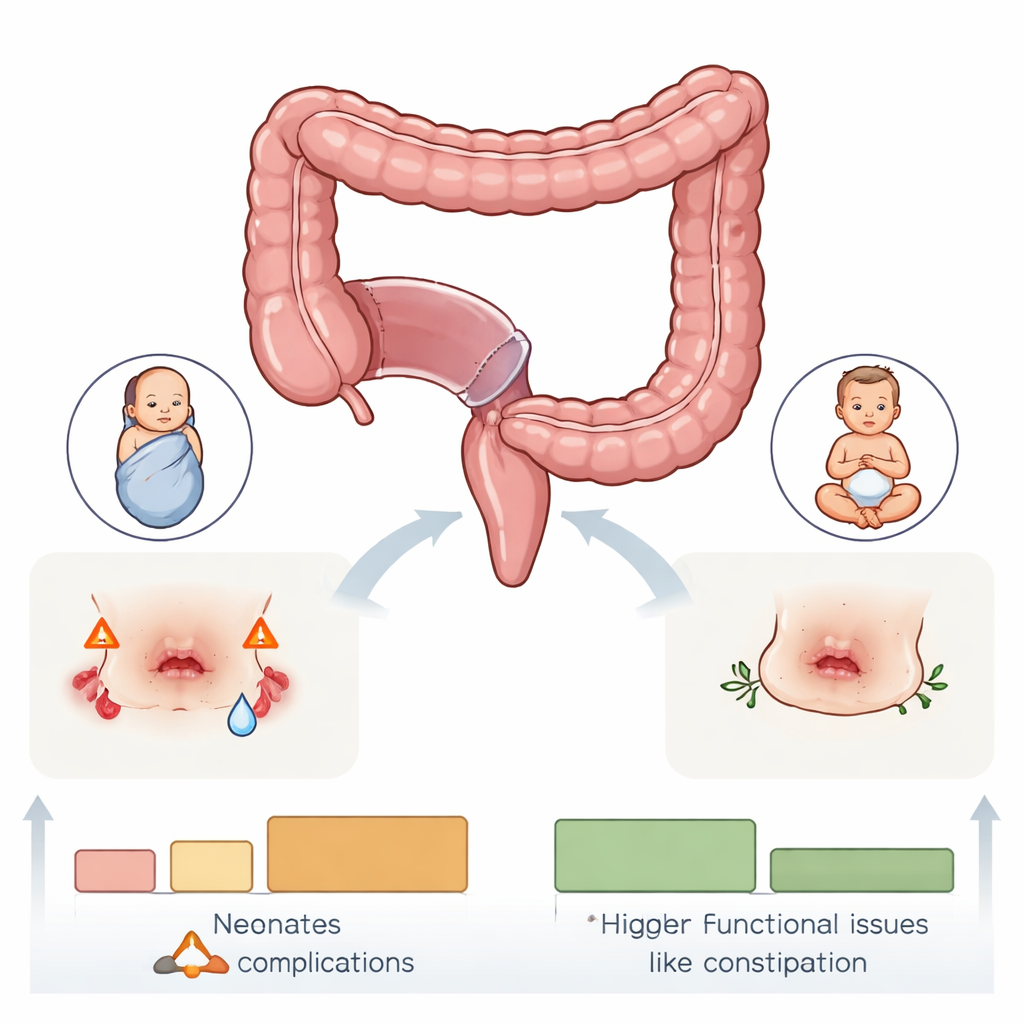
The biggest contrasts emerged in what happened after discharge. Newborns who had an early pullthrough were far more likely to develop painful skin breakdown around the anus in the first three months, reflecting higher stool frequency and irritation. They also had higher rates of narrowing at the surgical join (anal stenosis or stricture), especially by three months after surgery, and a greater risk of post-operative enterocolitis during that early period. In other words, the first months after a neonatal pullthrough could be stormy, demanding more care, dilations, or treatments to keep the new bowel connection open and the gut healthy. By contrast, older infants and young children generally experienced fewer of these early local problems.
Mixed Signals on Long-Term Bowel Control
Long-term bowel function proved harder to pin down. Only eight studies reported on constipation, stool frequency, or continence, and they used different scoring systems, making it impossible to merge the numbers formally. Taken together, they suggested that children who had surgery when older might be more prone to constipation and possibly more accidental soiling in the long run, while those operated on as newborns had looser, more frequent stools but tended to show better control over time. Because these findings were based largely on doctors’ and parents’ impressions rather than standardized tests, the authors caution against drawing firm conclusions.
What This Means for Families and Surgeons
For parents, the key takeaway is that waiting until after the first month of life—when the baby is a bit bigger and stronger—appears to offer a safer and smoother early recovery for most children with typical Hirschsprung disease, without clearly worsening long-term bowel function. Early surgery can still be appropriate in some cases, especially when symptoms are severe, but it may come with more short-term bumps in the road. Because the available studies are observational and definitions vary widely, the authors call for large, carefully designed prospective studies that follow children for many years. Until then, decisions about timing will continue to balance the urgency of a sick newborn’s condition against the potential benefits of allowing a little time to grow.
Citation: Alshahwani, N., Alsaied, A., Tewfik, S. et al. Perioperative outcomes in primary neonatal pullthrough versus pullthrough in older children with Hirschsprung disease: a systematic review and meta-analysis. Sci Rep 16, 7004 (2026). https://doi.org/10.1038/s41598-026-35690-4
Keywords: Hirschsprung disease, pediatric surgery, neonatal pullthrough, surgical timing, bowel function