Clear Sky Science · en
Carbon emission model and evaluation analysis of vehicle waste tire different recycling processes based on reducing environmental pollution
Why old tires matter to the climate
Every car and truck on the road eventually needs new tires, and the worn-out ones often end up piled in landfills or burned. These waste tires are hard to break down and can leak harmful substances into the air, soil, and water. This study asks a simple but important question: when we look at the entire life of a tire—from factory to scrapyard—which handling methods create the least climate-warming carbon emissions, and which recycling options do the most to cut them?
Following a tire from birth to death
The researchers built a carbon “accounting book” for a heavy truck tire, tracking emissions in four stages: production, transport, use on the vehicle, and end-of-life recycling. They used a standard approach called the carbon emission factor method, which multiplies how much material or energy is used by how much carbon it typically releases. For each stage, they added up emissions linked to raw materials like natural rubber and carbon black, electricity and fuel used in factories and trucks, and the diesel burned while the tire is in service on a vehicle.
Where most of the carbon really comes from
The results show that the vast majority of a tire’s climate impact does not come from the factory. For the tire they studied, about 96% of total life cycle emissions are produced during the use stage, because the tire affects how much fuel the vehicle consumes over tens of thousands of kilometers. Transporting the tires contributes only about 2% of total emissions, and manufacturing accounts for just under 2%. This means that any change which extends tire life or avoids making a brand-new tire can have a much bigger effect than small efficiency tweaks in factories or shipping. 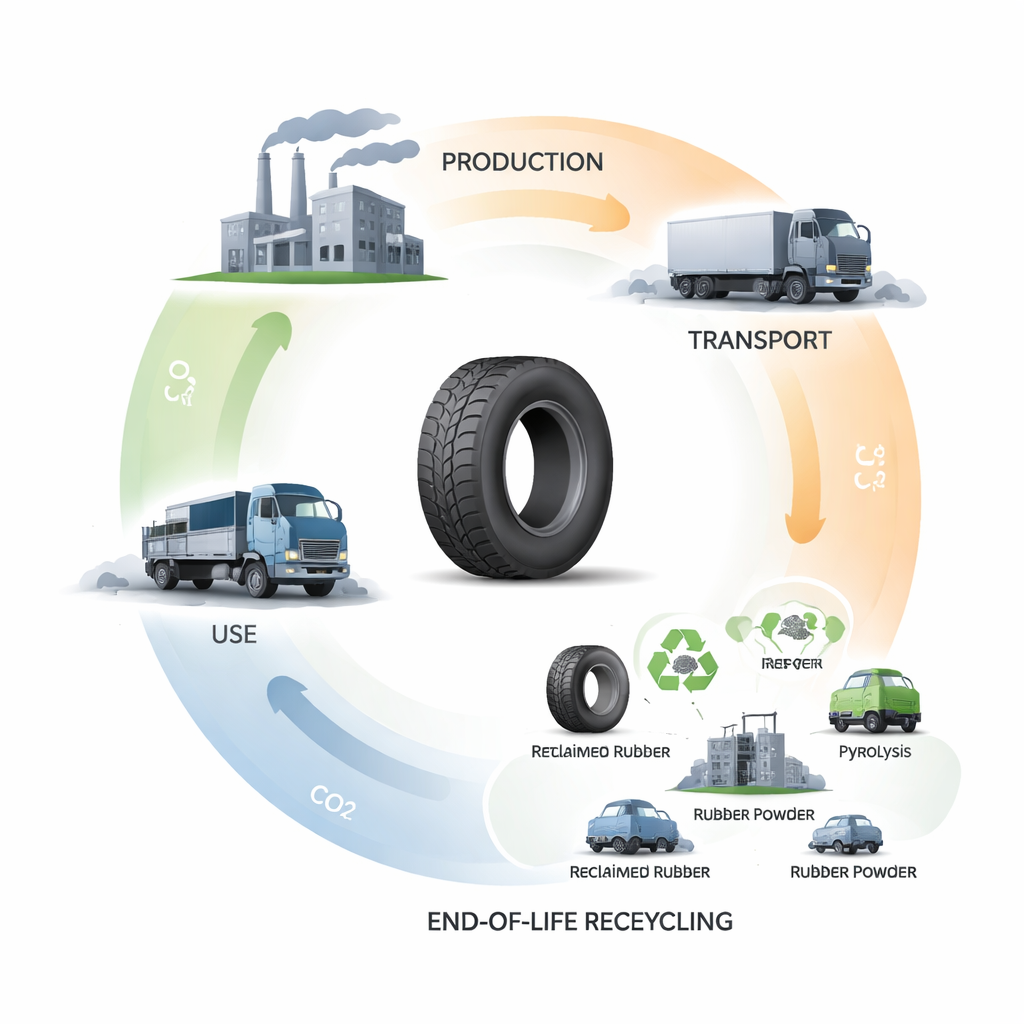
Comparing different ways to reuse old tires
Once a tire reaches the end of its first life, there are four main recycling paths: retreading the tire so it can be used again; turning it into reclaimed rubber; grinding it into rubber powder; or breaking it down through high-temperature treatment known as pyrolysis. Within these paths, the team examined eight specific industrial processes, such as hot and cold retreading, different ways of producing reclaimed rubber, and several grinding and pyrolysis techniques. For each, they calculated not just the emissions from running the process, but also the “carbon savings” from replacing new materials or fuels with products made from waste tires.
Which recycling choices save the most carbon
When the numbers are compared, retreading stands out as the clear climate winner. Among all eight processes, cold retreading performs best, cutting emissions by about 59% compared with making and using brand-new tires, while hot retreading follows closely at about 55%. Ambient grinding of tires into rubber powder and atmospheric continuous desulfurization for reclaimed rubber also provide meaningful reductions, around 50%. In contrast, high-energy options like cryogenic grinding and certain forms of pyrolysis yield much smaller benefits, in some cases barely offsetting their own energy use. Overall, the ranking of processes from strongest to weakest in cutting carbon is: Cold Retreading, Hot Retreading, Ambient Grinding, Atmospheric Continuous Desulfurization, Screw Extrusion, Atmospheric Pyrolysis, Vacuum Pyrolysis, and Cryogenic Grinding. 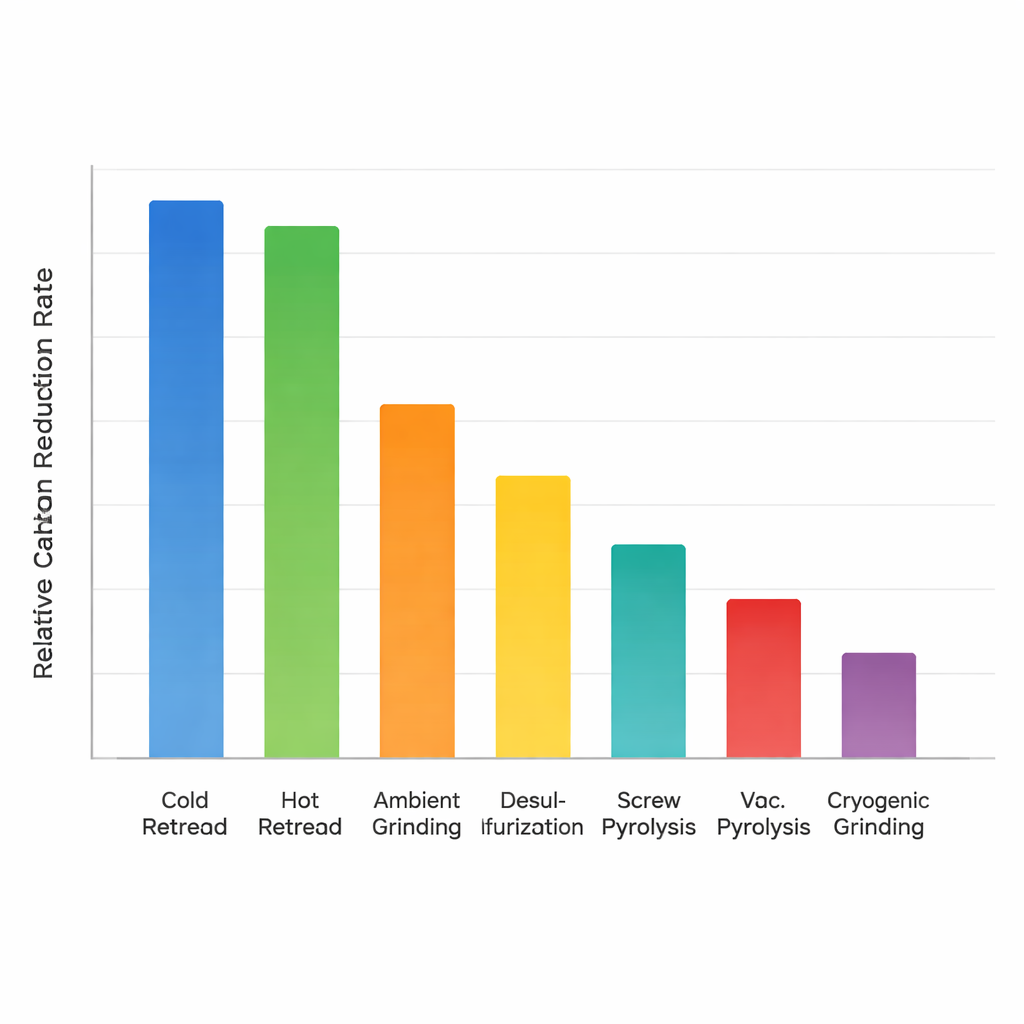
What makes the biggest difference in factories
The study also tested how sensitive total tire emissions are to changes in the factory stage. When the amount of materials used in tire production increased by 40%, total production-stage emissions rose by about 31.5%. But a similar increase in energy use raised emissions by only about 9.3%. This suggests that, inside factories, using less raw material—or switching to lower-carbon ingredients—matters more for the climate than modest changes in electricity or fuel use. Still, because the use phase dominates overall emissions, the greatest leverage lies in measures that extend tire life or avoid the need for new tires altogether.
What this means for everyday life and policy
For non-specialists, the message is straightforward: the greenest tire is the one that keeps rolling safely for longer instead of being thrown away. Retreading old tires, especially using cold processes, allows much of the original tire body to be reused, saving both materials and the large carbon footprint of manufacturing replacements. The authors argue that supporting high-quality retreading and efficient reclaimed rubber technologies can significantly lower the climate impact of road transport. Their work offers a roadmap for policymakers, tire makers, and recycling companies to set standards and investments that favor the most climate-friendly options, helping turn a growing waste problem into an opportunity for meaningful carbon reductions.
Citation: Wang, Q., Li, A. Carbon emission model and evaluation analysis of vehicle waste tire different recycling processes based on reducing environmental pollution. Sci Rep 16, 5821 (2026). https://doi.org/10.1038/s41598-026-35688-y
Keywords: waste tires, tire recycling, carbon emissions, retreaded tires, life cycle assessment