Clear Sky Science · en
Odors modulate self face perception and frontal ERP responses
How Smells May Change the Way You See Yourself
Most people have had the experience of feeling more or less confident about their looks depending on the situation. This study suggests that the surrounding smells you breathe in may quietly shape how attractive you find your own face—and how your brain reacts when you look at yourself. By pairing different odors with photos of volunteers’ faces, and recording their brain waves, the researchers show that even a single whiff can nudge both self-judgment and underlying brain activity.
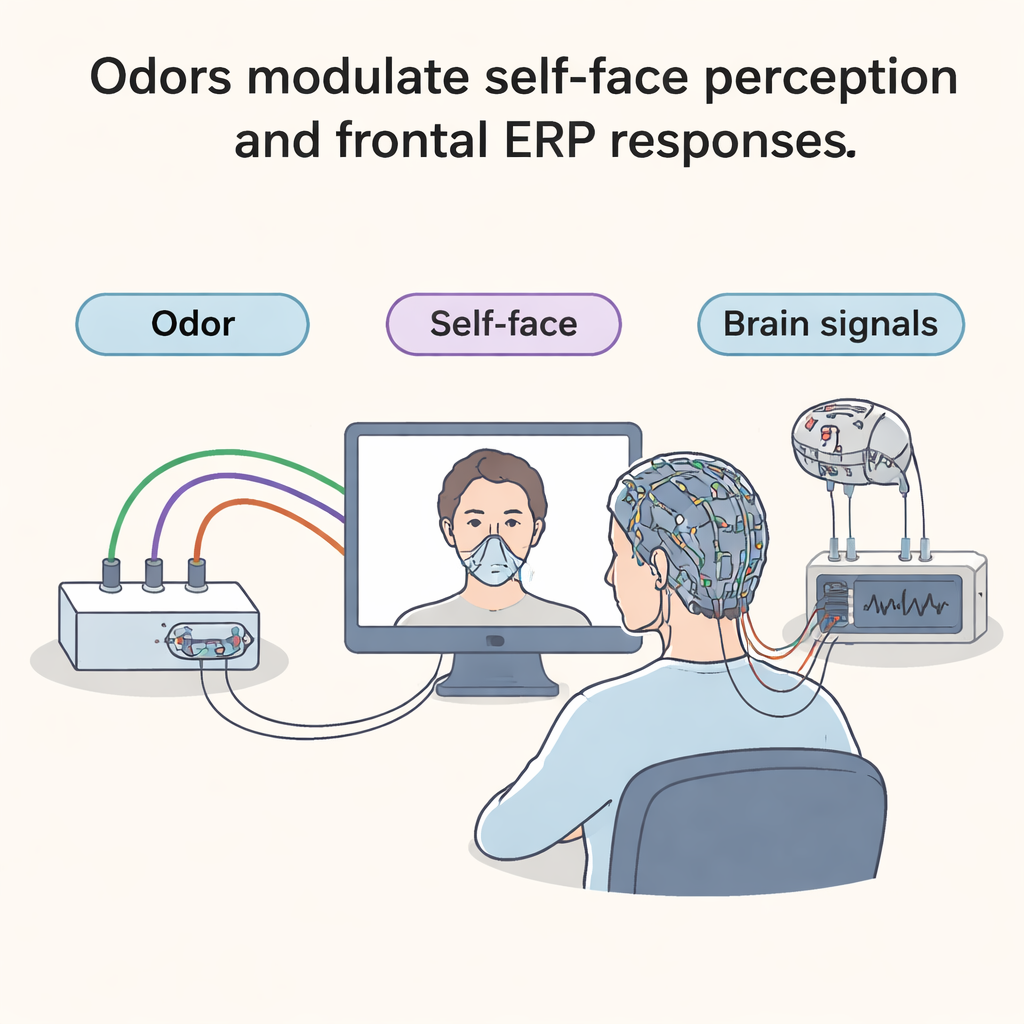
Setting the Stage: Faces, Feelings, and Scents
Our faces are central to social life: they help others recognize who we are, guess our age and health, and form snap judgments about our personality and attractiveness. Scientists already knew that background odors can change how we judge other people’s faces. Pleasant smells tend to make strangers look more appealing, while foul smells can have the opposite effect. But until now, almost all of this work has focused on other faces. The special case of seeing our own face—tightly tied to identity, emotion, and self-esteem—had rarely been examined in combination with smell.
The Experiment: Pairing Odors with Your Own Face
The research team recruited 31 healthy young adults and carefully tested their sense of smell. Each person had a neutral-looking photograph taken of their own face, which was later shown to them on a computer screen. Before each brief flash of their self-face image, participants received one of three odor conditions through a mask controlled by a precise delivery device: plain air (a solvent-only control), lavender (intended as a neutral-to-pleasant smell), or isovaleric acid, a pungent sweaty odor known to be strongly unpleasant. Participants were not told exactly how their photos were handled; they only knew they would be seeing images derived from their own faces.
What People Reported: Foul Smells, Harsher Self-Ratings
After blocks of trials, volunteers rated both the odors and their own face on simple scales. Lavender and isovaleric acid were judged equally strong, but the sweaty odor was rated much less pleasant than either air or lavender. Crucially, when people had just smelled the unpleasant scent, they liked their own face less and rated it as less attractive than after air or lavender. Lavender did not differ significantly from air on average, in part because some people found it very pleasant while others were more neutral. Across individuals, however, the more pleasant they found a given odor, the more positively they evaluated their own face under that odor condition, linking smell value directly to self-evaluation.
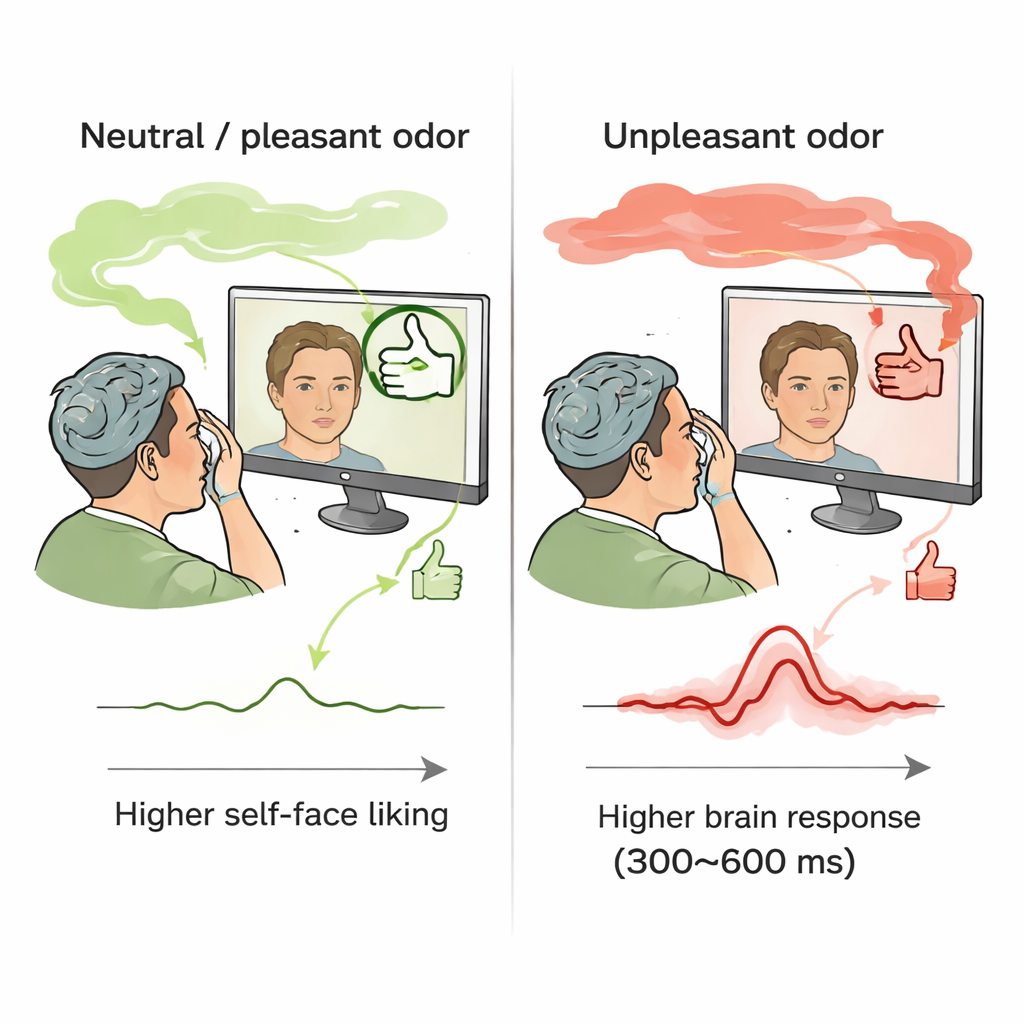
Inside the Brain: Millisecond-by-Millisecond Changes
While participants viewed their own faces, the researchers recorded brain activity using electroencephalography (EEG), focusing on rapid electrical responses called event-related potentials (ERPs). They divided the first second after each face appeared into several time windows, from very early visual processing (about 50 milliseconds) to later, more reflective stages (up to 1,000 milliseconds). Across this entire span, many electrodes over the scalp showed differences between odor conditions. One particularly important window, between 300 and 600 milliseconds, is known to reflect attention and emotional evaluation. In this study, a positive wave in that period—sometimes linked to judging attractiveness—was larger over certain frontal and central areas when the unpleasant odor was present, and its size was positively related to how much people liked and valued their own face.
Why It Matters: Everyday Smells and Self-Image
Together, these findings indicate that the emotional tone of the air around us can subtly color how we see ourselves, not just how we see others. A bad smell made people judge their own face more harshly, while also ramping up brain responses during a key window for affective self-assessment. The authors suggest that ordinary olfactory environments—such as personal hygiene, perfumes, room scents, or even body odors—may exert a modest but real influence on self-perception and confidence. In other words, the way you smell your world might help shape how you feel about the person looking back at you in the mirror.
Citation: Yoon, S., Moon, S., Kim, K. et al. Odors modulate self face perception and frontal ERP responses. Sci Rep 16, 5082 (2026). https://doi.org/10.1038/s41598-026-35683-3
Keywords: self-face perception, odor and emotion, EEG brain responses, facial attractiveness, multisensory integration