Clear Sky Science · en
Optimisation and economic assessment of a lowcost insecticide for stored product insect pest control and seed viability
Why everyday materials matter for food security
In many parts of the world, small-scale farmers lose a large share of their stored harvest to insects after the crops have been brought in from the field. Commercial pesticides can be effective, but they are often too expensive, hard to get, or come with environmental and health concerns. This study explores whether three very familiar household materials—kerosene, table salt, and laundry detergent—can be combined into a simple spray that kills storage pests while still allowing valuable seeds to sprout later. 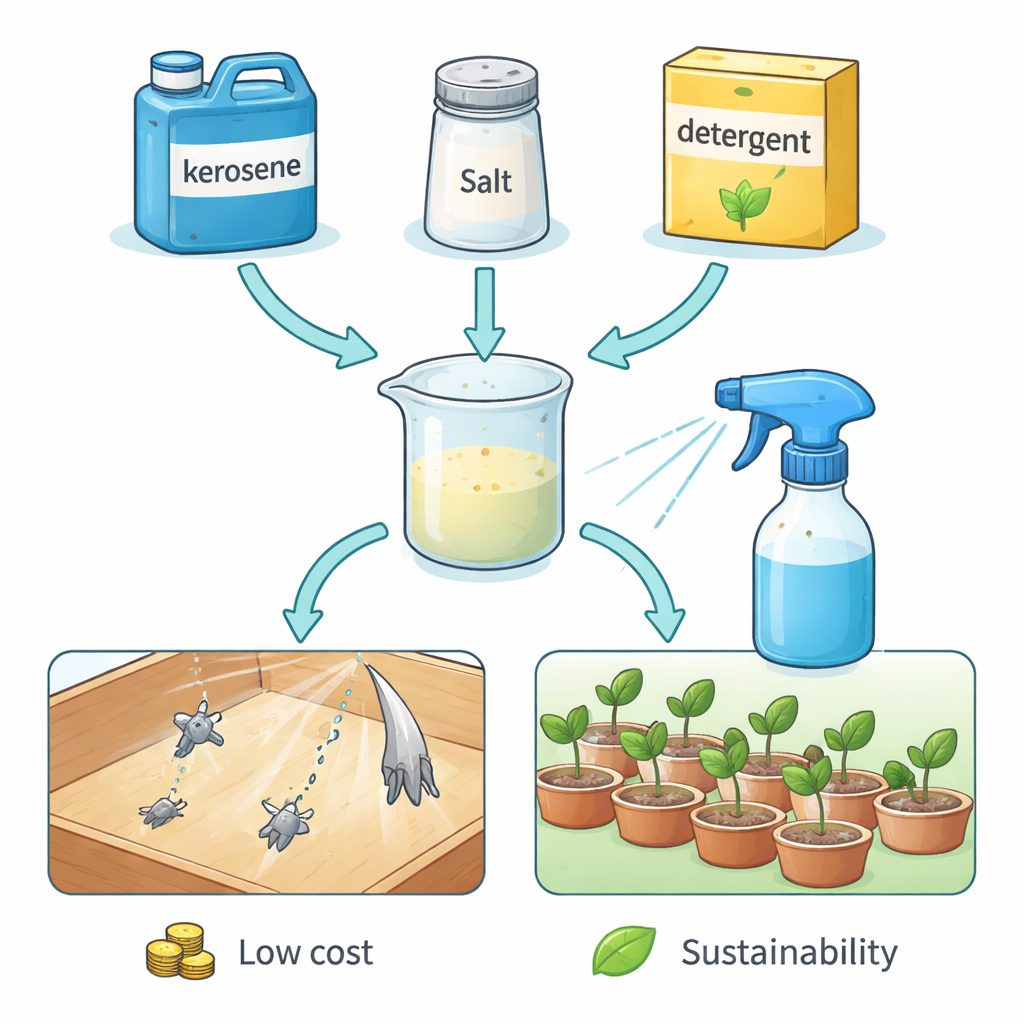
Turning common items into a simple spray
The researchers set out to design and fine‑tune a homemade insecticide using only kerosene, salt, and detergent mixed with water. They focused on cockroaches collected from real indoor environments as stand‑ins for common storage pests, and on neem tree seeds as a test of whether treated seed would still germinate. Rather than guessing at recipes, the team used a structured experimental plan that systematically varied how much of each ingredient went into the mixture. For each recipe, they sprayed the emulsion into wooden boxes holding cockroaches and neem seeds, then tracked how quickly insects were knocked down and how many seeds sprouted in soil pots over the following days.
How the mixture knocks insects down
Observations during the tests showed a consistent pattern: soon after spraying, cockroaches became hyperactive, twitched, and then could no longer right themselves, eventually dying. Earlier work suggests why this happens. Kerosene can coat the insect’s outer surface and breathing openings, cutting off air and disturbing waxy protective layers. Detergent acts like a helper, breaking the liquid into smaller droplets and helping the kerosene spread and cling more tightly to the insect’s body, making it easier for the mixture to plug the breathing holes. Salt on its own did little to kill the insects but seemed to boost kerosene’s effects when combined with it, possibly by drawing moisture out through the cuticle. By analysing how quickly different mixtures caused knockdown, the team estimated that an optimised recipe could disable half the cockroaches in about 12 minutes, though the timing estimate was imprecise because counts were only taken every 30 minutes. 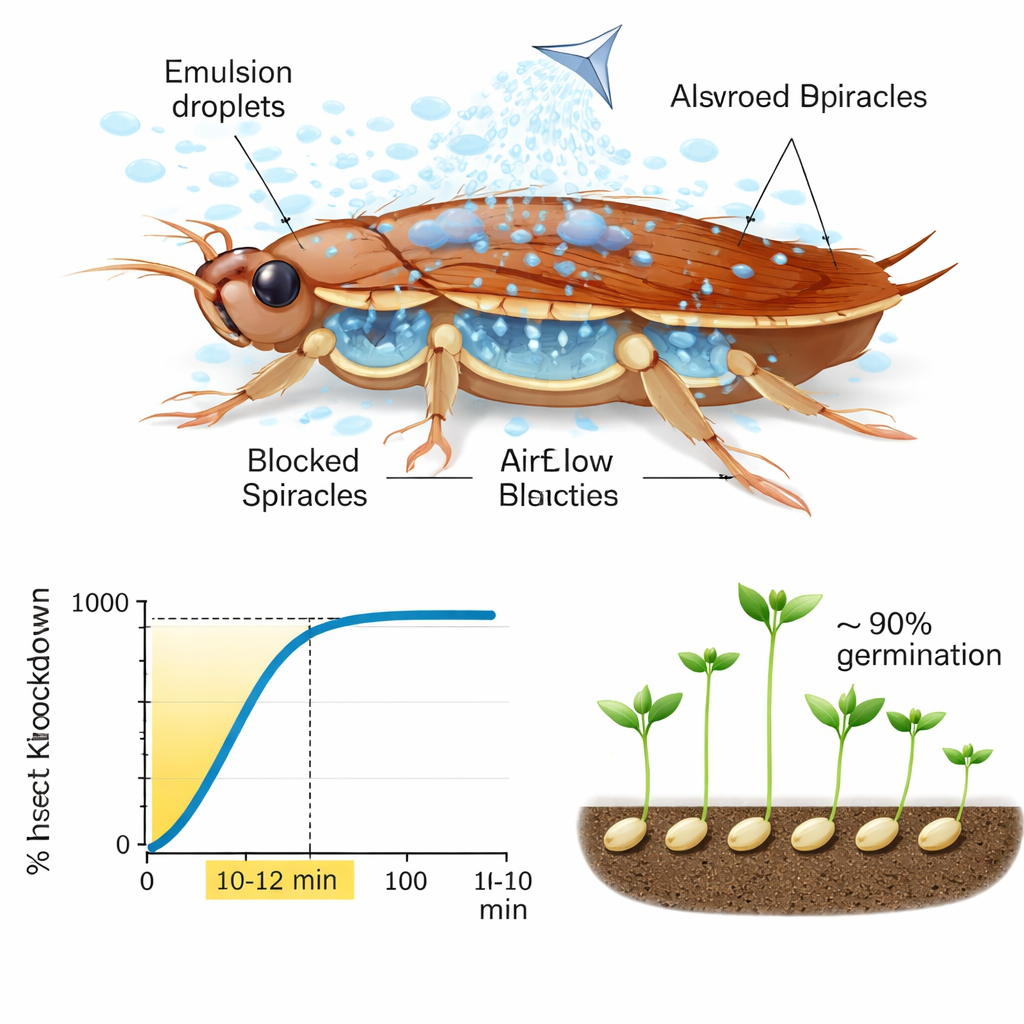
Protecting seeds while fighting pests
An effective storage spray also has to be gentle enough that seeds can still germinate. In pot experiments following international seed‑testing guidelines, neem seeds treated with some of the harsher mixtures—especially those heavy in kerosene or salt—germinated poorly, with only about 30% sprouting. But seeds exposed to more moderate recipes, including the central “mid‑level” mix, reached close to 90% germination, similar to untreated controls and to the seeds’ measured natural viability. The results show that there is a narrow but workable window where the spray can kill most insects quickly without seriously harming seed performance, as long as ingredient levels are kept within balanced ranges.
Finding the best balance and counting the cost
Using mathematical models, the researchers searched for a combination that would both maximise insect death and keep germination high. The best‑performing formulation, on paper, used roughly eight millilitres of kerosene, seven grams of salt, and eleven grams of detergent. When this recipe was tested in new trials, it achieved about 90% cockroach mortality and 90% neem seed germination, only slightly below the model’s predicted performance. Chemical fingerprinting with infrared light confirmed that the mixture contained the expected groups of hydrocarbon and detergent molecules that help it form a stable emulsion and penetrate insect surfaces. A simple cost analysis, based on local retail prices in Nigeria, suggested that making a litre of this homemade spray would cost well under one dollar—several times cheaper than some commercial insecticides sold to farmers in the same markets.
What this means for farmers and the environment
The study shows that with careful testing and optimisation, very common and affordable materials can be turned into an insecticidal spray that strongly reduces pest numbers while allowing most stored neem seeds to remain viable. For smallholder farmers, such a tool could provide a low‑cost way to protect stored, non‑edible seeds and reduce post‑harvest losses. However, the authors emphasise that their work is still at the proof‑of‑concept stage. They did not yet measure how long residues last on seeds, how safe the spray is for people or beneficial organisms, or how well it performs in real storage facilities over months. Before any widespread use, further studies on safety, species‑specific effectiveness, and field performance will be needed to ensure that this household‑based approach truly offers a safe and sustainable alternative to conventional pesticides.
Citation: Ogbeh, G.O., Idachaba, O. & Sini, V.J. Optimisation and economic assessment of a lowcost insecticide for stored product insect pest control and seed viability. Sci Rep 16, 7673 (2026). https://doi.org/10.1038/s41598-026-35677-1
Keywords: low-cost insecticide, stored grain pests, cockroach control, seed germination, kerosene detergent emulsion