Clear Sky Science · en
Strength analysis of cable tunnels with different embedding depths by using finite element method
How buried tunnels keep your lights on
Modern cities rely on hidden power highways: long underground tunnels packed with high‑voltage cables. These passages free up space on crowded streets and protect vital infrastructure—but building them safely without overspending is a delicate balancing act. This study looks at how the depth and shape of these tunnels influence their strength and long‑term stability, helping engineers decide when a simple box shape is enough and when a more expensive arched design is worth the extra cost. 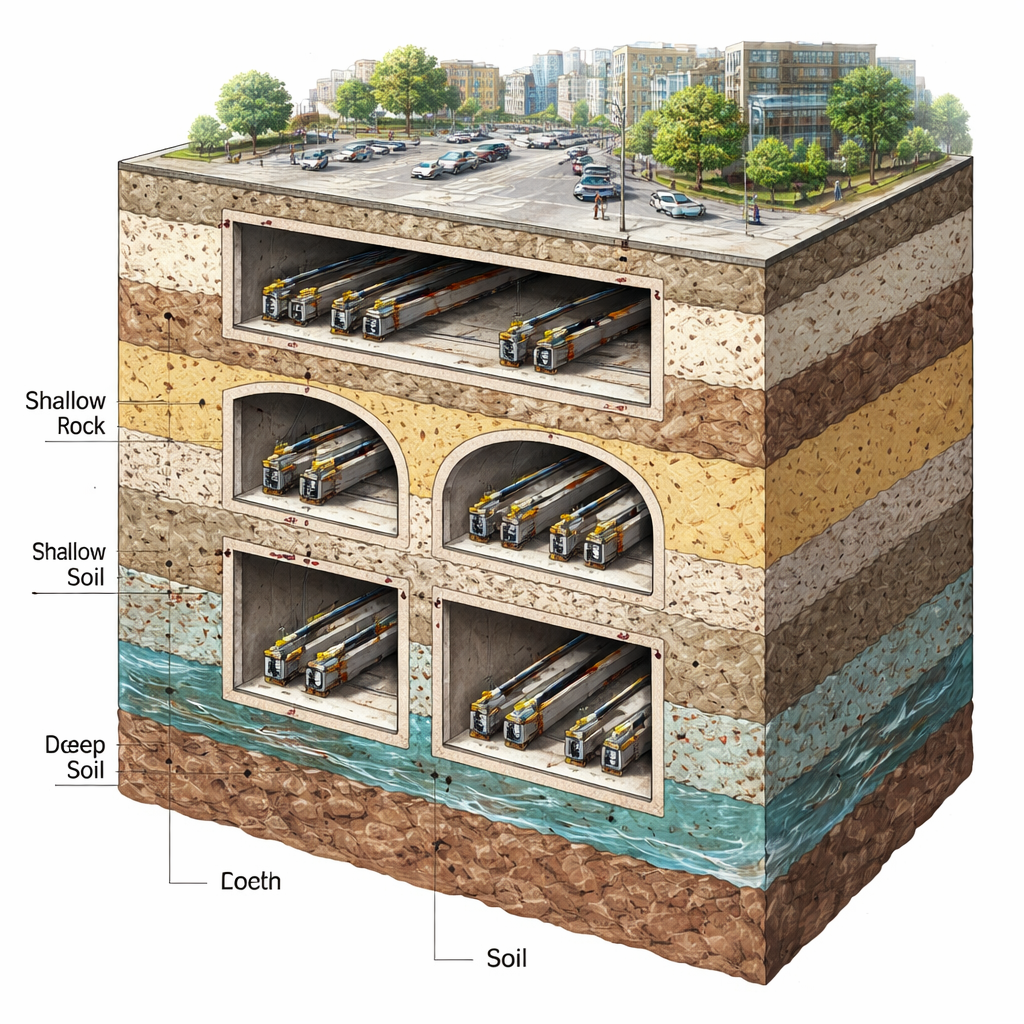
A hidden power line beneath the city
The research focuses on a 15.6‑kilometer cable tunnel designed to carry 110 kV and 10 kV power lines that feed homes and businesses. Along its length, the tunnel passes through four very different ground conditions: shallow rock (ZK1), shallow soil (ZK2), deep rock with groundwater (ZK3), and deep soil with groundwater (ZK4). Each zone has its own weight, strength, and water content, all of which affect how the surrounding ground pushes on the tunnel lining. Getting these forces wrong could lead to cracking, leaks, or costly repairs; being too conservative, on the other hand, wastes materials and money.
Two simple shapes, very different behavior
The engineers compared two cross‑sectional shapes for the tunnel lining. One is a straightforward rectangle—essentially a concrete box. The other is a so‑called three‑centered arch, which looks like a rounded vault sitting on short vertical walls. Arch shapes are known to carry compression—the “squeezing” forces from the surrounding ground—more efficiently, but they are harder to build and generally cost more. The study’s key question was: in each type of ground and at each depth, which shape offers enough safety with the lowest overall cost?
Testing tunnel strength in a virtual laboratory
Instead of relying only on rough rules of thumb, the authors built a detailed three‑dimensional computer model of the tunnel and surrounding soil and rock. They used a standard approach in civil engineering called the finite element method, which chops the tunnel and its environment into many small blocks and calculates how each block deforms and carries load. The ground itself was represented using a widely accepted theory of how soil and rock fail under pressure, allowing the model to estimate both stresses (how hard the material is being pushed or pulled) and movements (how much it shifts). The team examined three typical surface situations above the tunnel: a green zone with no traffic, a light non‑motorized lane, and a heavier road with four to six vehicle lanes—the most demanding case. 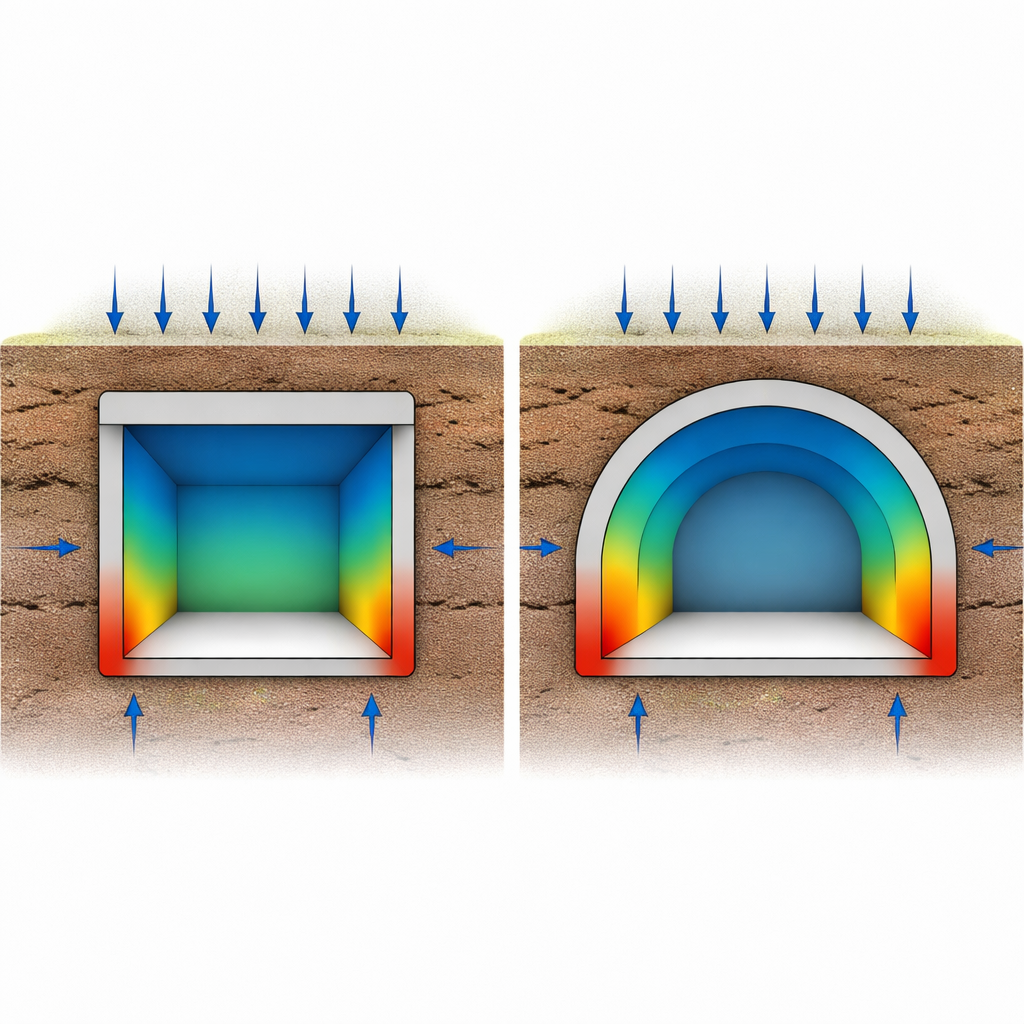
Where cracks might start and how to avoid them
For each ground zone and tunnel shape, the researchers looked at key points around the lining, especially corners and the “feet” of the arch where stresses tend to concentrate. In all cases, the overall compressive forces in the concrete stayed far below the allowable strength, meaning neither shape was at risk of being crushed. The crucial difference was in tension—the pulling force that concrete handles poorly and that can lead to cracking. In shallow conditions (ZK1 and ZK2), both shapes remained safe, and the simpler rectangular tunnel turned out to be more economical because it was easier to build. In deeper, wetter conditions (ZK3 and ZK4), however, the box shape produced noticeable tension in parts of the lining, while the arched design converted those pulls into gentler compression. To keep a rectangular tunnel safe at those depths, engineers would have to add more steel reinforcement, increasing cost and complexity.
Design choices that balance safety and cost
By combining realistic ground data with detailed computer simulations, the study shows that there is no one‑size‑fits‑all tunnel shape. For shallow sections of the power tunnel, a rectangular box safely carries the loads with a lower price tag. For deeper sections under higher ground pressure and groundwater, an arched tunnel is the smarter choice because it naturally reduces the risk of cracks in the concrete lining. For non‑specialists, the takeaway is clear: understanding how the earth presses on buried structures allows engineers to tailor tunnel shapes to local conditions, delivering reliable electricity beneath our feet without unnecessary expense.
Citation: Li, C., Yan, M. Strength analysis of cable tunnels with different embedding depths by using finite element method. Sci Rep 16, 5578 (2026). https://doi.org/10.1038/s41598-026-35672-6
Keywords: cable tunnel design, underground power lines, tunnel shape, finite element modeling, urban infrastructure