Clear Sky Science · en
Memristance and transmemristance in multiterminal memristive systems
Why tiny memory circuits matter
Modern technologies like artificial intelligence and brain-inspired computing need hardware that can learn and adapt rather than just store data. Memristive devices—tiny components whose electrical resistance remembers past signals—have emerged as promising candidates. This paper explores how collections of many such devices, wired together and accessed through multiple electrical terminals, can be described and controlled using a unified framework. That framework not only helps engineers design new kinds of computing hardware, but also offers tools to probe how information flows through complex, self-organizing networks of nanoscale wires.
From simple memories to complex networks
Early memristive devices had just two terminals, like a standard resistor that can change its resistance depending on the electrical signals it has experienced. These basic elements are already being used to build fast, low-power memories and to accelerate machine-learning algorithms. Typically, they are arranged in neat crossbar grids—regular, ordered arrays where each crossing point stores a number as a particular resistance. However, researchers have also begun to explore far more irregular systems made of many interacting memristive elements, such as tangled networks of nanowires or nanoparticles. In these systems, the overall behaviour depends less on individual devices and more on how the entire network responds collectively to patterns of stimulation over time.
Many terminals, many points of view
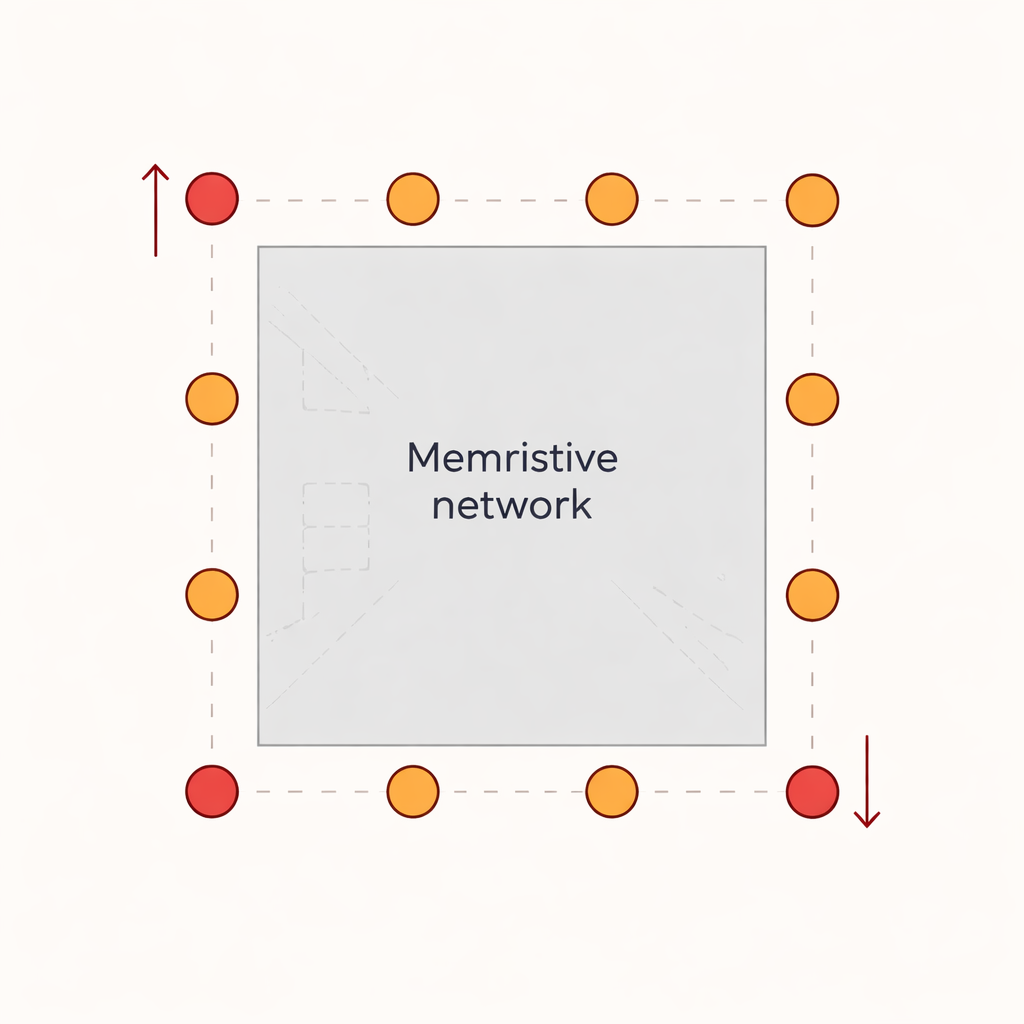
The authors generalize the usual two-terminal description to what they call multiterminal memristive systems. Instead of one input and one output, these systems have many accessible terminals that can either be driven by a voltage or left floating. A mathematical object called a memristive matrix links the voltages and currents at all non-floating terminals and evolves as the internal state of the network changes. Measuring the changing electrical “distance” between any two terminals reveals how the effective resistance between them grows or shrinks in response to stimulus patterns. This idea is crucial because it means that what we observe at one pair of terminals reflects how the hidden interior of the network is reorganizing itself.
Watching hidden changes from the side
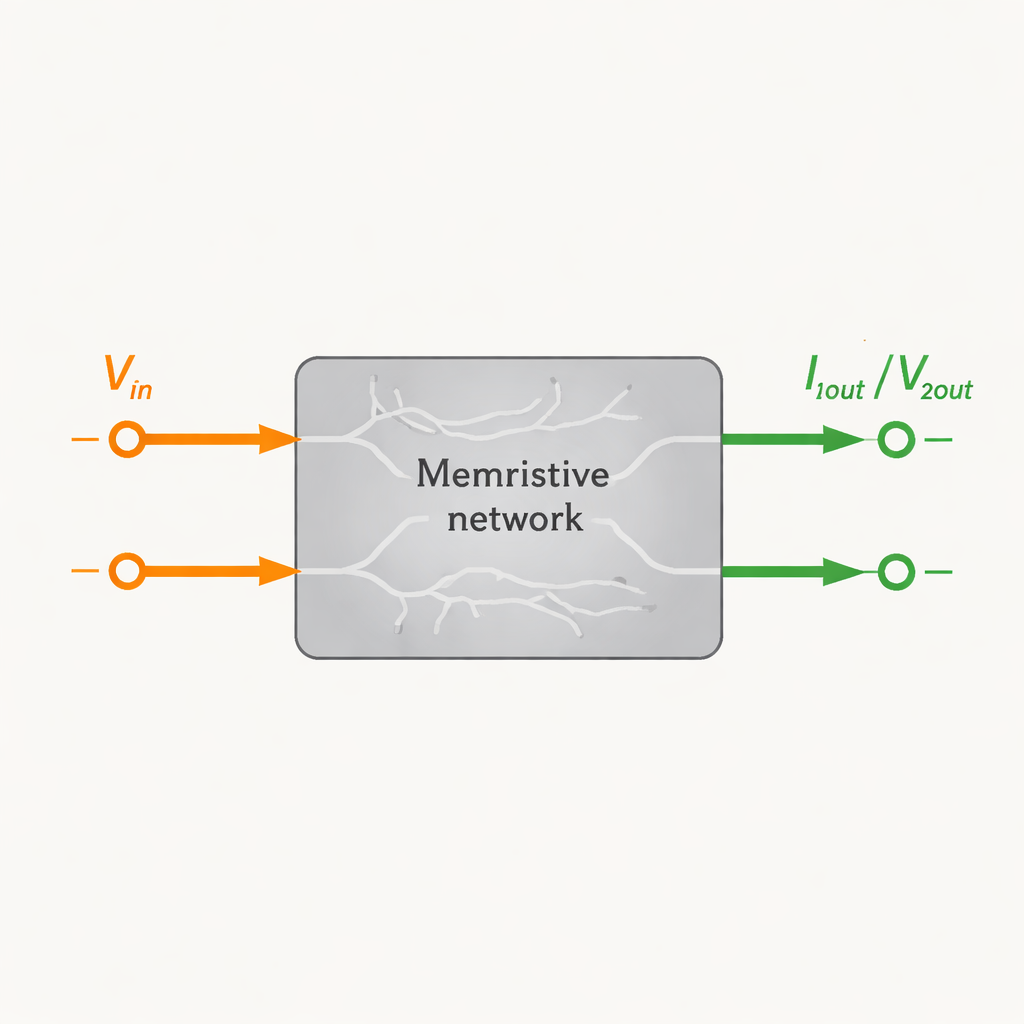
A key advance in this work is the extension from memristance (change in resistance seen at stimulated terminals) to transmemristance, which captures how stimulation at one pair of terminals affects signals measured at a different pair. In practice, that means you can apply a voltage at one location and watch the resulting voltage or current change somewhere else, effectively “listening in” on the network’s internal reconfiguration from multiple vantage points. This concept is developed first in theory using graph models, where nodes represent regions or junctions and edges behave as memristive connections whose strengths vary over time. As the network is driven, certain pathways become more conductive and then relax, and these shifts are mirrored in how strongly different terminal pairs become coupled to one another.
Real nanowire webs that learn
To show that these ideas apply in practice, the authors study self-organizing networks of metallic nanowires contacted by arrays of metal electrodes. Each electrode touches many wires, and the numerous wire–wire junctions act as tiny memristive elements. When a voltage pulse is applied between one pair of electrodes, the current response and measured resistance at those electrodes display a characteristic “learn and forget” pattern: resistance drops during the pulse and then slowly relaxes afterward. At the same time, voltages measured at other, unstimulated electrode pairs evolve in a correlated way, revealing transmemristive behaviour. By interpreting these measurements through the memristive matrix and related graph tools, the researchers can infer how connectivity within the network shifts over time, even though individual junctions are not directly observable.
Toward new kinds of adaptive hardware
In plain terms, this work shows how to treat complex, many-terminal memristive networks as unified, tunable objects whose internal state can be both driven and read out from different places. Memristance tells us how the network responds where we poke it; transmemristance tells us how that response ripples through the rest of the system. Together they provide practical observables that reflect the hidden dynamics of nanoscale components. This unified framework links circuit theory, network science, and materials physics, paving the way for new characterization methods and for hardware that performs computation using the natural, adaptive dynamics of memristive networks rather than rigid digital logic.
Citation: Milano, G., Pilati, D., Michieletti, F. et al. Memristance and transmemristance in multiterminal memristive systems. Sci Rep 16, 5271 (2026). https://doi.org/10.1038/s41598-026-35671-7
Keywords: memristive networks, neuromorphic hardware, nanowire networks, reservoir computing, adaptive electronics