Clear Sky Science · en
Sustainable dual-drug analysis: a synchronous spectrofluorimetric approach with integrated greenness and whiteness metrics for favipiravir and levofloxacin
Why testing these COVID-19 drugs still matters
Favipiravir and levofloxacin are two medicines that were often given together during the COVID-19 pandemic: one fights the virus, the other tackles dangerous bacterial infections that can follow. To keep patients safe, pharmacists and regulators must be sure every tablet really contains the right amount of each drug, and that testing them does not place an unnecessary burden on the environment. This study introduces a new way to check both drugs at once that is not only extremely sensitive and reliable, but also designed from the ground up to be cleaner, cheaper, and more sustainable than many current laboratory methods.
A brighter way to see medicines
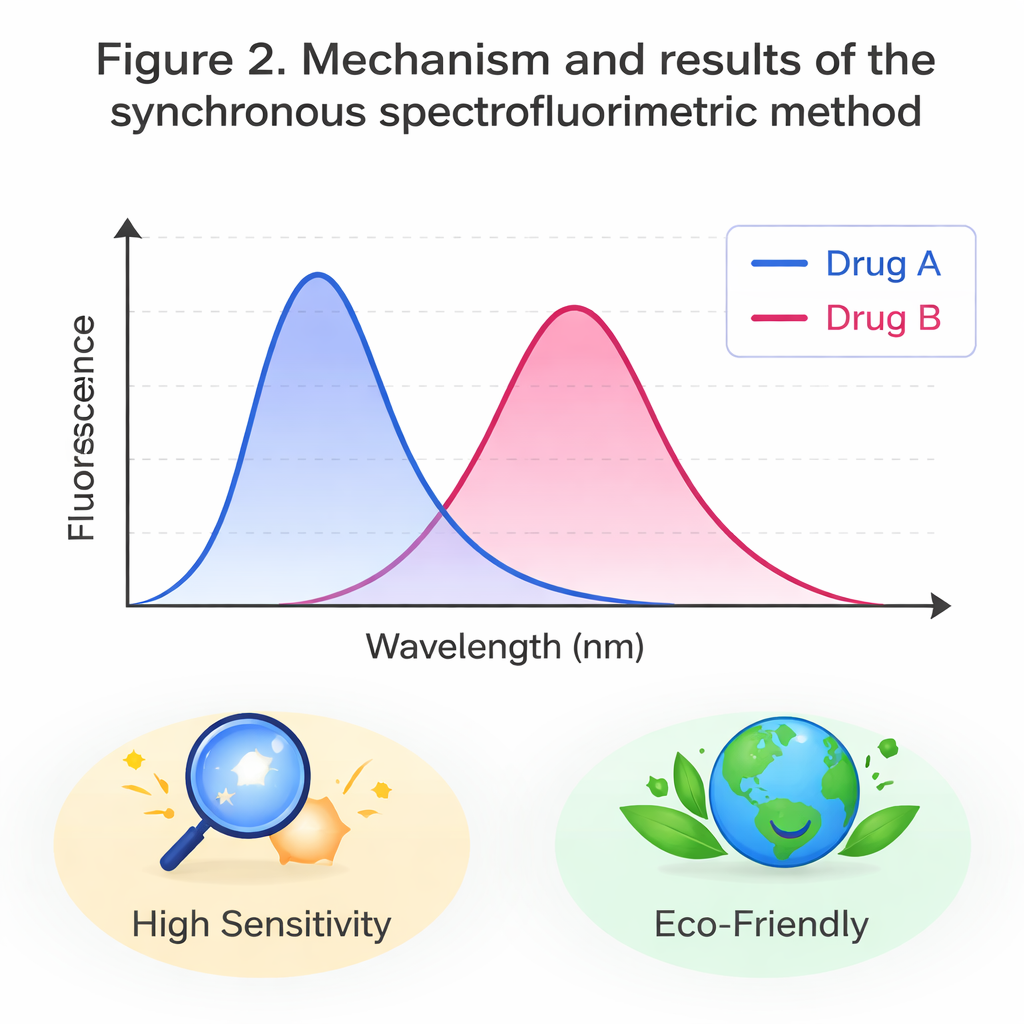
The researchers built their method around the fact that many drug molecules glow faintly when exposed to certain kinds of light, a property called fluorescence. Favipiravir and levofloxacin each emit light at different colors, but their signals overlap so much that standard fluorescence tests cannot easily tell them apart when both are present. To solve this, the team used a more advanced mode called synchronous spectrofluorimetry, which sweeps the incoming and outgoing light together with a fixed spacing. By carefully choosing that spacing for each drug, they were able to separate the glowing signals of favipiravir and levofloxacin into distinct peaks, allowing both to be measured in the same solution.
From lab bench to real tablets
After setting up the measurement conditions, the scientists optimized key details that often trip up real-world testing. They examined how the distance between the light wavelengths, the acidity or alkalinity of the solution, and the choice of solvent affected the brightness and clarity of the signals. Conveniently, they found that simple distilled water works best and that the method runs well without adding acids or buffers, which simplifies the procedure. Using this setup, they drew calibration curves that link fluorescence intensity to drug concentration, then applied the method to mixtures mimicking real samples and to commercial tablets containing each medicine.
Accuracy, sensitivity, and everyday practicality
To judge whether the method is trustworthy, the team followed international guidelines for testing analytical techniques. They showed that the fluorescence signal changes in a straight-line fashion over a very wide range of concentrations, from just a few billionths of a gram per milliliter up to hundreds of nanograms. The smallest amounts they could reliably detect were less than two nanograms per milliliter for both drugs, meaning the approach can spot even trace quantities. When they checked repeat measurements on different days and at different concentrations, the results were very consistent, with only tiny variations. When compared with standard ultraviolet (UV) methods used in many quality-control labs, the new approach matched their accuracy but beat them handily in sensitivity, making it better suited to tracking tiny residues or impurities.
Making chemical testing greener and “whiter”
Beyond technical performance, the authors evaluated how friendly their method is to people and the planet, using several recently developed rating tools. These tools score everything from the kind and amount of chemicals used, to energy consumption, waste generation, and the practicality of the method in routine work. Because the test relies mainly on water, small sample volumes, and a relatively simple instrument, it earned an excellent score on a green “Eco-Scale,” along with strong ratings from two other green metrics. They also applied “blueness” and “whiteness” scores, which fold in practicality, cost, and overall balance between efficiency and environmental impact. Here too, the method scored highly, suggesting it is not only gentle on the environment but also realistic for everyday use in crowded laboratories with limited budgets.
What this means for patients and the future
In plain terms, this work delivers a fast, low-cost, and highly sensitive lab test that can confirm, in a single run, whether favipiravir and levofloxacin products contain what they should, while producing minimal chemical waste. That combination of precision and sustainability is vital as health systems continue to monitor COVID-19 treatments and prepare for future outbreaks. The authors note that the next step is to prove the method in complex fluids such as blood plasma, which would open the door to tracking how these drugs behave inside the body. For now, their study shows that smarter light-based measurements can help keep medicines safe and effective without sacrificing environmental responsibility.
Citation: Batakoushy, H.A., El-Demerdash, A.O., Taha, A.M. et al. Sustainable dual-drug analysis: a synchronous spectrofluorimetric approach with integrated greenness and whiteness metrics for favipiravir and levofloxacin. Sci Rep 16, 4718 (2026). https://doi.org/10.1038/s41598-026-35670-8
Keywords: favipiravir, levofloxacin, spectrofluorimetry, green analytical chemistry, COVID-19 therapeutics