Clear Sky Science · en
Effects of corn straw on the performance of rock-breaking incendiary agents
Turning Farm Waste into Safer Rock-Breaking Power
Breaking rock is essential for mining, tunneling, and building cities, but traditional explosives can shake the ground, throw off dangerous debris, and raise serious safety and environmental concerns. This study explores an unexpected helper for this problem: corn straw, a common farm waste often burned or discarded. By blending finely ground corn straw into a special heat-producing mixture used to crack rock, the researchers show it is possible to improve rock breaking, cut costs, and reuse agricultural waste at the same time.
Why Rock Needs a Gentler Push
In many engineering projects, workers drill holes into rock and use energetic materials to fracture it. Conventional explosives do this very quickly, producing shock waves that can damage nearby structures and pose safety risks. An alternative is to use incendiary agents—mixtures that burn intensely rather than detonate. These mixtures, often made from aluminum powder and potassium nitrate, generate high temperatures and expanding gases that push apart cracks in the rock more gently than a blast. The challenge is to make such agents strong and efficient enough, while also improving safety and sustainability.
From Cornfield to Drill Hole
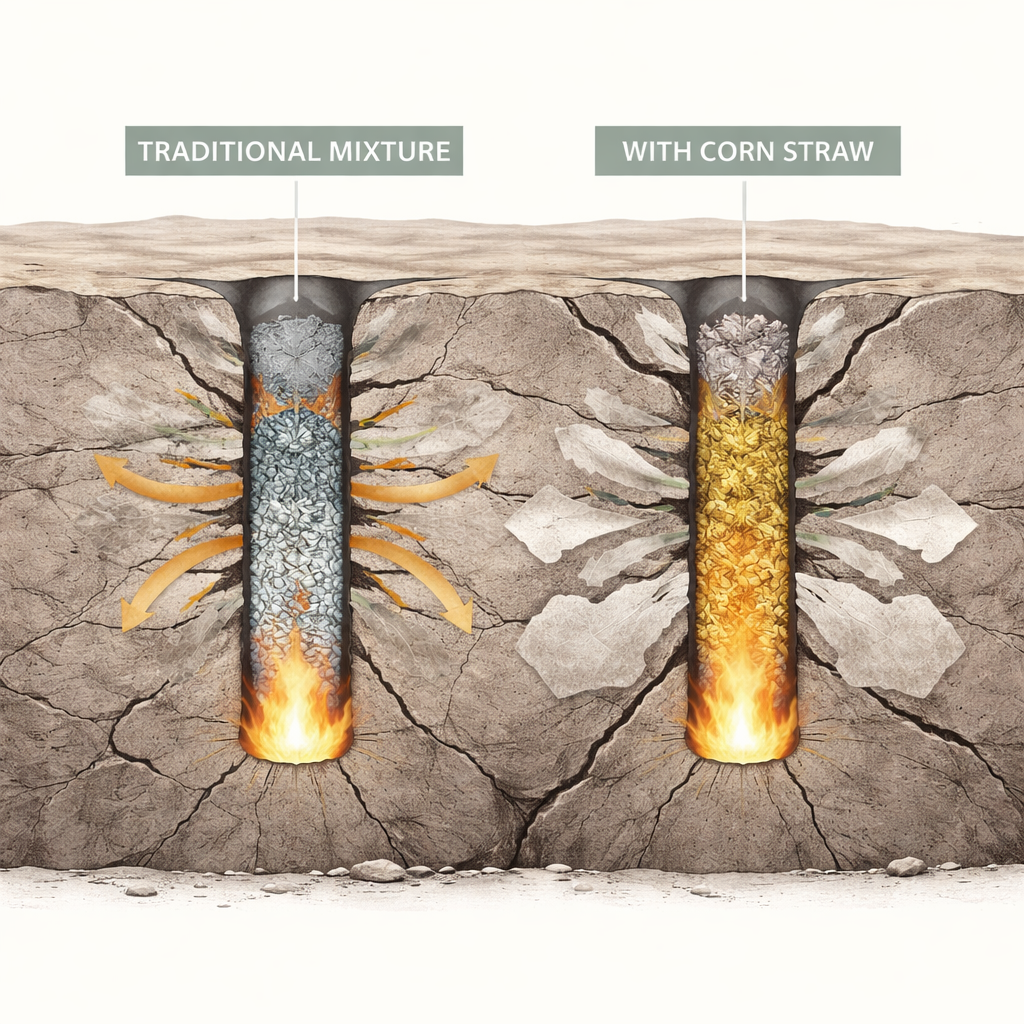
The researchers replaced part of the aluminum powder in a standard rock-breaking mix with finely ground corn straw, a biomass fuel rich in carbon and volatile compounds. They tested many recipes by firing small charges from a launcher and measuring how far a heavy cap was thrown, which reflects how much useful work the mixture can do. The best-performing formula contained 70% potassium nitrate, 21% aluminum, and 9% corn straw—meaning nearly one-third of the metal fuel was swapped out for plant matter. At this level, the mixture’s external work capacity increased by about 38%, and the launched cap traveled around 40% farther than with the original formula, showing that the farm waste was not just a filler, but an effective part of the energetic system.
What Happens When the Mixture Heats Up
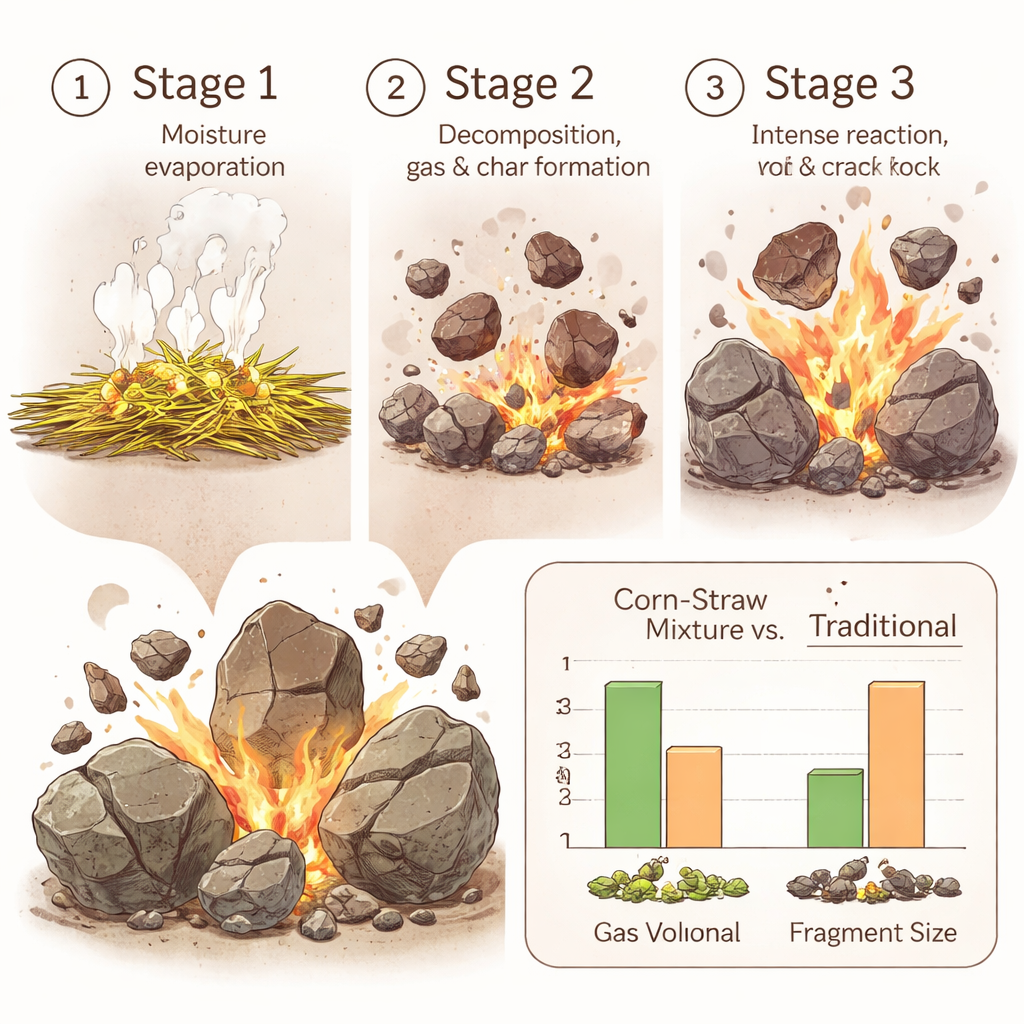
To understand why corn straw helps, the team heated tiny samples while tracking both weight loss and the gases that escaped. They found that the modified mixture breaks down in several stages. First, water bound in the straw evaporates. Next, components of the straw—such as cellulose and lignin—slowly decompose, forming gases and charcoal-like carbon. Finally, this char reacts with potassium nitrate and aluminum at high temperature, producing a surge of gases like carbon dioxide, along with solid oxides. Compared with the original mixture, the version with corn straw lost more mass and generated more gas in these later stages, which means more expanding gas is available to pry apart rock.
Cooler Flames, Safer Handling, Better Fractures
Adding corn straw does change the way the mixture ignites and burns. Because breaking down plant material absorbs heat, the modified agent needs more electrical energy to ignite—its ignition input energy rose from about 201 to 375 joules per gram. This higher threshold makes it less sensitive to accidental triggers, improving storage and handling safety. At the same time, the peak combustion temperature drops by roughly 41%, from nearly 1,000 °C to under 600 °C, giving a somewhat milder but still effective burn. In real rock-breaking tests using concrete blocks, the biomass-enhanced agent produced fragments that were about 29% smaller on average and more evenly sized, a clear sign of better cracking performance. Calculations also showed that its theoretical gas production more than doubled, reaching about 2.45 times that of the original mix.
From Waste Straw to Smarter Rock Breaking
For a non-specialist, the key message is simple: mixing ground corn straw into a rock-breaking incendiary agent helps it push rock apart more effectively, while also making it safer to ignite and cheaper to produce. The plant material boosts gas generation, improves how the rock fractures, and raises the energy needed to trigger the reaction, all without relying solely on costly metal powders. At the same time, it turns an agricultural waste into a useful resource. With further refinement and testing in harsh field conditions, this approach could offer mining and construction industries a more sustainable, controlled way to break rock—using energy harvested from the cornfield as well as from the laboratory.
Citation: Xie, Q., Liu, L., Wang, M. et al. Effects of corn straw on the performance of rock-breaking incendiary agents. Sci Rep 16, 4968 (2026). https://doi.org/10.1038/s41598-026-35665-5
Keywords: biomass energy, rock breaking, corn straw, incendiary agents, sustainable mining