Clear Sky Science · en
Synthesis, characterization, DFT analysis, molecular docking and anticancer investigations in colorectal carcinoma of a novel pyrazole-hydrazone zinc(II) complex
Why a metal-based drug might fight colon cancer more gently
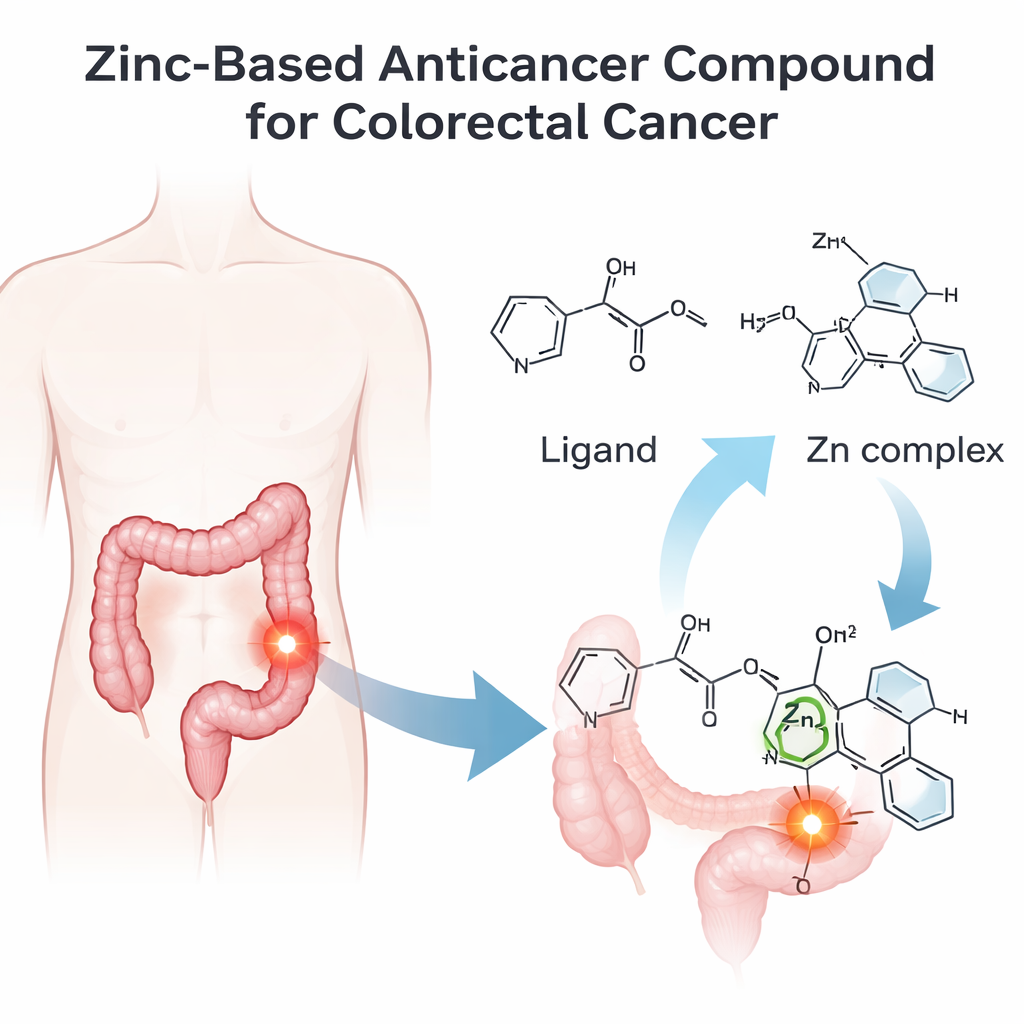
Many powerful cancer drugs are built around heavy metals like platinum. They can be effective but often come with harsh side effects and resistance over time. This study explores a different approach: a new drug candidate built around zinc, an essential nutrient already present in our bodies, combined with an organic scaffold called a pyrazole–hydrazone. The researchers asked whether attaching zinc to this scaffold could create a compound that hits colon cancer cells hard while sparing healthy cells.
Building a smarter zinc-based molecule
The team first designed and synthesized a new organic molecule, referred to as IMP, then bound it to a zinc ion to make a zinc complex called IMP-Zn. They confirmed the exact structure of both using a suite of techniques that essentially “fingerprint” molecules: infrared spectroscopy to see which chemical bonds are present, nuclear magnetic resonance to map atom positions, mass spectrometry to verify molecular weight, and ultraviolet–visible spectroscopy to study how the compounds interact with light. These experiments, together with electrical conductivity tests, showed that zinc is tightly coordinated to three key atoms in IMP and two chloride ions, forming a single, well-defined zinc-centered complex.
Peering into the molecule with virtual chemistry
To complement the lab measurements, the researchers ran detailed computer simulations using density functional theory (DFT). These calculations allowed them to predict how electrons are distributed within IMP and IMP-Zn, how stable each form is, and how readily the molecules might participate in chemical reactions. The results showed that once zinc is attached, the energy gap between the molecule’s “frontier” orbitals shrinks, meaning electrons can move more easily within the structure. This usually translates into higher chemical reactivity. The zinc complex also showed a higher so-called electrophilicity index, suggesting it is better equipped to interact with biological targets than the free ligand IMP on its own.
How the zinc complex tackles colon cancer cells
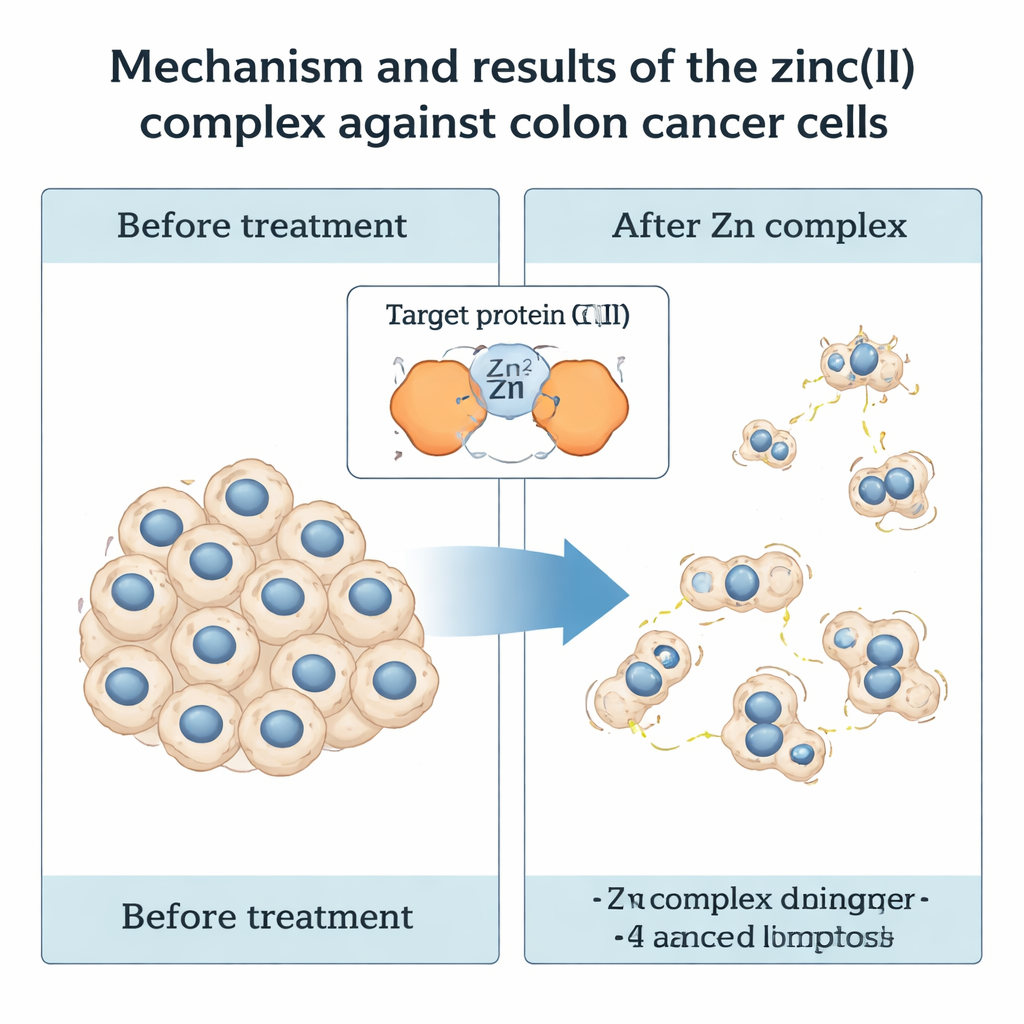
The real test was biological. The researchers treated human colorectal cancer cells (HCT116) with IMP and IMP-Zn at various doses and times, then measured how many cells survived. Both compounds slowed cancer cell growth, but the zinc complex was clearly stronger: at 48 hours, IMP-Zn cut cell viability in half at about 25 micromolar, while the ligand alone needed a much higher dose. Just as important, the same concentrations of IMP-Zn had no detectable toxic effect on a normal human kidney cell line (HEK293), pointing to a degree of selectivity for cancer cells. When the team followed treated cancer cells over two weeks, they found that IMP-Zn sharply reduced both the number and size of colonies the cells could form, indicating it interferes with their ability to proliferate long-term.
Clues that the cells are pushed toward programmed death
To understand how the zinc complex harms cancer cells, the scientists examined the cell cycle—the series of stages cells pass through as they grow and divide. After exposure to IMP-Zn, a much larger fraction of HCT116 cells shifted into a “SubG0” phase, a signature of cells with fragmented DNA. This pattern is commonly associated with apoptosis, a controlled form of cell death often targeted by anticancer drugs. Molecular docking simulations provided another piece of the puzzle: virtual models suggested that IMP-Zn binds more strongly than IMP to several cancer-related proteins, including a growth-factor receptor kinase, a cell-cycle–regulating kinase, and a drug-metabolizing enzyme. These tighter interactions support the idea that zinc coordination helps the compound latch onto critical cellular machinery and disrupt cancer cell survival.
What this could mean for future treatments
Altogether, the study shows that “decorating” a pyrazole–hydrazone framework with zinc does more than tweak its chemistry: it turns IMP into a more reactive, more potent, and seemingly more selective agent against colorectal cancer cells. While IMP-Zn is still far from a finished drug—it has yet to be tested in animals or humans—its ability to significantly slow colon cancer cell growth, push cells toward apoptosis, and spare normal cells marks it as a promising member of a growing class of zinc-based metallodrugs. This work suggests that carefully designed zinc complexes could offer gentler, targeted alternatives or complements to traditional metal-based chemotherapy in the future.
Citation: Mermer, A., Bayrak, A.M., Bolat, Z.B. et al. Synthesis, characterization, DFT analysis, molecular docking and anticancer investigations in colorectal carcinoma of a novel pyrazole-hydrazone zinc(II) complex. Sci Rep 16, 6391 (2026). https://doi.org/10.1038/s41598-026-35664-6
Keywords: zinc-based anticancer agents, colorectal cancer, pyrazole hydrazone complex, molecular docking, apoptosis