Clear Sky Science · en
Electrical current injury shows no specific acute histological changes in peripheral nerves and their vascular supply
Why electric shocks can be hard to read after death
When someone dies from an electric shock, we might imagine that doctors or forensic experts can simply look inside the body and see clear burn patterns along the nerves and blood vessels. This study shows that reality is more complicated. Even powerful currents that stop the heart in an instant can leave surprisingly little visible damage in deeper tissues, making it difficult to prove that electricity was the cause of death.
How scientists tested electric shocks in animals
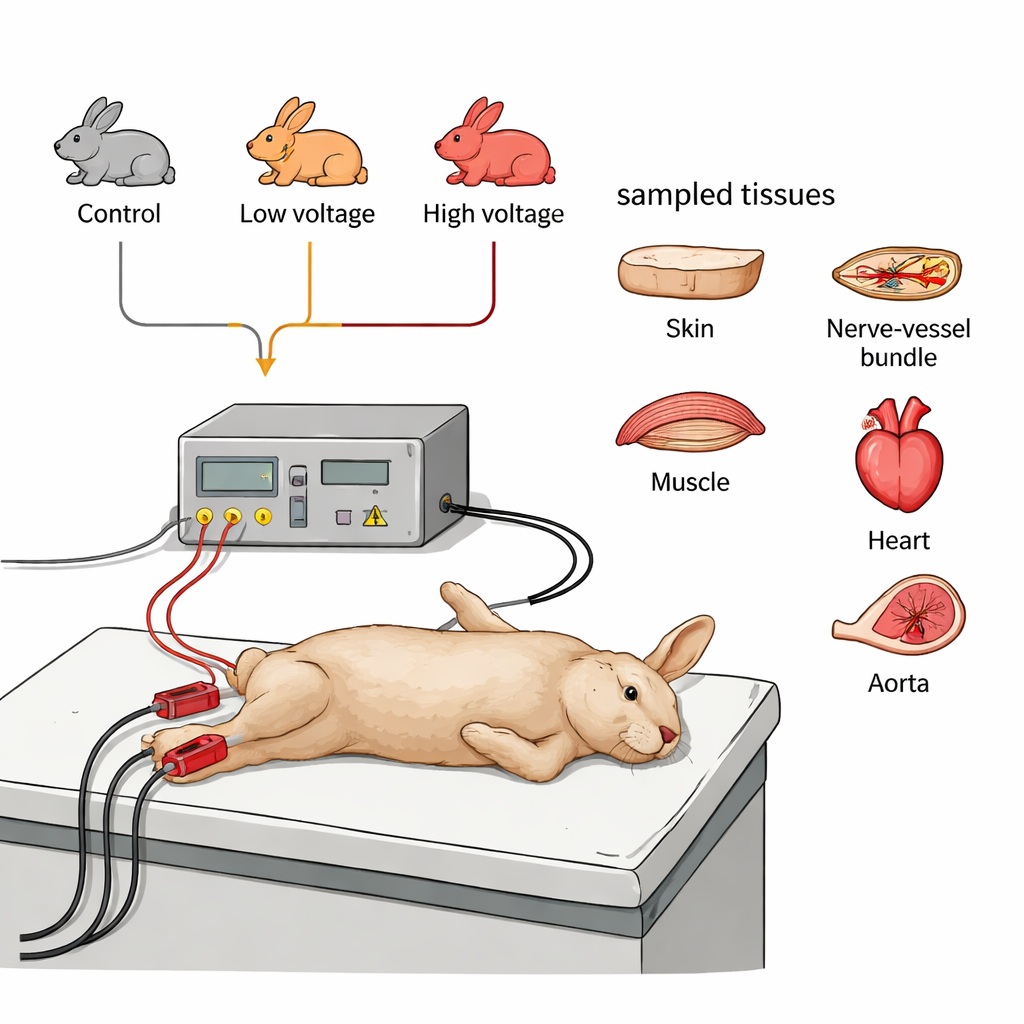
To explore what electricity does to the body in the very first moments after an injury, researchers used 21 healthy rabbits as a stand-in for humans. The animals were divided into three groups: one with no shock, one exposed to a low-voltage shock, and one exposed to a high-voltage shock. Under anesthesia, two electrodes were clipped onto the shaved right hind leg of each rabbit in the shock groups. A brief jolt lasting just one‑tenth of a second was delivered, and the animals were then quickly examined and humanely euthanized within a minute, mimicking sudden death from electrocution.
Looking closely at nerves, blood vessels, and organs
After the shocks, the team removed small samples from several key places: the skin where the current entered, the bundle of nerves and blood vessels in the thigh, nearby leg muscle, the heart, and the main artery in the abdomen. These tissues were fixed, sliced into thin sections, and stained with different dyes so that various structures would stand out under the microscope. The scientists also used special antibody-based stains to highlight the cells lining blood vessels, hoping to spot subtle early damage to the vascular system or nerves that ordinary stains might miss.
Burn marks on the skin, but deeper tissues look normal
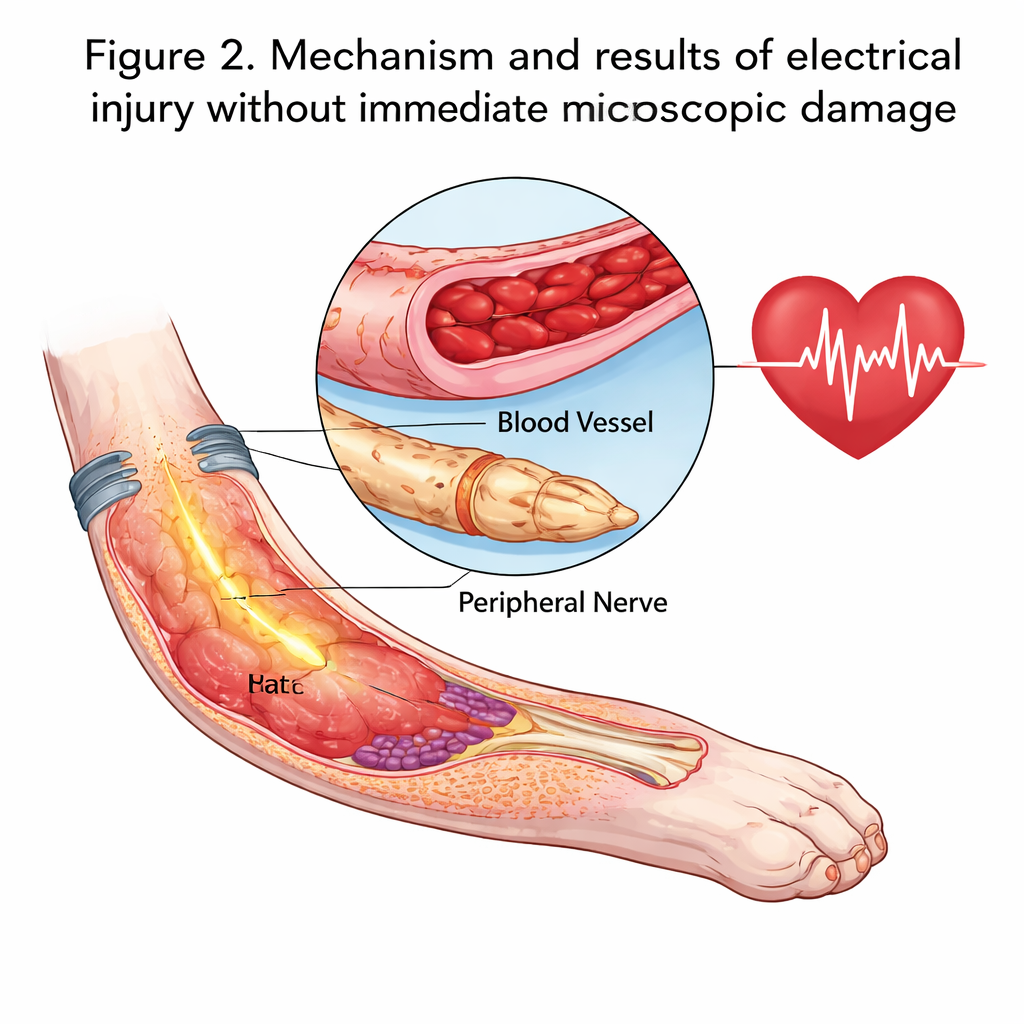
On the surface, the electric shocks did leave marks. In the low-voltage group, the skin under the electrodes showed a mild burn: the outer layer looked slightly melted and the supporting fibers were stretched, but the base layer of the skin remained intact. In the high-voltage group, the burns were more severe, with clear death of skin cells and separation between the outer and deeper layers, forming tiny blisters. However, despite these visible burns, the deeper tissues told a different story. The nerves and blood vessels in the thigh, the leg muscle, the wall of the large artery, and the heart muscle all appeared normal, with no clear signs of cell death, ruptured vessels, or clots, even under detailed and specialized staining.
Why a deadly shock may leave few early traces
Previous studies have described dramatic changes in blood vessel walls, muscles, and nerves after electric injury—but usually hours or days later. By contrast, this experiment focused on the very first minutes. The authors suggest that much of the damage caused by electric current does not appear instantly as broken or dead tissue. Instead, electricity likely first disturbs cell membranes and the way ions move in and out of cells, a process called electroporation. These microscopic and functional changes can trigger dangerous heart rhythms or breathing failure long before any structural injury becomes visible under a microscope.
What this means for real-world investigations
For families, doctors, and courts trying to understand an unexpected death, this study carries an important message: a normal-looking heart, nerve, or blood vessel under the microscope does not rule out electrocution. When death follows quickly after an electric shock, standard tissue samples from nerves and vessels may show no specific signs of injury beyond local skin burns. The real problem may be an invisible electrical collapse of the heart or nervous system, not damage that can be easily seen. As a result, forensic specialists must rely heavily on the scene, witness reports, and external burn marks, using microscopic tests only as supporting evidence rather than a definitive proof of fatal electrocution.
Citation: Kulvajtová, M., Matěj, R., Zajíček, R. et al. Electrical current injury shows no specific acute histological changes in peripheral nerves and their vascular supply. Sci Rep 16, 5059 (2026). https://doi.org/10.1038/s41598-026-35658-4
Keywords: electrocution, electrical injury, forensic pathology, burns, cardiac arrhythmia