Clear Sky Science · en
Optomechanical vector sensing of new forces at 6 micron separation
Why tiny gaps in gravity matter
Gravity is the force that holds planets in orbit and keeps our feet on the ground, yet we have never directly measured how it behaves at separations of just a few millionths of a meter. Many ideas in modern physics predict that, at such short distances, gravity could be slightly stronger or weaker than expected, or even feel the pull of hidden dimensions. This paper describes a new experiment that uses a microscopic glass bead held in place by laser light to probe for previously unseen, gravity-like forces across a gap of only about six micrometers—roughly one-tenth the thickness of a human hair.
Holding a grain of glass with light
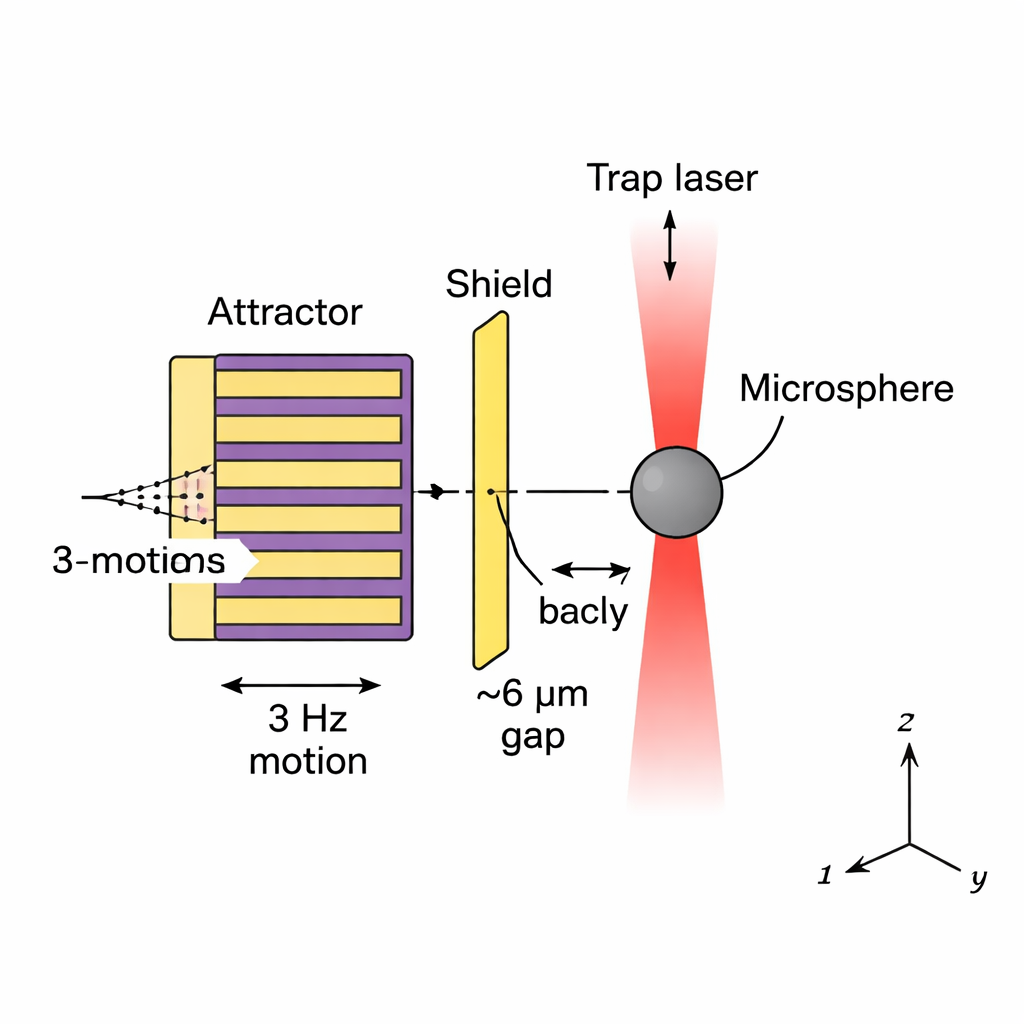
At the heart of the experiment is a tiny silica sphere, about 8–10 micrometers across, that is trapped in mid-air by a focused infrared laser beam. The laser acts as an “optical tweezer,” confining the bead in three dimensions inside an ultra-high-vacuum chamber so that air currents and other disturbances are minimized. As the bead scatters light from the trapping laser, sensitive photodetectors track its motion along three perpendicular directions, allowing researchers to reconstruct the full force acting on it as a function of time. The system is calibrated by giving the bead a known electric charge and applying controlled electric fields, turning the bead into a highly precise force sensor capable of detecting pushes as small as about 10−17 newtons.
A moving mass to test for new pulls
To search for new forces that couple to mass, the team places a specially patterned “attractor” chip close to the trapped bead. This chip alternates strips of gold and silicon, creating a repeating pattern of higher and lower density. When the attractor is driven back and forth at a few cycles per second, any extra gravity-like interaction beyond ordinary Newtonian gravity would tug on the bead with a characteristic pattern that depends on direction and time. Importantly, this setup does not just look at a single component of the force; instead, it records all three spatial components and many harmonics of the drive frequency. That richer, vector-like fingerprint makes it much easier to distinguish a genuine new interaction from ordinary mechanical or electrical noise.
Taming vibrations, charges, and stray light
Measuring such tiny forces requires suppressing or accounting for a host of backgrounds. Vibrations from the moving stage that carries the attractor can shake the optics and mimic a force, so the authors measure spectra with the attractor pulled far away and then exclude the main vibration tone from their analysis. Electric effects are another concern, because the bead can carry a small electric dipole that responds to changing electric fields. To reduce this, a thin, gold-coated silicon “shield” wall is placed between bead and attractor, and a rapidly rotating electric field is used to keep the bead’s dipole confined to a plane that minimizes its unwanted motion. The dominant remaining background comes from stray laser light scattering off the moving attractor and into the position detectors. The group combats this by coating the attractor with an extremely dark “Platinum Black” layer and adding a tiny, well-placed aperture to filter the useful light mode. They also construct special “null” signals from the detector segments that are insensitive to true bead motion but highly sensitive to scattered light, allowing them to monitor and reduce this background compared with earlier generations of the experiment.
How to read a non-detection
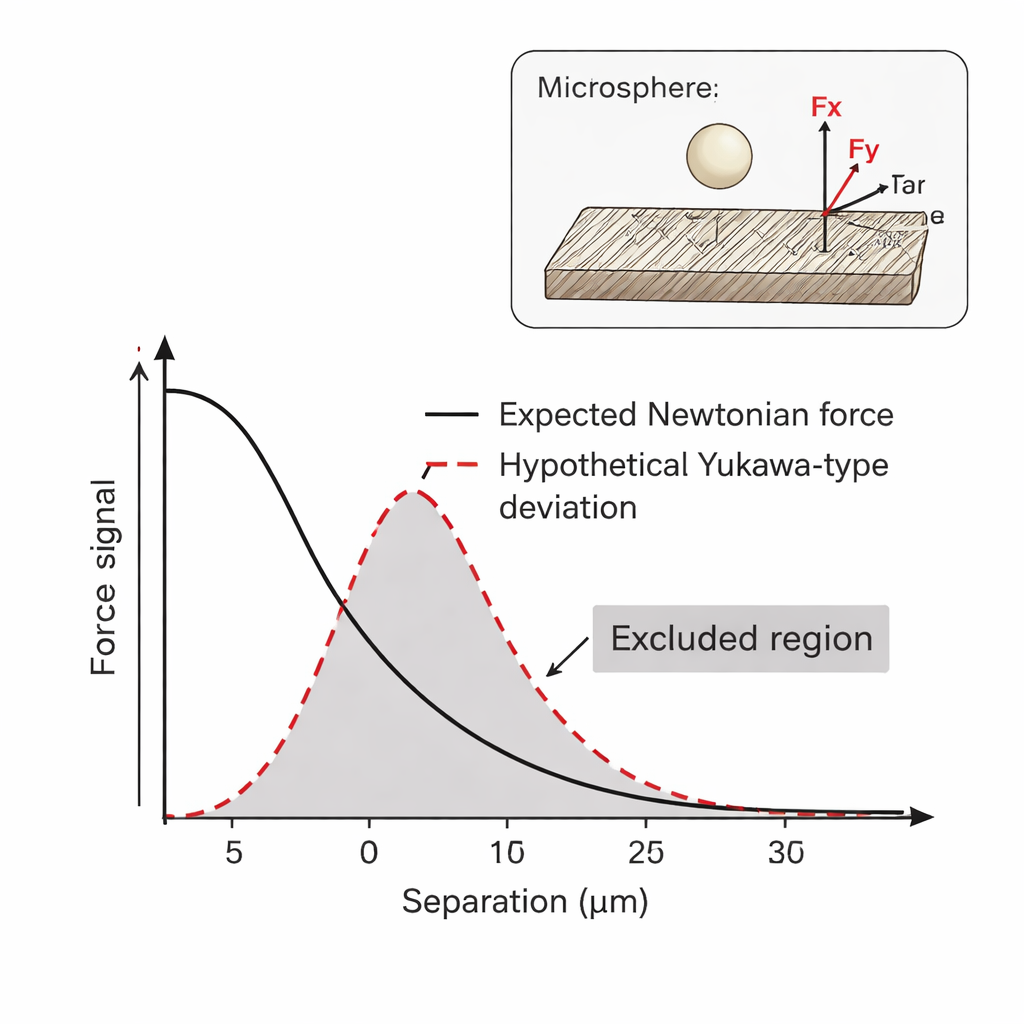
After collecting data with three different microspheres, the researchers compare the measured force signals with detailed templates of what a new, short-range force would look like. These templates are generated using numerical models that account for the exact shapes and materials of the bead and attractor and for the recorded motion of the attractor during each run. They test both attractive and repulsive possibilities and scan a range of length scales, from about 1 to 100 micrometers. While some excess power appears at certain harmonics of the drive frequency, its pattern in direction and phase does not match the predictions for a new Yukawa-type force. The authors therefore interpret their results as upper limits on how strong any such hidden interaction could be, relative to ordinary gravity, at each length scale.
What this means for gravity and beyond
The experiment finds no sign of a new force, but it tightens the net considerably. For interactions with a range of about 5 micrometers, the strength of any additional gravity-like pull or push must be less than about ten million times that of Newtonian gravity between the same masses, with similarly strong bounds above about 10 micrometers. These constraints improve on previous measurements using levitated beads by up to two orders of magnitude and are the first to exploit the full three-dimensional, time-dependent force vector. Beyond closing off portions of the landscape for theories involving extra dimensions or new light particles, the work showcases a powerful tool: microscopic objects stably levitated close to solid structures while still allowing precision metrology. This platform is not only sharpening our picture of gravity at tiny scales but also laying the groundwork for future tests of dark matter, exotic particles, and ultimately the quantum nature of gravity itself.
Citation: Venugopalan, G., Hardy, C.A., Kohn, K. et al. Optomechanical vector sensing of new forces at 6 micron separation. Sci Rep 16, 5180 (2026). https://doi.org/10.1038/s41598-026-35656-6
Keywords: short-range gravity, optical levitation, microsphere force sensor, Yukawa interaction, new physics search