Clear Sky Science · en
Innovative solutions for lossy nonlinear transmission lines model using a modified extended mapping approach with fractional effects
Why shaping electrical pulses really matters
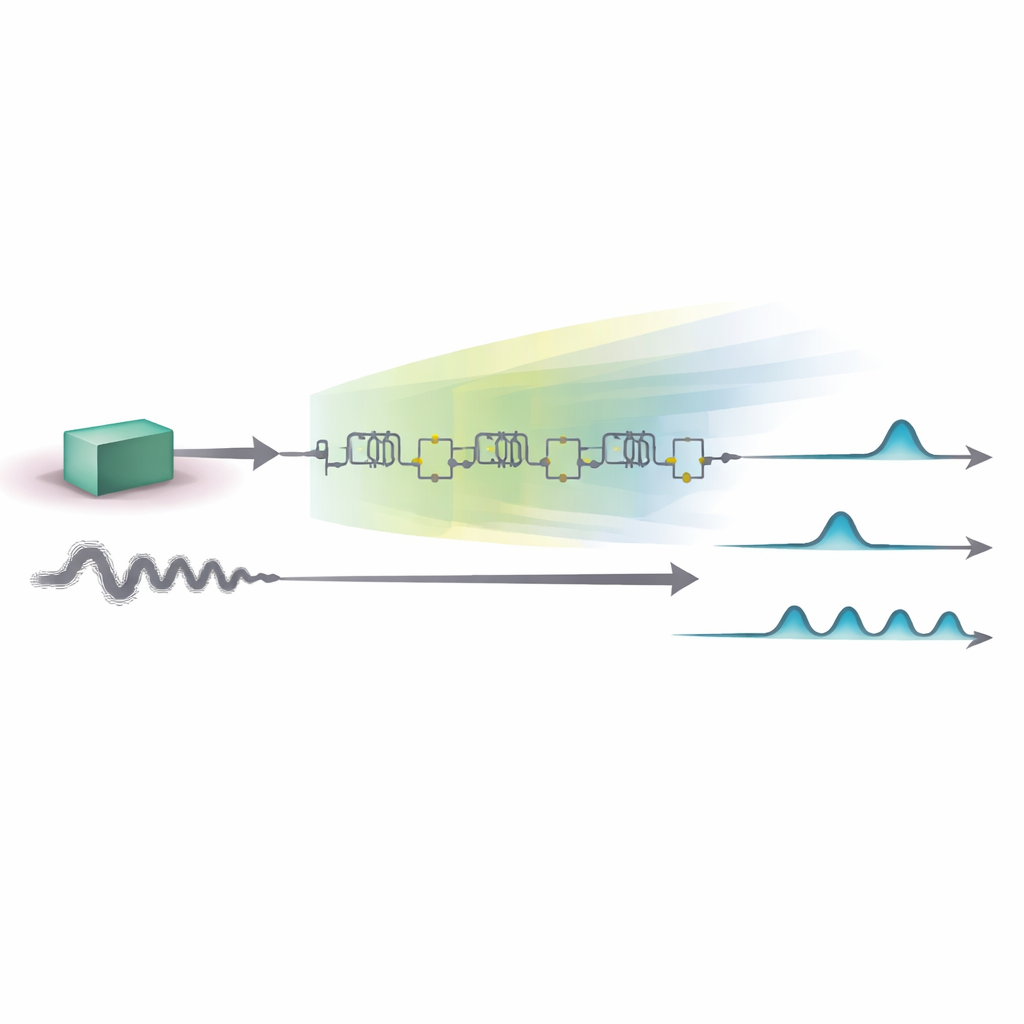
Every phone call, radar ping, and high‑speed data burst travels along transmission lines—wires and circuit traces that guide electrical signals. As electronics get faster and more compact, these lines stop behaving like simple wires: resistance, nonlinear components, and memory effects in materials distort the signals, causing blurring and loss. This paper explores how carefully designed nonlinear transmission lines can instead create and preserve special self‑shaping pulses called solitons, and shows a new mathematical way to predict a whole zoo of such waveforms in realistic, lossy circuits.
From simple wires to smart signal highways
Traditional transmission lines are built to carry signals without changing their shape, but in modern electronics they are often loaded with components such as varactors—capacitors whose value depends on voltage. These additions make the line nonlinear: strong pulses alter the very medium they travel through. At the same time, resistance in the wires and dielectric losses in the substrate drain energy and normally smear out sharp edges. The authors focus on a practical model of such a system, the lossy nonlinear electrical transmission line (Loss‑NLETL), which captures both the dispersive nature of the line and the way losses and voltage‑dependent capacitance modify traveling pulses.
Adding memory to the math
Standard equations for wave propagation treat space and time with ordinary derivatives, which assume that the system’s response at a given moment depends only on what is happening right then. Real materials, however, often “remember” their past: charges build up, fields relax slowly, and earlier activity influences what comes later. To represent this memory in a mathematically manageable way, the authors employ conformable fractional derivatives—generalizations of the usual derivatives that can smoothly interpolate between local and memory‑rich behavior. They introduce these fractional operators in both space and time within the Loss‑NLETL model, allowing the line’s response to be tuned continuously between classical and fractional regimes.
A new way to uncover hidden wave shapes
Finding exact wave solutions in such a complicated, lossy, and fractional system is notoriously difficult. The authors use a technique called the Modified Extended Mapping (Mod‑EM) method, which assumes that complicated waveforms can be expressed in terms of a simpler “building block” function and its derivatives. By transforming the original partial differential equation into an ordinary one for traveling waves and then applying Mod‑EM, they systematically balance the highest‑order terms and solve the resulting algebraic conditions. This approach produces many exact analytical solutions rather than a single special case, revealing how different choices of circuit parameters and fractional orders generate different pulse shapes.
A rich zoo of pulses and patterns
The analysis uncovers a striking variety of waveforms. The solutions include composite hyperbolic pulses with sharp, kink‑like steps; dark solitons that appear as localized dips on an almost constant background; singular periodic waves with spiky, repeating structures; smooth exponential traveling pulses that naturally decay with distance; and classic hyperbolic solitons that maintain their shape while moving. The authors also obtain mixed structures that blend step‑like transitions with slowly decaying tails, as well as highly structured Jacobi elliptic waves—periodic patterns that can morph between pulse trains and more complex lattices of peaks and valleys. Many of these solutions had not been reported for this model before, especially in the presence of both fractional space and time derivatives.
Seeing how tuning changes the signal
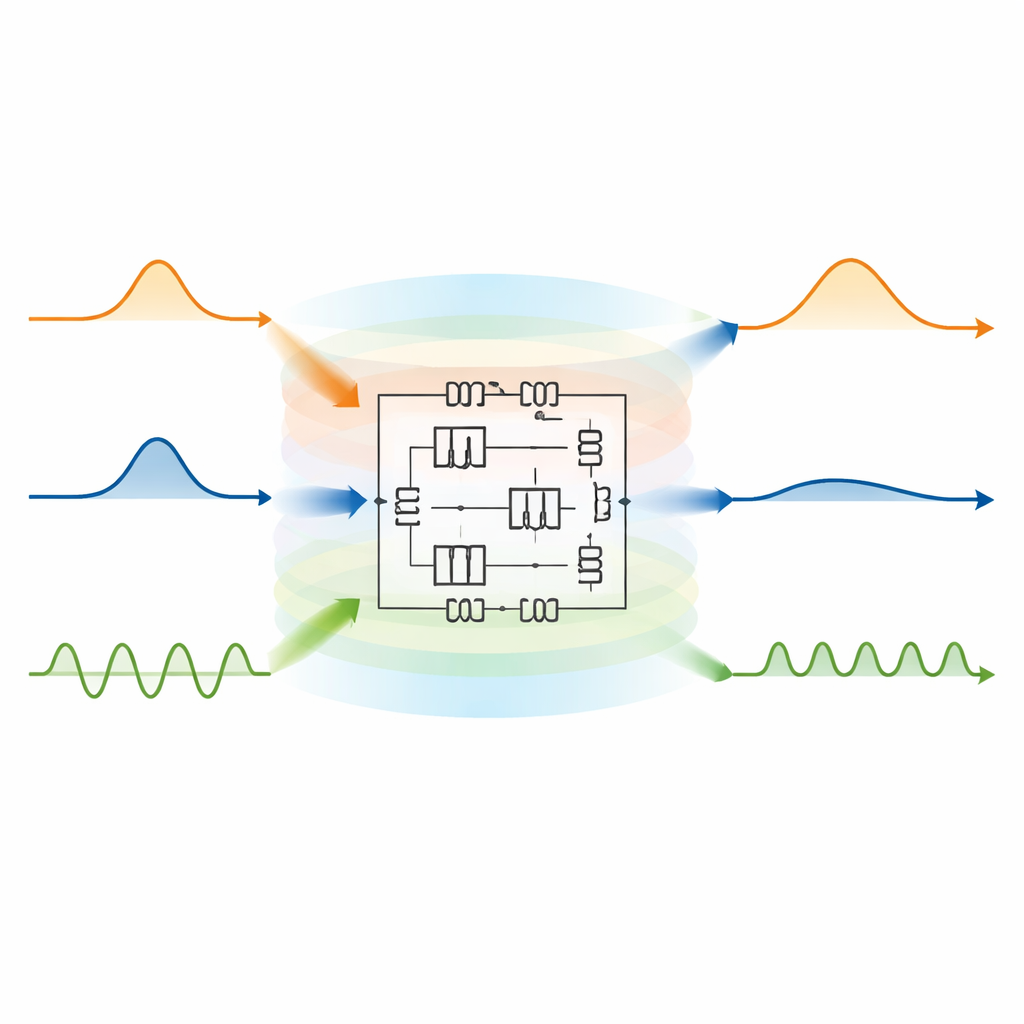
To connect the math to physical intuition, the authors visualize representative solutions through 2D profiles, 3D surfaces, and density plots. By varying key parameters—most notably the spatial fractional order, denoted β₁—they show how pulses become sharper or broader, how deep a dark soliton’s dip can be, and how periodic structures stretch or compress. Loss parameters and nonlinear strength similarly control whether waves remain localized, form repeating patterns, or develop singular spikes. A comparison with earlier work shows that the Mod‑EM method, combined with the fractional formulation, yields a much broader catalog of exact solutions than previous approaches, which typically captured only a few bright or periodic solitons.
What this means for real circuits
In everyday terms, this study demonstrates that by combining nonlinear components, controlled loss, and fractional‑style memory effects, engineers can design transmission lines that sculpt electrical pulses rather than merely pass them. The Mod‑EM method provides a detailed map linking circuit and fractional parameters to specific waveform types—sharp edges, stable dips, decaying pulses, or intricate periodic trains. Such control is crucial for high‑speed digital links, ultra‑wideband radar, and power‑electronics circuits, where preserving or deliberately shaping short pulses can make the difference between clean operation and signal chaos. The work offers both new theoretical insight into soliton behavior in realistic, lossy media and practical guidance for crafting next‑generation signal pathways.
Citation: Hussein, H.H., Alexan, W. & Kandil, S.A. Innovative solutions for lossy nonlinear transmission lines model using a modified extended mapping approach with fractional effects. Sci Rep 16, 8623 (2026). https://doi.org/10.1038/s41598-026-35652-w
Keywords: nonlinear transmission lines, electrical solitons, fractional calculus, signal shaping, lossy circuits