Clear Sky Science · en
Feed intake, digestibility and passage kinetics in grazing horses
Why how horses graze matters
Many horse owners assume that turning their animals out on grass is the most natural and therefore safest way to feed them. Yet pasture can provide too many calories and too little of some minerals, contributing to obesity, laminitis and other health problems. To prevent this, we need to know how much horses actually eat on pasture, how well they digest it and how their constant roaming affects digestion. This study followed a small group of mares living outdoors around the clock to measure what went in, what came out and how far they walked, using chemical “breadcrumbs” and GPS tracking rather than intrusive lab-style methods.
Following invisible crumbs through the gut
We cannot easily weigh everything a grazing horse eats or collect all of its droppings. Instead, the researchers used long-chain waxy substances called n-alkanes that naturally coat plant leaves, plus one added synthetic alkane, as invisible markers. The horses were gradually adapted to a mature grass pasture and then given a single specially prepared bolus containing a known dose of a marker called C36. As the horses grazed freely, the markers moved with the chewed grass through the digestive tract and were later detected in the dung. By measuring how marker levels rose and fell in feces over time, and knowing their concentrations in the plants, the team could estimate both feed intake and digestibility without disrupting normal behavior. 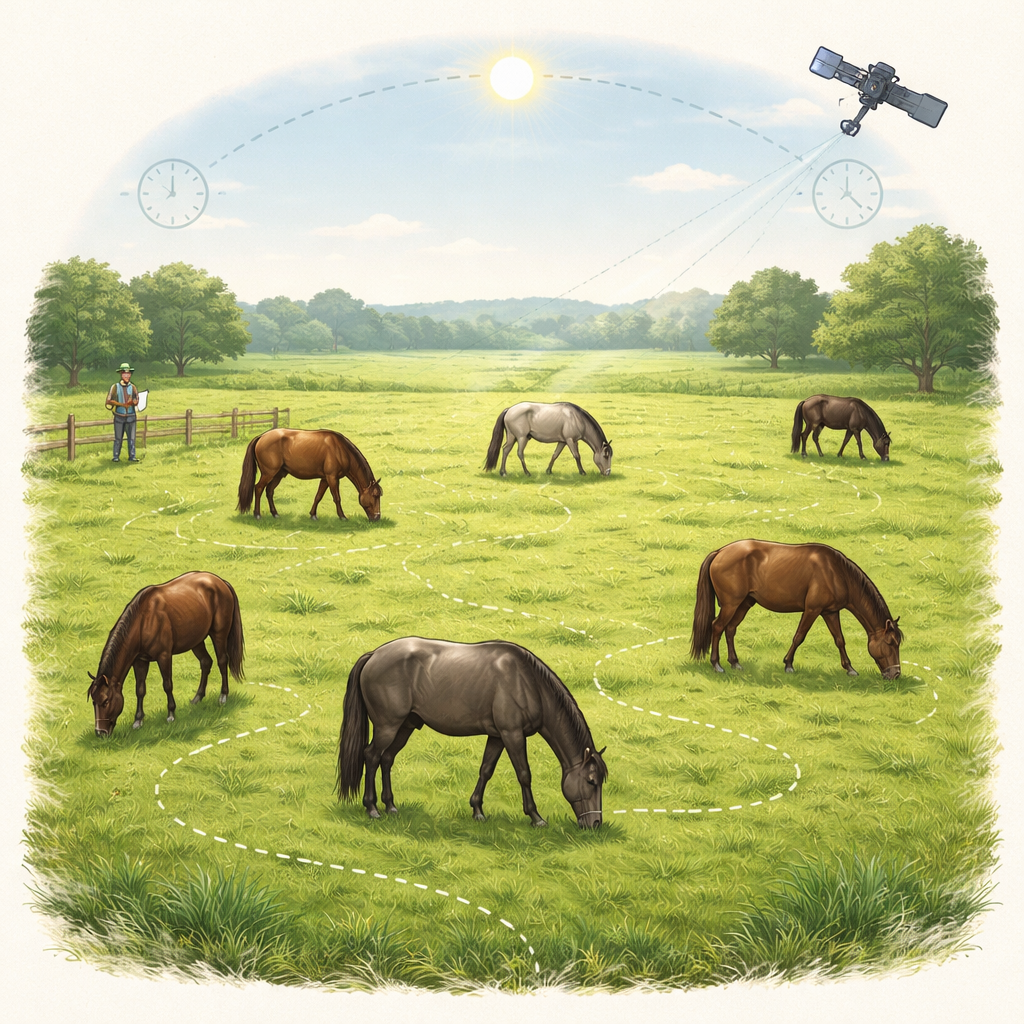
Timing the journey through the horse’s belly
To understand how quickly food moved through the gut, the scientists fitted a mathematical model to the pattern of C36 excretion for the group. This yielded a mean retention time of about 17.5 hours—shorter than values reported for stabled horses fed hay. The authors suggest that near-constant, low-intensity movement on pasture speeds up the passage of food compared with life in a box stall. At the same time, they found that trying to model each horse individually with limited samples led to unstable results, underlining that this method currently works best at the group level rather than as a precise tool for single-animal diagnostics.
How much they ate and how well they used it
Using the external marker C36 together with different natural plant alkanes, the team calculated how much organic matter the horses consumed and how much they digested. Depending on the marker chosen, intake ranged from about 1.5 to 3.1 percent of body weight per day on a dry matter basis—figures that align well with earlier pasture studies. Digestibility values, a measure of how much of the feed is broken down and absorbed, fell between 45 and 68 percent for organic matter. Results based on one particular plant marker, C29, matched previous work most closely, suggesting it gives the most reliable estimates under these conditions. The mares maintained body weight and condition, indicating that the pasture supplied enough energy and protein despite being relatively mature grass.
Tracking how much horses like to roam
Because movement can influence digestion, the researchers also monitored how far the horses walked using GPS devices attached during daylight hours. Even on a modest 0.5-hectare field, individuals covered on average around 1.3 to 2.0 kilometers per hour of recorded time, with some hourly distances as low as 90 meters and as high as 4.6 kilometers. The horses spent almost all monitored time slowly grazing and walking, with no strong peaks at specific hours but noticeable day-to-day variation. Compared with some earlier reports from more confined or intermittently grazed horses, these distances were substantial, supporting the idea that continuous turnout encourages steady, purposeful locomotion as part of foraging. 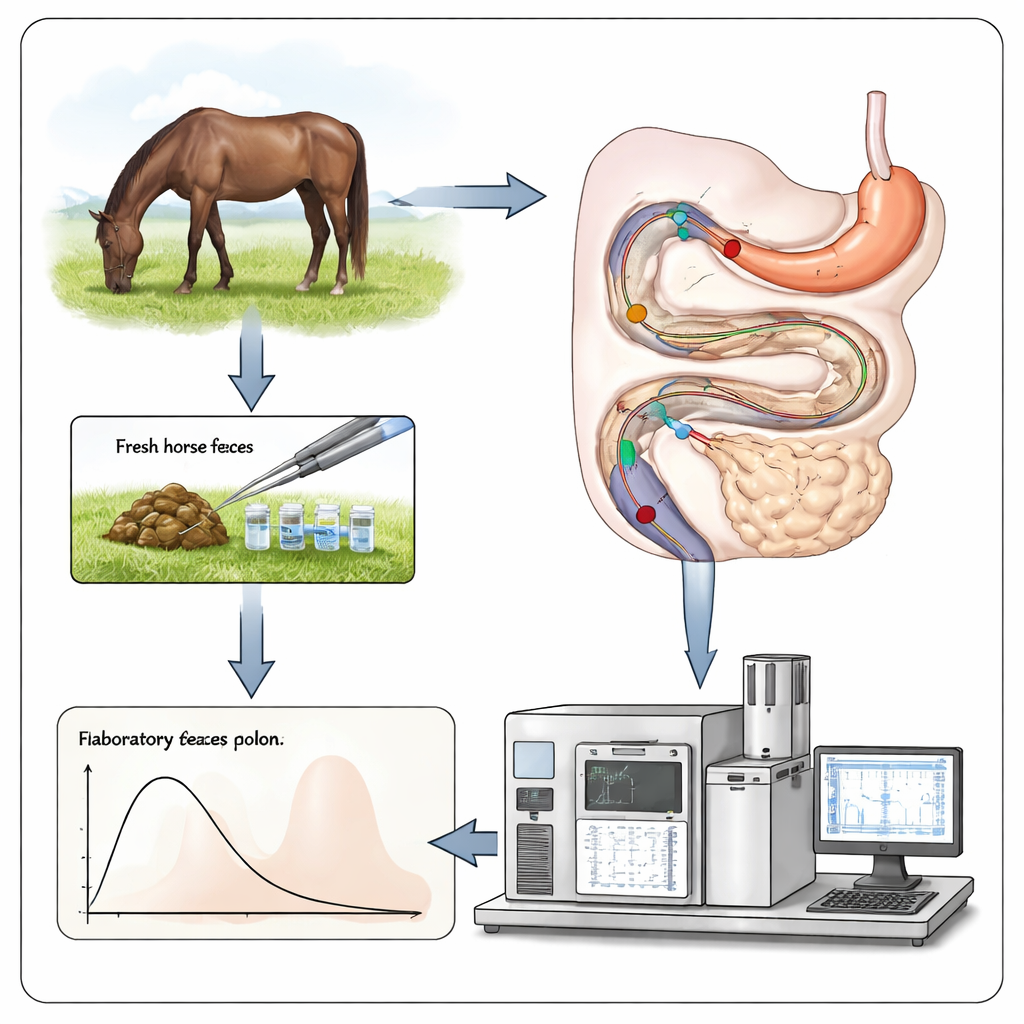
What this means for everyday horse care
This preliminary study shows that combining chemical markers with mathematical models and GPS tracking can offer a realistic picture of how much free-grazing horses eat, how well they digest pasture and how their natural roaming patterns tie into gut function. While the technique still has limitations—especially for estimating intake in individual animals—it supports the view that round-the-clock group grazing allows calm, continuous foraging and plenty of gentle movement, which likely suits the horse’s biology and behavior. For owners and managers, the message is that pasture access should, where possible, allow horses to move and browse freely, while recognizing that rich grass can oversupply energy and that careful monitoring or supplementation may still be needed to balance the diet.
Citation: Bachmann, M., Bochnia, M., Wensch-Dorendorf, M. et al. Feed intake, digestibility and passage kinetics in grazing horses. Sci Rep 16, 3052 (2026). https://doi.org/10.1038/s41598-026-35647-7
Keywords: grazing horses, pasture intake, digestibility, equine welfare, GPS tracking