Clear Sky Science · en
Real-world evidence from 50,000 online participants using MoCA-XpressO for cognitive prescreening
Why Your Memory Appointments May Soon Start Online
As populations age and concern about memory problems grows, clinics are struggling to keep up. This study looks at a short, self-guided online test called XpressO, designed to flag people who might be developing mild cognitive problems, including very early Alzheimer’s disease. By analyzing results from more than 50,000 people who took the test on their own phones or computers, the researchers show how age, education, and sex shape scores—and what that means for getting timely care.

A Five-Minute Brain Check at Home
XpressO is a digital follow-up to the widely used Montreal Cognitive Assessment, a paper-and-pencil screening test for thinking and memory. Instead of visiting a clinic, users open an app or website and complete a brief series of tasks: placing objects, figuring out simple logical sequences, and recalling items after a delay. The program turns performance into a score from 0 to 100 that estimates whether someone would likely fall above or below the usual cut-off for mild cognitive impairment on the clinic test. Low scores suggest possible problems; high scores suggest typical performance for that person’s age group.
Who Chose to Test Their Memory
Between early 2024 and March 2025, over 56,000 people enrolled themselves to try XpressO; after quality checks, 52,147 participants were analyzed. Most used a web browser rather than the mobile app, and a majority completed the test in French or English from North America. Compared with the general populations of the United States and Canada, this group was older, more often female, and more highly educated—exactly the types of people who tend to be especially worried about their brain health. About 19% of users scored in the low range, 21% in the middle, and 60% in the high range, indicating that many participants likely had normal cognition, but a sizeable fraction might warrant closer evaluation.
Age, Schooling, and Sex Shape Risk
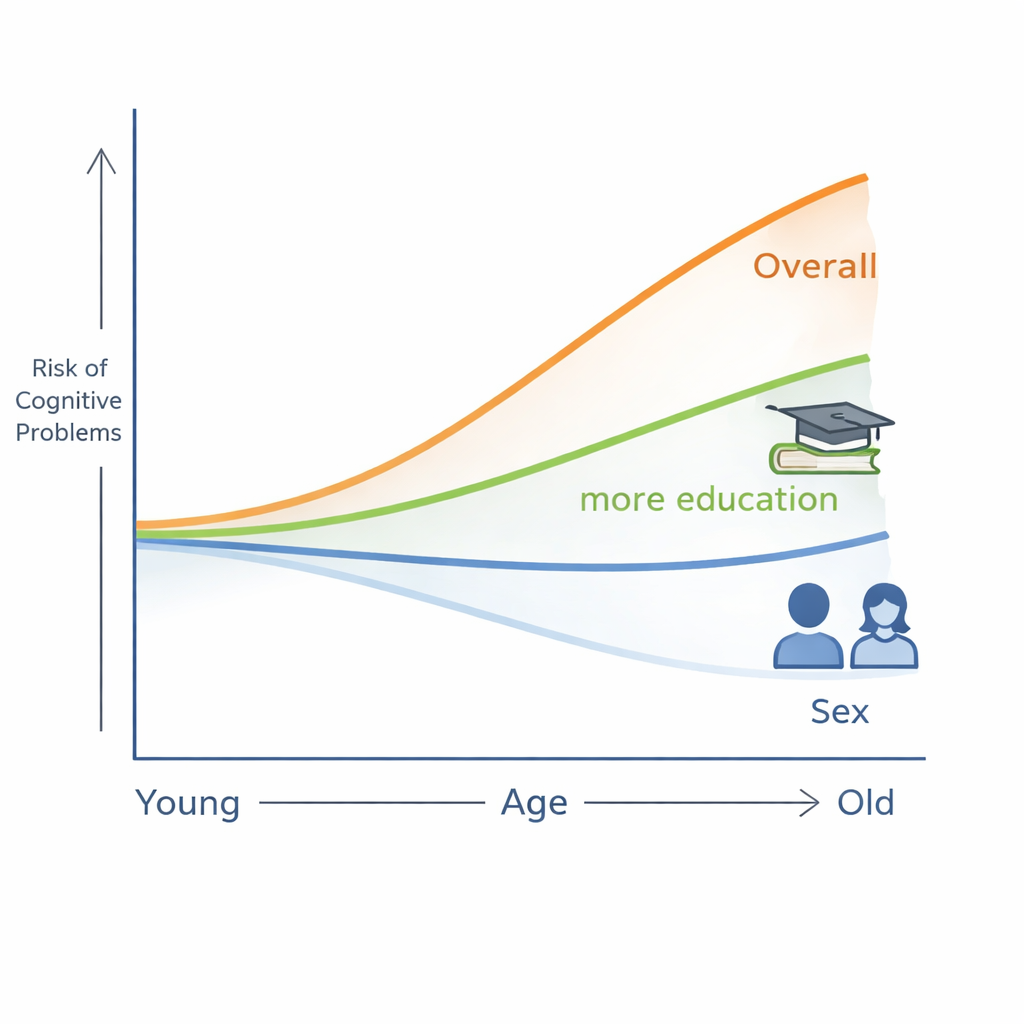
The researchers focused on how three everyday characteristics—age, years of education, and sex—were tied to low XpressO scores. As expected, older adults were more likely to land in the low-score group, with the share of concerning results roughly doubling each decade after 60. Education worked in the opposite direction: more years of schooling were strongly linked to better scores and lower odds of screening positive. When the team translated their statistical models into relative risks, each additional year of age raised the chance of a positive prescreening result by about half a percentage point, while each extra year of education reduced that risk by about one percentage point. Women, on average, had a modestly lower chance of screening positive than men of the same age and education level.
A Complex Mix of Influences
Beyond simple averages, the study showed that these three factors interact in subtle ways. The protective effect of education was stronger at older ages, meaning that additional schooling could partly offset the risk associated with getting older. Women tended to do better than men at the same education level, and this advantage appeared to grow with more years of schooling. At the same time, the researchers checked whether test language (French vs. English) and device type (phone app vs. web browser) might distort scores. When they accounted for age, sex, and education, most of the apparent differences between platforms and languages shrank, suggesting that who takes the test matters more than how they access it.
Why Adjusting for Demographics Is Not Always Better
One might assume that correcting scores for age, education, and sex would make the test fairer and more accurate. To test this, the team used the large online sample to build “demographically adjusted” versions of the score and then evaluated them in a smaller clinic group of 101 people whose diagnoses were confirmed using the traditional paper test. Surprisingly, both adjusted versions were slightly worse at telling apart people with and without cognitive impairment. The standard, unadjusted XpressO score showed better overall discriminative power, even though demographic corrections did help explain away some platform and language differences.
What This Means for Patients and Doctors
For a lay reader, the bottom line is that a brief, self-guided online test can meaningfully help sort out who might need a full memory workup, especially at a time when potential disease-modifying treatments for Alzheimer’s disease make early detection more important than ever. Age, education, and sex clearly influence performance, and higher education offers noticeable protection, but trying to mathematically “correct” scores for these traits can actually blunt the test’s ability to spot trouble. Instead, tools like XpressO are best seen as an efficient first step: they can flag people at higher risk so that scarce specialist time is focused on those who most need detailed evaluation.
Citation: Huijbers, W., Wischmann, HA., Gruber, J. et al. Real-world evidence from 50,000 online participants using MoCA-XpressO for cognitive prescreening. Sci Rep 16, 5092 (2026). https://doi.org/10.1038/s41598-026-35640-0
Keywords: online cognitive screening, mild cognitive impairment, Alzheimer’s disease prescreening, digital memory tests, MoCA XpressO