Clear Sky Science · en
Changes in platelet count as a marker of myocardial iron uptake after administration of ferric carboxymaltose in patients with heart failure
Why this matters for people with weak hearts
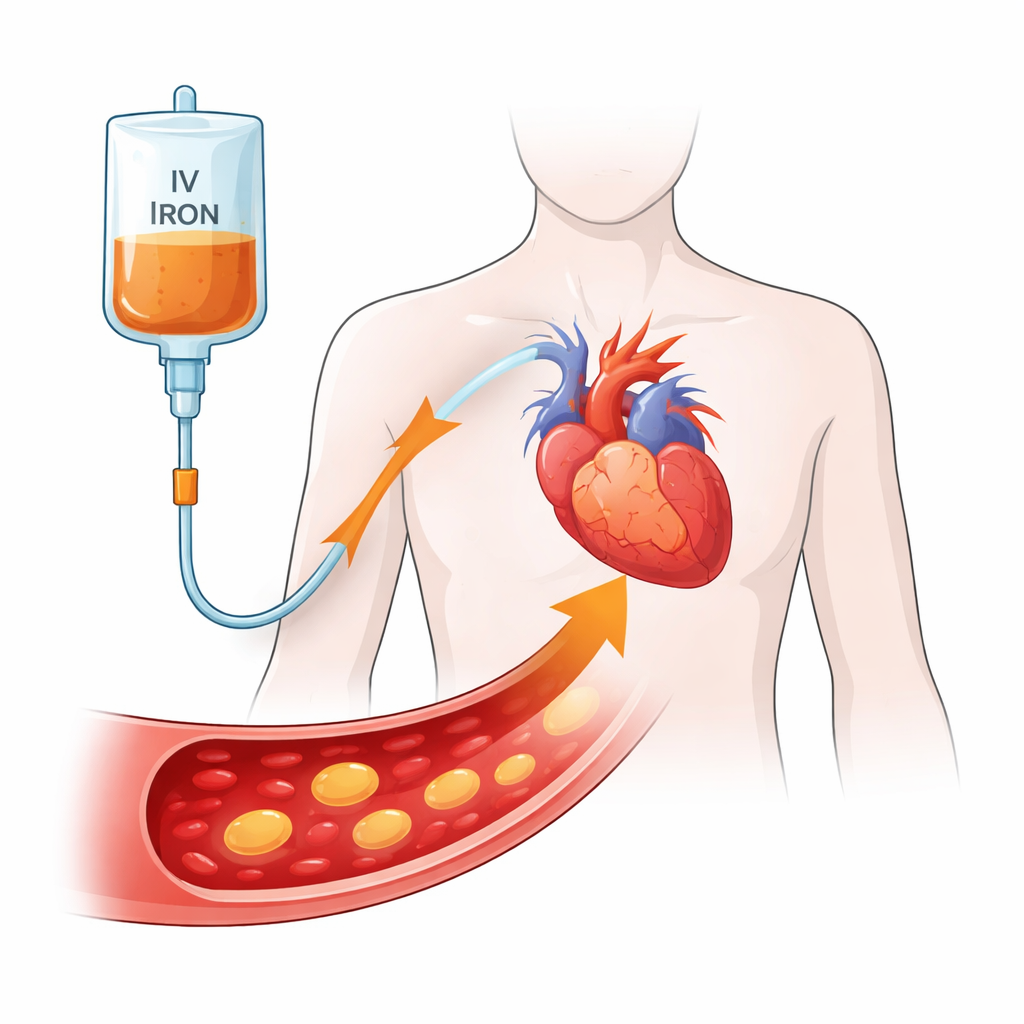
Many people living with long‑term heart failure also have low iron levels, which can sap their energy and worsen symptoms. Doctors often give iron directly into a vein to help, but they lack simple ways to check how well the heart itself is taking up that iron. This study asked an unexpected question: can a routine blood test—the platelet count—offer clues about how much iron actually reaches the heart muscle and how much the heart’s pumping improves?
Iron, blood cells, and the struggling heart
Iron deficiency is common in heart failure and is linked to poorer quality of life, more hospital visits, and a higher risk of death. Intravenous iron, especially a form called ferric carboxymaltose, has been shown to improve symptoms and exercise capacity. Yet current tests focus mostly on iron in the blood, not in the heart muscle itself. The authors used advanced heart scans to look inside the heart and then checked whether simple blood counts could mirror what these expensive scans were seeing. They focused on platelets, tiny blood fragments that help with clotting and often rise when iron is low.
How the study was done
The researchers re‑analyzed data from a previous randomized trial called Myocardial‑IRON. Forty‑five outpatients with chronic heart failure, reduced pumping function, and iron deficiency were randomly assigned to receive either ferric carboxymaltose or a salt‑water placebo. All were clinically stable and on standard heart‑failure medications. At the start, and then again 7 and 30 days later, doctors measured platelet counts from routine blood samples and used cardiac magnetic resonance imaging to assess two features: a measure called native T1, which reflects how much iron has entered heart muscle, and a measure of how well the left ventricle squeezes, known as global longitudinal strain.
What happened to platelets and the heart
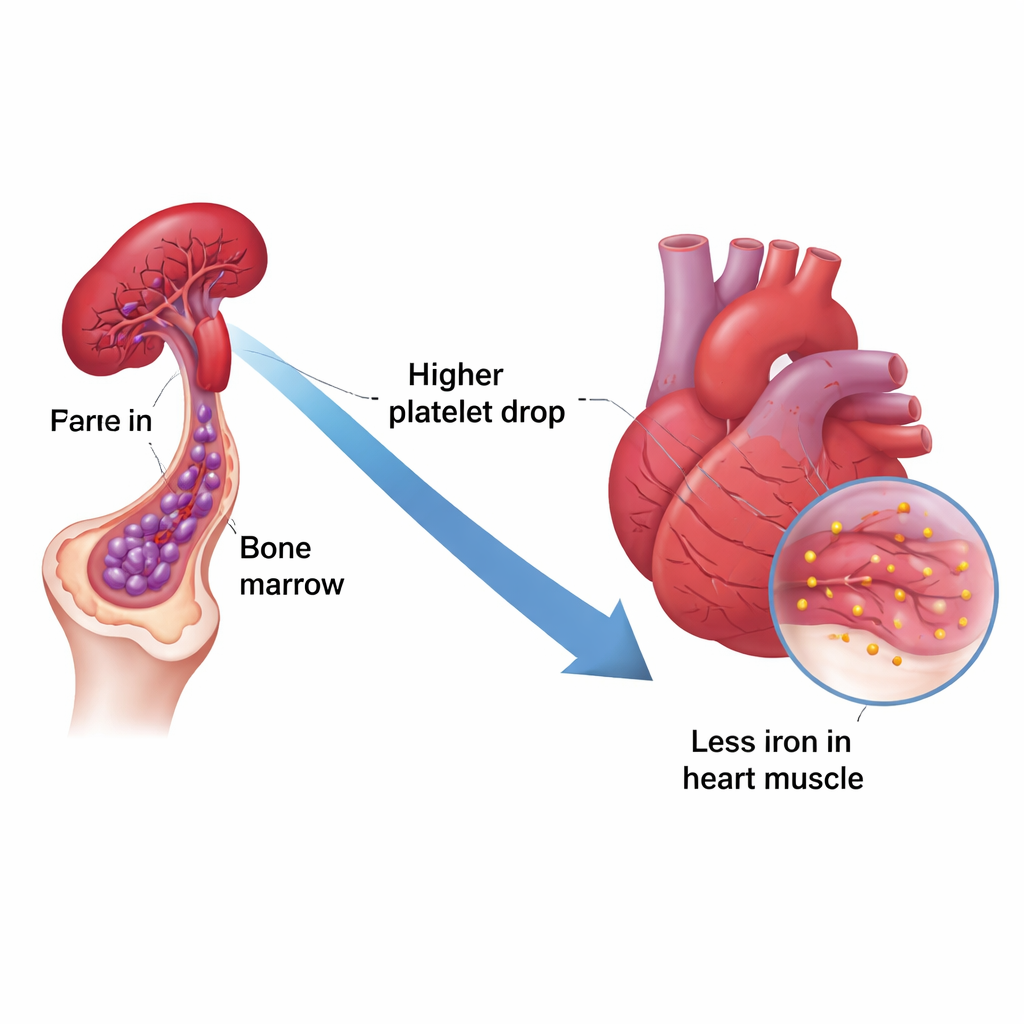
By 30 days, patients who received intravenous iron had a clear drop in platelet counts, while those who received placebo did not show meaningful changes. This confirmed earlier findings in other diseases that iron therapy tends to lower platelet numbers. But the most surprising result was how that drop related to the heart. Among patients receiving ferric carboxymaltose, those with the largest fall in platelets actually showed less favorable changes in the heart scans: their T1 values suggested less iron had reached the heart muscle, and their pumping function improved less. In contrast, no such links were seen in the placebo group.
What might be happening inside the body
The authors suggest that iron does not spread evenly through the body after an infusion. When iron stores are refilled, the body may shift blood‑forming stem cells away from making platelets and back toward making red blood cells, which could lower platelet counts. Intravenous iron is also taken up by organs such as the liver and spleen, where immune cells can clear platelets from the circulation. The study raises the possibility that, in some patients, stronger uptake of iron by the spleen and bone marrow—reflected by a bigger fall in platelets—might come at the expense of iron delivery to the heart muscle, blunting the heart’s recovery.
What this means for patients and doctors
This small, short‑term study cannot prove cause and effect, and it has important limitations, including the modest number of patients and a follow‑up of only one month. Still, it hints that a simple, widely available test—the platelet count—might eventually help doctors judge how a weak heart responds to intravenous iron. A falling platelet count after treatment was not a sign of better heart health in this group; instead, it was linked to less iron in the heart and smaller gains in pumping strength. More research is needed, but the work opens the door to using everyday blood tests to better tailor iron therapy in people with heart failure.
Citation: Mollar, A., García-Conejo, C., Revuelta-López, E. et al. Changes in platelet count as a marker of myocardial iron uptake after administration of ferric carboxymaltose in patients with heart failure. Sci Rep 16, 5044 (2026). https://doi.org/10.1038/s41598-026-35632-0
Keywords: heart failure, iron deficiency, intravenous iron, platelet count, cardiac MRI